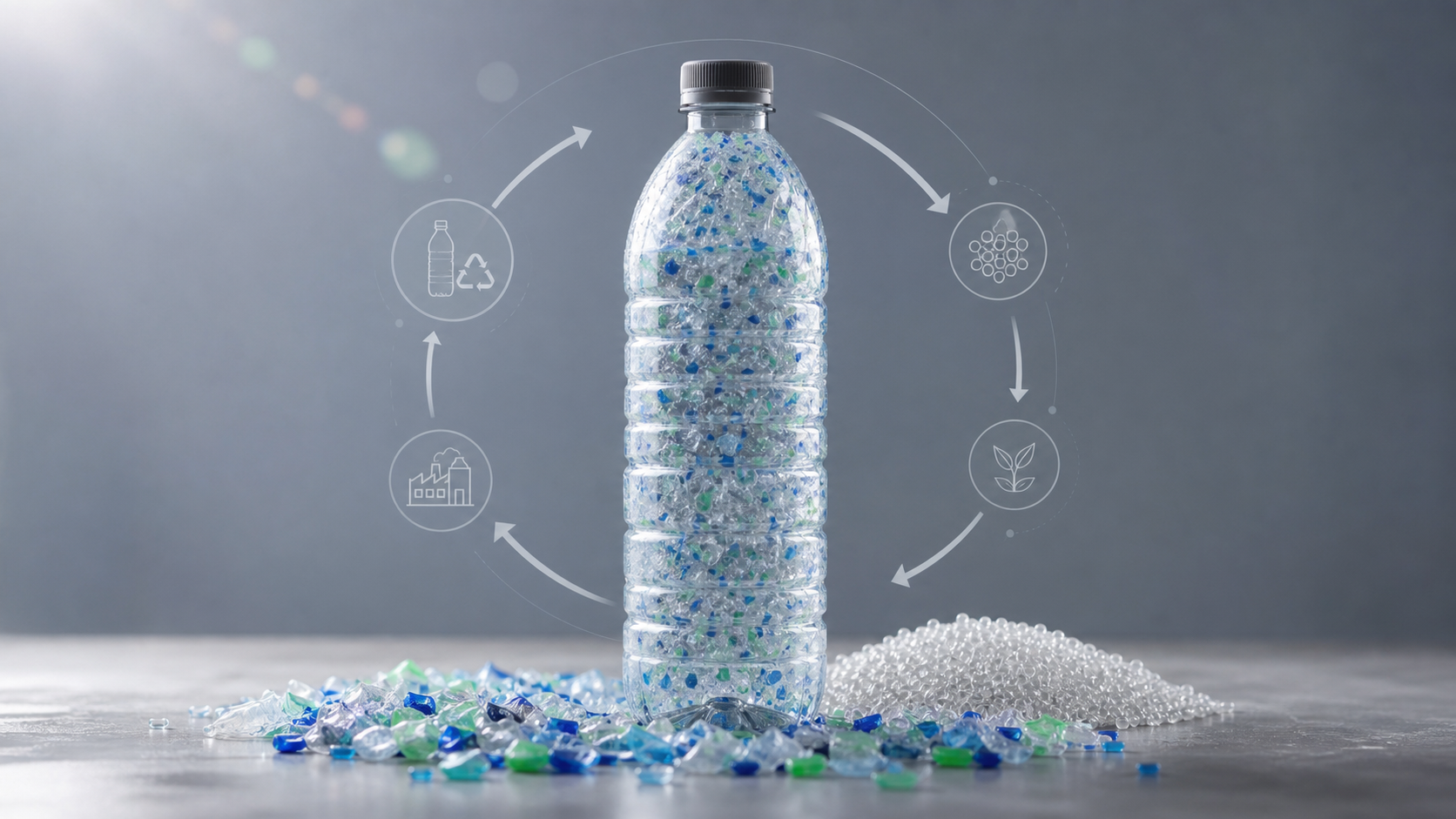
The European Union has already entered the first major compliance phase for recycled plastic in beverage bottles. Under the Single-Use Plastics Directive, PET beverage bottles must contain at least 25% recycled plastic from 2025, while the requirement rises to 30% for covered beverage bottles from 2030.
For producers, the challenge is no longer whether recycled PET, or rPET, belongs in packaging strategies. The real question is whether reliable volumes, quality grades and competitive pricing will remain available as demand grows. Chemicals and polymer buyers now need to assess recycled PET as a strategic feedstock rather than simply another packaging input.
The 25% Recycled PET Target Has Already Arrived
The 25% requirement applies to PET beverage bottles covered by the Directive and is calculated as an average across PET bottles placed on the market in each Member State. That distinction matters because producers can manage compliance across their portfolio rather than treating every individual bottle as an identical 25% formulation.
The policy has nevertheless created a structural increase in demand for food-grade recycled PET. Producers need material that meets technical specifications while also supporting documented recycled-content calculations and verification.
For procurement teams, this creates a stronger connection between regulatory planning and polymer sourcing. A bottle producer may have sufficient resin today but still face a supply gap when competitors, retailers and brand owners simultaneously increase their rPET requirements.
Why the 2030 30% Target Is More Difficult
Moving from 25% recycled content in PET bottles to 30% across covered beverage bottles changes the scale of the challenge. The 2030 target applies to beverage bottles within the Directive's scope, not only PET bottles, with the requirement calculated as an average across the relevant bottles placed on the market.
That broader requirement increases the importance of recycled-content availability across different bottle formats and material streams. Producers that rely heavily on PET today still need to evaluate how their wider packaging portfolio will perform as the deadline approaches.
The regulatory direction is also becoming more comprehensive. The EU's Packaging and Packaging Waste Regulation introduces additional recycled-content requirements for plastic packaging, adding another layer to the longer-term demand outlook for recycled polymers.
Recycling Capacity Is Becoming the Key Supply Question
The central market tension is straightforward: policy is pushing demand for recycled plastic upward while the European recycling sector faces capacity pressure. The supplied market context points to EU recycling capacity declining by roughly 4% year on year, with additional losses projected.
That creates a potentially uncomfortable situation for producers. A regulatory target can mandate demand, but it cannot automatically create enough economically viable recycling capacity.
The gap between nominal capacity and usable supply also matters. Food-contact beverage applications require appropriate quality, processing capability and compliance documentation. A recycler may have output capacity on paper, yet not every tonne will necessarily meet the specifications required by beverage packaging manufacturers.
rPET Supply Could Become a Procurement Bottleneck
For buyers, recycled PET supply involves more than securing a nominal annual quantity. Procurement teams must evaluate whether suppliers can maintain consistent quality and volume across the entire contract period.
Several factors can tighten the market:
Collection volumes: More recycled-content demand ultimately requires enough post-consumer PET entering collection systems and recycling facilities.
Food-grade processing: Beverage applications require suitable recycled material and controlled processing, which limits the pool of usable supply.
Competing buyers: Beverage producers, packaging converters and consumer brands can compete for the same recycled feedstock.
Energy and operating costs: Recycling economics depend heavily on collection, sorting, washing, processing and energy costs.
Cross-border sourcing: Importing recycled polymer can broaden the supplier base but introduces additional logistics, qualification and documentation requirements.
This makes supplier diversification increasingly important. A procurement strategy based on a single recycled PET supplier can expose producers to unexpected shutdowns, maintenance periods or regional shortages.
What the New EU Verification Rules Mean for Buyers
Compliance is moving beyond the percentage printed in a product specification. The European Commission adopted Implementing Decision (EU) 2026/1425 in June 2026, establishing updated rules for calculating, verifying and reporting recycled plastic content in single-use beverage bottles.
The rules define the relevant beverage bottle scope and identify economic operators across the supply chain, including recyclers and converters.
For procurement managers, this means supplier documentation should become part of the sourcing decision. Buyers should consider:
recycled-content calculation methodology
material traceability
supplier declarations and supporting records
food-contact suitability where required
batch consistency
country of origin and logistics documentation
ability to support regulatory reporting requirements
A low-priced rPET offer may become expensive if the supplier cannot provide the documentation required to demonstrate compliance.
Price Pressure Could Change the Economics of PET
Recycled PET pricing does not move according to virgin polymer economics alone. Collection costs, bale availability, sorting efficiency, recycling yields, energy prices and demand for food-grade material all influence the final cost.
The 2030 target could therefore create a stronger premium for reliable high-quality rPET if demand grows faster than usable supply. Buyers that wait until the final compliance window may face less negotiating power.
At the same time, weaker demand in certain packaging segments can temporarily soften recycled polymer prices. Procurement teams should therefore avoid treating rPET as a permanently rising-cost material and instead monitor the balance between feedstock availability, recycling capacity and contracted demand.
Contract structure will become increasingly important. Longer-term agreements can offer supply security, while flexible purchasing arrangements may help buyers benefit from periodic market weakness.
Collection Rates Will Determine More Than Recycling Rates
Recycling capacity cannot operate efficiently without sufficient feedstock. The SUP framework also established separate collection targets for plastic beverage bottles, reaching 77% by 2025 and 90% by 2029.
That makes collection infrastructure a critical part of the rPET supply equation. Deposit return systems, sorting infrastructure and local waste-management performance can directly influence how much usable PET reaches recyclers.
For chemical and polymer traders, this creates regional differences in sourcing opportunities. Countries with stronger collection systems may become strategically important supply locations even when their overall plastics manufacturing footprint is smaller.
Producers Need a Different Sourcing Strategy for 2030
The 2030 deadline is close enough that producers should already be translating regulatory targets into procurement plans. Waiting for market shortages to appear could leave buyers competing for material at the same time.
A stronger approach includes several actions:
Map annual rPET requirements now. Convert the regulatory percentage into actual tonnes based on expected bottle production and product mix.
Qualify multiple suppliers. Maintain alternatives across different recycling facilities and geographic markets rather than depending on one source.
Separate quality requirements by application. Not every recycled PET grade will provide the same performance or compliance characteristics.
Build documentation into supplier qualification. Regulatory evidence should form part of the commercial evaluation rather than an administrative check after purchasing.
Monitor virgin PET and rPET together. The relative economics between the two materials can influence formulation and purchasing decisions.
Review contracts before the 2030 rush. Securing dependable supply early can reduce exposure to spot-market volatility.
Is Europe Actually on Track for the 2030 Target?
The answer depends on which part of the supply chain is being measured. The regulatory framework is already established, the 25% PET target has entered its implementation period and updated calculation and verification rules are now in place.
The more difficult question concerns the availability of suitable recycled material at commercially workable prices. If recycling capacity continues to contract while mandatory demand increases, producers may face a widening gap between regulatory expectations and easily accessible supply.
There is also an important distinction between technical compliance and procurement resilience. A market can technically contain enough recycled material to satisfy an aggregate target while individual producers still struggle to secure the right grade, volume or delivery schedule.
That is why the strongest indicator for procurement teams may not be the headline recycling percentage. It may be the availability of contracted, verified and application-ready rPET.
The Bottom Line for Polymer Buyers
The EU's recycled-content policy has transformed recycled PET from a sustainability option into a core procurement consideration. The 25% PET requirement is already active, while the 30% target for covered beverage bottles in 2030 raises the stakes for producers and their suppliers.
The market challenge is now shifting from policy ambition to execution. Producers need dependable recycled feedstock, recyclers need sufficient collection volumes and traders need to connect buyers with suppliers that can provide consistent material and appropriate documentation.
For procurement teams, the safest strategy is to treat 2030 as a sourcing deadline rather than a distant regulatory milestone. Early supplier qualification, diversified sourcing and disciplined monitoring of rPET availability can help reduce exposure as competition for compliant recycled polymer intensifies. Ready to source Polyethylene Terephthalate (PET) from verified global suppliers? Explore competitive offers on our platform today.