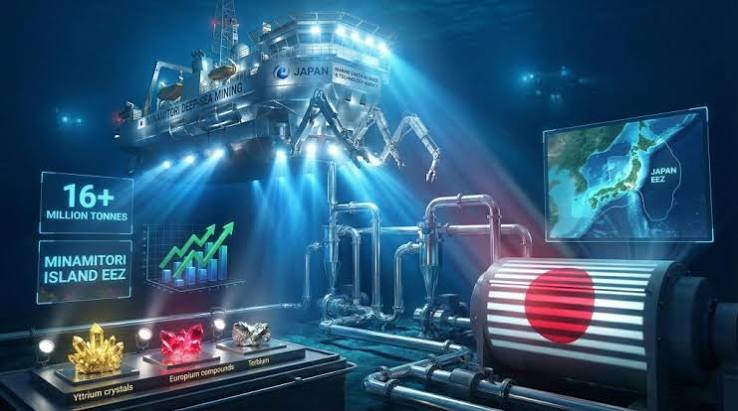
Japan's rare earth diversification strategy stands apart from most international efforts because it is targeting resources located beneath the seafloor rather than relying exclusively on conventional terrestrial mines. In January 2026, Japan successfully retrieved rare earth mud from approximately 6,000 meters below sea level near Minamitorishima Island, demonstrating that deep-sea extraction is technically possible at the research stage. The Japanese government has described the achievement as significant for economic security, while emphasizing that commercial development still requires verification of the complete mining, separation and refining chain and its economic feasibility.
Why Minamitorishima Matters
The Minamitorishima project targets rare earth-rich mud located within Japan's exclusive economic zone. Japan's research program is designed not only to test extraction but ultimately to develop a continuous system covering mining, dredging, refining and productization. That integrated objective gives the project strategic importance because success could create a domestic resource base that is less exposed to geopolitical disruptions affecting imported rare earth supplies.
The major limitation is depth. Extracting material from around 6,000 meters underwater is substantially more technically demanding than conventional terrestrial mining. Japan therefore has to demonstrate that the resource can be recovered continuously, transported to the surface and processed at competitive cost before the project can be considered a genuine commercial alternative.
Japan vs. the United States: Technology and Conventional Supply
The United States is pursuing a more diversified portfolio. Rather than relying on one unconventional resource, Washington has been supporting domestic mining, processing, stockpiling and international partnerships. Japan and the U.S. are also increasingly cooperating directly: in March 2026, the two governments signed a memorandum establishing a working group on deep-sea mineral development, including potential cooperation around Japan's Minamitorishima rare earth project.
That makes the two strategies potentially complementary. Japan contributes expertise in deep-sea resource development, while the United States brings substantial interest in accelerating commercial mineral development and building alternative supply chains.
Australia Provides a More Mature Mining Model
Australia's approach is considerably closer to conventional commercial production. Lynas Rare Earths is expanding its global supply chain and pursuing new resources while also supporting the development of rare-earth magnet manufacturing in the United States. Its strategy illustrates the advantage of working with resources that can be developed through established mining and processing infrastructure rather than creating an entirely new deep-ocean extraction industry.
For near-term supply diversification, Australia therefore ranks ahead of Japan in commercial readiness. Japan's deep-sea resources may ultimately prove strategically valuable, but the technology and economics remain under development.
Brazil Is Emerging as Another Diversification Hub
Brazil is also attracting increasing international attention because of its large rare earth resource base. U.S., Australian and other foreign-backed companies are increasing exploration activity, while Brazil is simultaneously considering policies designed to encourage domestic processing and retain more of the economic value inside the country.
Brazil's advantage is geological and terrestrial: it can potentially provide new supply without the extreme engineering requirements associated with 6,000-meter-deep ocean extraction. Its challenge is building the necessary processing capacity while managing environmental, land-use and community concerns.
Europe's Strategy Focuses on Diversification Rather Than One Mega-Project
The European approach is broader still. Instead of depending on a single flagship mine or resource discovery, European policymakers are attempting to strengthen critical-mineral resilience through domestic projects, overseas partnerships, recycling and alternative supply arrangements. The objective is to reduce exposure to China's dominant position across the rare-earth value chain.
This distinction matters because mining is only one part of rare-earth security. Separation, refining, alloy production and permanent-magnet manufacturing can create additional points of dependency even when raw ore comes from outside China.
China Remains the Benchmark Everyone Is Trying to Challenge
The scale of the diversification challenge is illustrated by China's continued dominance of the industry. China remains the world's leading rare-earth producer and processor and has demonstrated that export controls can be used as a strategic economic tool. Recent restrictions have affected supplies to major industrial economies, reinforcing the incentive for Japan, the U.S., Europe, Australia and Brazil to develop alternative sources.
This means that simply discovering a new deposit is not enough. Successful diversification requires an end-to-end supply chain capable of taking rare earths from resource to separated material and ultimately into high-value products such as permanent magnets.
How the Strategies Rank
Japan's Minamitorishima project ranks highly for strategic originality and potential resource security, but lower for current commercial readiness because the full extraction-to-refining chain and economics still need to be demonstrated.
Australia currently has an advantage in commercial maturity, while the United States benefits from its combination of domestic investment and international partnerships. Brazil offers substantial terrestrial resource potential, and Europe's strength lies in pursuing multiple diversification mechanisms rather than relying on one source.
The strongest long-term strategy may therefore be a combination of these approaches: conventional mining for near-term supply, new processing capacity to break China's refining bottleneck, recycling to reduce primary-material requirements and unconventional resources such as Japan's deep-sea deposits as a longer-term strategic reserve.
The Intelligence Takeaway
Japan's deep-sea rare earth project should not yet be viewed as a replacement for conventional mining. Its importance is that it represents a completely different supply-security option. If Japan can demonstrate economically viable extraction, separation and refining from Minamitorishima, it could transform a currently experimental resource into a strategic domestic supply source.
For now, Japan ranks among the most technologically ambitious diversification efforts, while Australia and other terrestrial producers remain better positioned for near-term commercial supply. The broader lesson is that reducing Chinese dependence will require multiple parallel strategies rather than a single substitute source.