
Chemical Industry Employment Flatlines in 2026: What 545000 US Jobs and Rising Capital Intensity Signal
The U.S. chemical industry is entering a period where production, investment, and employment are moving at different speeds.
According to the American Chemistry Council's (ACC) Mid-Year 2026 Outlook, chemical-industry employment continued to ease in 2025 and is expected to remain essentially flat through 2026 and 2027. The industry employs approximately 545,000 workers, whose average pay reached about $108,000 in 2025, significantly above the broader manufacturing average.
At the same time, chemical companies continue investing in new manufacturing capacity, automation, advanced materials, and infrastructure. The result is an increasingly capital-intensive industry in which future production growth may not require proportional growth in headcount.
What Flat Employment Signals
Stable employment does not necessarily indicate a stagnant chemical industry.
ACC expects U.S. chemical production volumes to increase 0.5% in 2026 and accelerate to 1.5% in 2027. Basic chemicals, agricultural chemicals, exports, and technology-linked specialty chemicals are expected to support parts of this recovery.
The fact that employment remains flat while production gradually improves suggests that companies may be relying increasingly on:
Automation
Higher plant productivity
Process optimization
Digital manufacturing systems
Larger and more efficient facilities
Capital-intensive production technologies
In other words, the industry can potentially produce more chemistry without adding large numbers of workers.
Capital Spending Tells a Different Story
ACC expects chemical-industry capital spending to rise only 0.9% in 2026, following 1.3% growth in 2025. However, capital expenditures are expected to accelerate to approximately 3–4% annually from 2027 onward.
This creates an important contrast:
Employment → Flat
Capital Investment → Increasing
Production → Gradually Recovering
The pattern points toward a chemical industry increasingly dependent on productivity and capital efficiency rather than workforce expansion.
Why Capital Intensity Is Increasing
Several structural changes are encouraging chemical producers to invest more heavily in technology and equipment.
Automation
Automated process controls, robotics, and digital monitoring can increase output while reducing dependence on incremental labor.
Advanced Manufacturing
New facilities increasingly require sophisticated equipment and process technology rather than simply larger workforces.
Energy Efficiency
Investment in efficient production systems can reduce energy consumption and improve competitiveness.
New Materials
Growth in semiconductors, data centers, advanced manufacturing, and other technology markets is creating demand for higher-performance chemical products.
Capacity Consolidation
Larger and more efficient facilities can replace older or less competitive production assets, changing the relationship between capacity and employment.
A High-Value Workforce
The flat employment trend should not be interpreted as declining importance of workers.
ACC notes that the approximately 545,000 chemical-industry workers earn significantly more than the manufacturing average, with average pay around $108,000 in 2025.
This reflects the technical requirements of modern chemical manufacturing.
Chemical facilities depend on workers with expertise in:
Process engineering
Plant operations
Maintenance
Safety
Automation
Quality control
Research and development
Environmental compliance
As plants become more automated, the skill mix may become more important even if total employment remains stable.
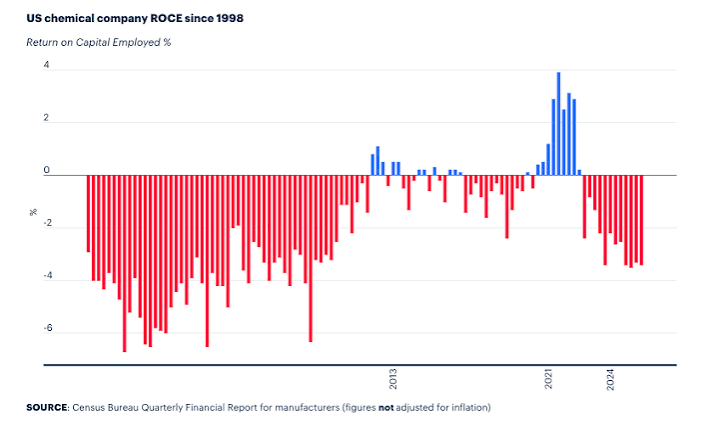
The Global Industry Is Also Under Pressure
The employment trend is occurring against a difficult global chemical backdrop.
S&P Global's 2026 World Petrochemical Conference highlighted oversupply, shifting cost dynamics, supply rationalization, changing feedstock economics, geopolitical uncertainty, and restructuring as major issues facing the chemical industry.
These pressures can encourage companies to focus on productivity rather than workforce expansion.
Where producers face excess capacity or weak margins, investment may increasingly target cost reduction, asset efficiency, automation, and portfolio optimization instead of additional labor.
Competitive Intelligence
Chemical companies and procurement teams should monitor employment alongside other industrial indicators.
1. Capital Spending
Increasing investment can signal future capacity additions even when employment remains flat.
2. Productivity
Higher output per worker can reveal whether automation and process improvements are generating efficiency gains.
3. Plant Capacity
New or expanded facilities may have significantly different labor requirements from older plants.
4. Workforce Skills
Stable headcount does not mean stable skill requirements. Automation can increase demand for highly specialized technical workers.
5. Industry Consolidation
Mergers, closures, and asset rationalization can change regional employment and supply availability simultaneously.
Procurement Implications
For chemical buyers, a capital-intensive industry can have important supply-chain implications.
Procurement teams should:
Monitor new capacity announcements
Track plant closures and consolidation
Evaluate supplier automation and reliability
Monitor regional production economics
Diversify critical chemical suppliers
Assess long-term capacity availability
Consider the impact of labor shortages on maintenance and operations
A supplier with modern, highly automated facilities may have different cost and reliability characteristics from an older labor-intensive producer.
Looking Ahead
The U.S. chemical industry's employment outlook highlights a broader transformation in manufacturing.
With employment expected to remain essentially flat in 2026 and 2027, while capital spending is expected to accelerate from 2027 onward, future growth is likely to depend increasingly on productivity, automation, advanced technology, and capital efficiency.
This could make the U.S. chemical industry more productive without creating a proportionate increase in jobs.
For chemical producers, the strategic challenge will be balancing investment in advanced capacity with workforce development and operational expertise. For buyers, understanding how capital intensity changes supplier capacity and competitiveness will become increasingly important when evaluating long-term sourcing strategies.
Key Takeaways
U.S. chemical-industry employment is expected to remain essentially flat in 2026 and 2027.
The industry employs approximately 545,000 workers.
Average chemical-industry pay reached about $108,000 in 2025.
Chemical production is expected to recover gradually despite stable employment.
Capital spending is forecast to increase 0.9% in 2026 and accelerate to 3–4% annually from 2027.
Automation and productivity are becoming increasingly important drivers of chemical manufacturing growth.
Procurement teams should evaluate supplier capacity, technology, workforce capability, and investment trends together.
Sources
https://www.americanchemistry.com/chemistry-in-america-industry-innovation-impact/news-trends/blog-post/2026/mid-year-2026-outlook-a-pivotal-moment-for-american-chemistry · https://press.spglobal.com/2026-03-05-41st-World-Petrochemical-Conference-to-Tackle-Chemical-Industry-Challenges-in-an-Era-of-Disruption?asPDF=1 · https://www.soci.org/chemistry-and-industry/cni-data/2026/1/chemistry-in-2026-navigating-the-year-of-uncertainty

Polyvinyl Alcohol - China
Found this useful?