
Intelligence Check: How Many States Have Pending PFAS Litigation Against DuPont?
DuPont's PFAS litigation footprint continues to evolve across the United States, making the number of states involved an important intelligence question for chemical industry risk teams.
The picture is more complicated than simply counting every state that has ever filed a PFAS case. Some claims have been settled, others remain active and several state attorney general actions have proceeded through broader federal multidistrict litigation.
The 2026 landscape is particularly significant because California has added a novel fraudulent-transfer theory to its existing PFAS litigation. California's August 2026 amended complaint alleges that DuPont-related corporate restructuring and asset transfers were designed to evade PFAS liabilities.
California Is the Most Distinctive Current Case
California's litigation stands out because it goes beyond conventional contamination claims.
The state's Second Amended Complaint alleges that transactions involving DuPont, Corteva, Chemours and Qnity violated fraudulent-transfer and voidable-transaction laws. The state says the restructuring was intended to hinder recovery for PFAS claims and liabilities.
This makes California important not simply because it represents another state pursuing DuPont, but because its legal theory could influence how other jurisdictions approach corporate restructuring involving legacy environmental liabilities.
New York Adds a Fresh State-Level Action
New York also remains part of the active PFAS litigation picture.
In July 2026, New York Attorney General Letitia James sued DuPont, Chemours, Corteva, EIDP and 3M, alleging that the companies contributed to PFAS pollution through consumer products.
That action is distinct from an earlier New York case involving alleged PFOA contamination near Hoosick Falls. Corporate filings also identify that earlier property-damage case as still pending against DuPont and other defendants.
This makes New York a particularly important state to include when tracking DuPont's active PFAS exposure.
New Jersey Has Both Resolved and Continuing Claims
New Jersey represents one of the most significant resolved components of DuPont's PFAS exposure.
The state settlement involving DuPont, Chemours and Corteva includes $875 million in aggregate cash payments, payable over 25 years. The settlement received federal court approval in August 2026.
However, a settlement with the state does not mean every PFAS-related claim involving DuPont in New Jersey has disappeared.
Current corporate disclosures describe additional individual personal-injury and wrongful-death litigation involving PFAS exposure near DuPont and Solvay facilities.
For intelligence purposes, New Jersey should therefore be classified as a mixed jurisdiction, containing major resolved state claims alongside continuing litigation.
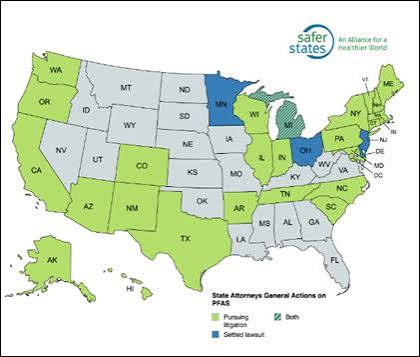
The National MDL Makes State Counting Difficult
One reason the question "How many states?" is difficult to answer is the structure of PFAS litigation itself.
State attorney general cases have been consolidated or coordinated in the federal AFFF multidistrict litigation framework.
A corporate filing lists state attorney general actions pending in the AFFF MDL on behalf of numerous states, including Alaska, Arizona, Arkansas, California, Connecticut, Delaware, Florida, Hawaii, Illinois, Indiana, Kentucky, Maine, Maryland, Massachusetts, Michigan, Mississippi, New Hampshire, New Jersey, New Mexico, New York, North Carolina, Ohio, Oklahoma, Oregon, Pennsylvania, Rhode Island, South Carolina, Tennessee, Texas, Vermont, Washington and Wisconsin.
However, that list should not automatically be treated as a list of states with separate, currently active DuPont-only lawsuits.
The MDL contains cases involving multiple PFAS defendants, including DuPont/Chemours and other manufacturers.
That distinction is critical for accurate intelligence.
A Better Way to Count the Litigation Footprint
For procurement and chemical risk teams, a three-category system is more useful than a single state count.
1. Active DuPont-specific litigation
This category includes states where current claims specifically identify DuPont or DuPont-related entities and remain unresolved.
California, New York, Ohio and portions of New Jersey's litigation fall into this category based on the current information reviewed.
2. Resolved or substantially resolved state claims
This category includes major settlements such as New Jersey's statewide agreement.
Delaware and other jurisdictions may also belong here depending on the specific claim and settlement being tracked.
3. Broader PFAS MDL participation
This is the largest category.
Many states have participated in PFAS litigation through the AFFF MDL, but that does not mean each state has an independently active DuPont case.
This distinction prevents the litigation footprint from being overstated.
Why California Changes the Intelligence Picture
California's amended complaint introduces an additional dimension to DuPont's PFAS exposure.
The state's allegations focus on corporate transactions, including transfers involving insurance rights and assets between DuPont-related companies. California argues that these transactions were designed to hinder recovery for PFAS claims.
If the theory survives procedural and substantive challenges, it could influence how other states examine chemical company spin-offs.
That makes California a potentially important precedent even before the underlying claims reach a final resolution.
New York Shows the Litigation Is Still Expanding
New York's 2026 lawsuit demonstrates that the PFAS litigation cycle has not simply moved into a settlement phase.
New state claims can continue emerging years after companies began resolving earlier contamination disputes.
For chemical manufacturers, this means historical settlement activity should not be interpreted as evidence that the broader liability landscape has stabilized.
New legal theories, new plaintiffs and new state actions can continue changing the exposure profile.

Activated Carbon (Granular) - India
Found this useful?