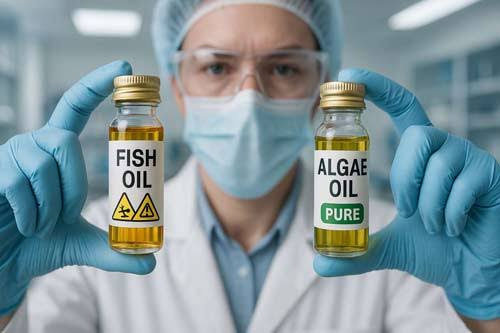
Omega-3 Sourcing Shift From Fish Oil to Algae-Based Alternatives
The omega-3 supply chain is entering a more diversified phase.
For decades, fish oil has been the dominant commercial source of EPA and DHA for supplements, functional foods and nutrition products. But growing pressure on marine resources, sustainability expectations, supply volatility and demand for vegan formulations are encouraging manufacturers to look beyond traditional fish-derived sources.
Algae-based omega-3 is emerging as the most important alternative.
The shift should not be interpreted as the disappearance of fish oil. Fish oil continues to benefit from established infrastructure, large-scale production, consumer familiarity and competitive economics. Instead, procurement is increasingly moving toward a dual-source model in which fish oil remains the volume foundation while algae becomes a strategic source for premium, plant-based and sustainability-focused applications.
Why the Omega-3 Supply Chain Is Being Reconsidered
The fundamental supply-chain challenge is that fish oil depends on marine resources.
Wild-caught forage fish remain an important source of fishmeal and fish oil, while growing aquaculture demand adds further pressure to these resources. The European Commission's 2026 assessment identifies the heavy dependence of aquaculture on wild-caught forage fish as a sustainability concern and highlights algal oil as one of the most promising alternatives.
At the same time, fish-oil availability can be affected by:
Fishing quotas
Marine ecosystem conditions
El Niño and other climate patterns
Fish-stock availability
Processing capacity
Regional logistics
Competition from aquaculture
Demand from supplements and animal nutrition
Recent industry analysis describes the omega-3 sector as facing sustained competition for constrained marine resources and increasing climate-driven supply volatility.
For buyers, this creates a new procurement question:
How much of our EPA and DHA requirement should remain dependent on marine biomass?
Fish Oil Still Dominates the Volume Market
The transition toward algae should not obscure the continuing strength of fish oil.
Current market estimates still place fish oil as the leading omega-3 source. One 2026 market assessment estimates that fish oil represented approximately 51% of the global omega-3 source segment in 2025. Dietary supplements are also expected to remain the largest application category.
Fish oil retains several important advantages:
Large production scale
Established global distribution
Competitive cost
High EPA and DHA availability
Extensive formulation experience
Strong consumer familiarity
Broad regulatory history
Multiple concentration options
This makes complete substitution difficult.
The more realistic market scenario is therefore source diversification rather than source replacement.
Why Algae Is Gaining Strategic Importance
Microalgae are particularly interesting because they are fundamentally connected to the marine omega-3 food chain.
Certain microalgal species naturally synthesize long-chain omega-3 fatty acids including DHA and EPA. Instead of obtaining these fatty acids indirectly through fish, manufacturers can cultivate the organisms under controlled production systems and extract the resulting oils.
A 2026 review identifies microalgal oils from species including Schizochytrium, Nannochloropsis and Crypthecodinium as promising alternatives to fish oil, with feeding studies showing that selected algal oils can partially or completely replace fish oil in some salmonid diets without significantly compromising key performance measures under optimized conditions.
This provides algae with an important strategic advantage:
EPA and DHA can be produced without relying directly on wild-caught fish.
Ranking the Main Omega-3 Sourcing Options
1. Fish Oil — Strongest for Scale and Cost
Fish oil remains the benchmark for high-volume omega-3 sourcing.
Its biggest advantage is infrastructure. Refiners, concentrators, supplement manufacturers and distributors already understand how to process and formulate fish-derived EPA and DHA.
For mainstream softgels and cost-sensitive products, fish oil remains difficult to displace.
However, buyers increasingly need to evaluate sustainability certification, oxidation control, contaminant testing and traceability alongside price.
2. Algae Oil — Strongest Strategic Alternative
Algae oil has the strongest position among alternative sources because it can provide DHA and, depending on the organism and process, EPA without direct dependence on fish harvesting.
The European Commission highlights several potential advantages of algal oil, including stable EPA/DHA levels, lower contamination risk and more predictable production through controlled cultivation.
Its strongest commercial applications include:
Vegan supplements
Prenatal nutrition
Infant nutrition
Plant-based foods
Premium omega-3 products
Sustainable nutrition products
DHA-focused formulations
The major limitation remains cost and production capacity.
3. Krill Oil — Premium Marine Niche
Krill oil remains relevant in premium omega-3 formulations, particularly where brands want differentiated lipid structures and phospholipid-based positioning.
However, it does not solve the fundamental marine-resource dependency issue.
It should therefore be viewed as a premium marine alternative rather than a complete sustainability solution.
4. Plant-Based ALA Sources — Different Nutritional Role
Flaxseed, chia and other plant sources can provide alpha-linolenic acid (ALA).
However, ALA is not directly equivalent to preformed EPA and DHA.
This distinction is critical for procurement teams.
A product requiring a meaningful dose of EPA or DHA cannot automatically substitute an ALA-rich ingredient and assume equivalent nutritional functionality.
Therefore:
Plant-based ≠ automatically equivalent to algae-based EPA/DHA.
DHA Is the Natural Entry Point for Algae
Algae has a particularly strong position in DHA applications.
DHA is important across:
Prenatal nutrition
Infant nutrition
Cognitive-health products
Eye-health products
General omega-3 supplements
Functional foods
Current market analysis estimates DHA accounted for roughly 45% of the omega-3 product-type segment in 2025, demonstrating the commercial importance of DHA-focused products.
This gives algae suppliers an important route into the market.
Instead of competing directly with fish oil across every omega-3 application, algae producers can concentrate on categories where DHA purity, vegan positioning and sustainability credentials have greater commercial value.
EPA Creates a More Difficult Competitive Battlefield
EPA presents a somewhat different opportunity.
Fish oil has a deeply established position in EPA-rich concentrates and cardiovascular-health products.
Algal production can provide EPA, but the economics, species selection, extraction technology and achievable concentration vary significantly.
That means buyers should not treat all algae oil as interchangeable.
A procurement specification should identify:
DHA concentration
EPA concentration
Total omega-3
DHA ratio
Oil form
Purity
Oxidation status
Stability
Source organism
The supplier's ability to consistently deliver the required EPA/DHA ratio can be as important as the total omega-3 percentage.
Sustainability Is Becoming a Supply-Chain Requirement
The strongest argument for algae is not simply that it is “plant-based.”
It is that controlled algal production can reduce direct dependence on marine fisheries.
A 2025 review described algal oil as a sustainable and vegan source of omega-3 and highlighted its potential to reduce dependence on overfished sources.
However, procurement teams should avoid assuming that every algae-based ingredient is automatically environmentally superior.
Production systems can require:
Carbon sources
Energy
Water
Fermentation infrastructure
Downstream extraction
Purification
A life-cycle assessment of heterotrophic algae-derived DHA found approximately 30–40% lower climate-change impact than fish oil for the commercial algae products studied, while also identifying sugarcane cultivation and feedstock efficiency as important drivers of the algae system's environmental footprint.
Therefore, the correct procurement question is:
“What is the measured environmental footprint of this specific algae production system?”
rather than simply:
“Is it algae?”
Controlled Production Can Improve Supply Predictability
One of algae's strongest supply-chain advantages is production control.
Fish-oil supply depends on biological resources that are affected by fishing conditions and marine ecosystems.
Algae can be cultivated in controlled systems.
The European Commission's 2026 report specifically identifies more predictable pricing and stable EPA/DHA production as potential advantages of algal oil, while noting that current production costs and capacity remain barriers.
This could become increasingly valuable as omega-3 buyers prioritize supply continuity.
For procurement teams, the comparison becomes:
Fish oil | Algae oil |
|---|---|
Dependent on marine biomass | Controlled cultivation |
Large existing supply | Smaller but expanding supply |
Lower cost | Higher current cost |
Established infrastructure | Developing infrastructure |
Broad EPA/DHA options | Strong DHA, expanding EPA |
Marine sustainability concerns | Potentially lower marine-resource dependence |
Fishing-related variability | Production-system variability |
Neither model is universally superior.
The correct choice depends on the application and purchasing objective.
Algae Could Reduce Marine Supply-Chain Concentration
A major strategic benefit of algae is diversification.
If supplement manufacturers rely entirely on fish oil, their omega-3 sourcing remains exposed to fluctuations in marine-resource availability.
Adding algae creates a second production pathway.

This is especially valuable because the omega-3 industry is simultaneously dealing with expanding demand and constrained marine resources. Recent industry analysis argues that reliance on a single EPA/DHA source is increasingly difficult to sustain as climate and resource pressures intensify.
For procurement, even a relatively small algae allocation can therefore have strategic value.
A company does not need to replace 50% of its fish oil immediately.
It could begin by allocating algae to selected premium product lines while maintaining fish oil for mainstream products.
The Emerging Dual-Sourcing Model
A practical procurement strategy could look like:
Mainstream products → Fish oil
Premium sustainable products → Algae oil
Vegan products → Algae oil
DHA-focused products → Algae oil
Cost-sensitive EPA/DHA products → Fish oil
Supply-risk management → Dual sourcing
This approach avoids forcing every product into one sourcing model.
It also allows manufacturers to test consumer acceptance and production economics before making larger changes.
Cost Remains the Biggest Barrier
Algae's sustainability advantage comes with a cost challenge.
The European Commission explicitly identifies higher costs and insufficient production capacity as key barriers to wider adoption of algal oil.
For a commodity-oriented supplement, this can be difficult to justify.
But cost comparisons become more favorable in premium products where consumers are willing to pay for:
Vegan certification
Sustainable sourcing
Traceability
High DHA concentration
Cleaner origin
Marine-resource independence
The relevant metric is therefore not simply:
$/kg of oil
It is:
$/gram of EPA/DHA + sustainability value + formulation value
Concentration Is Becoming More Important
Omega-3 buyers are increasingly interested in concentrates rather than low-potency oils.
Higher EPA/DHA concentration can reduce:
Capsule count
Serving size
Oil volume
Shipping weight
Storage requirements
The omega-3 concentrates market is estimated at approximately $3.31 billion in 2026 and is forecast to reach $6.33 billion by 2036, according to current market estimates.
This creates an opportunity for algae suppliers.
If algal producers can increase concentration while controlling production cost, algae can compete not only on sustainability but also on functional efficiency.
The Supplier Selection Criteria Are Changing
Traditional fish-oil procurement often emphasizes:
EPA/DHA concentration
Oxidation
Heavy metals
Price
Origin
Certification
The emerging algae category requires additional questions.
Buyers should evaluate:
Species or production organism
DHA concentration
EPA concentration
DHA/EPA ratio
Cultivation method
Feedstock source
Energy profile
Carbon footprint
Oxidative stability
Contaminant profile
Traceability
Vegan status
Non-GMO status where relevant
Regulatory documentation
Production capacity
Expansion plans
Minimum order quantity
Cost per effective EPA/DHA dose
This is turning algae from a niche ingredient into a more sophisticated procurement category.
The Sustainability Claim Needs Evidence
“Algae-based” is not enough to establish a superior environmental profile.
A sophisticated buyer should request evidence such as:
Life-cycle assessment
Carbon-footprint data
Energy source
Feedstock origin
Water-use information
Waste-management practices
Land-use implications
Production efficiency
The 2026 literature on microalgal biorefineries highlights an especially interesting future direction: integrated systems can recover omega-3-rich oils alongside pigments, proteins and other co-products, improving overall resource utilization.
This could eventually improve the economics and environmental performance of algae production.
Biorefineries Could Change the Economics
The next stage of algae development may therefore be bigger than omega-3 oil alone.
A microalgal biorefinery can potentially extract:
Omega-3 oil + protein + pigments + other high-value compounds
Instead of allocating all production economics to the omega-3 fraction, manufacturers can generate multiple revenue streams from the same biomass.
A June 2026 review described this cascading approach as a route toward scalable and circular production while reducing dependence on marine resources.
If this model reaches larger commercial scale, it could improve algae's competitiveness against fish oil.
What Supplement Buyers Should Do Now
The strongest procurement strategy is not to abandon fish oil.
It is to build optionality.
Buyers should:
1. Identify critical marine dependencies
Map which products depend entirely on fish-derived EPA/DHA.
2. Qualify an algae supplier
Even if current purchasing volumes are small, establish a validated alternative.
3. Compare cost per effective dose
Evaluate the price of delivering the same quantity of EPA/DHA rather than comparing oil prices alone.
4. Test premium applications first
Vegan, prenatal, sustainable and high-DHA products are natural entry points.
5. Request sustainability evidence
Avoid relying exclusively on marketing claims.
6. Monitor algae capacity expansion
Supply availability will be one of the most important determinants of future pricing.
7. Maintain fish-oil optionality
Fish oil remains economically important and should not be removed from the sourcing strategy prematurely.
Ranking the Omega-3 Sourcing Strategies
Rank | Sourcing strategy | Supply resilience | Sustainability positioning | Cost competitiveness | Best application |
1 | Dual fish oil + algae sourcing | Very High | High | High | Portfolio-wide |
2 | Algae-based DHA/EPA | High | Very High | Medium-Low | Premium/vegan |
3 | Sustainable concentrated fish oil | High | High | High | Mainstream supplements |
4 | Conventional fish oil | Medium | Medium-Low | Very High | Cost-sensitive products |
5 | Krill oil | Medium | Medium | Low | Premium niche |
6 | ALA plant oils | High | High | High | Plant-based ALA products |
The ranking makes one point clear:
The strongest procurement strategy is diversification, not complete substitution.
The Bigger Market Shift
The omega-3 industry is moving from a single-source mindset toward a portfolio of production technologies.
Fish oil remains the anchor.
Algae provides an alternative pathway.
Concentrates increase potency.
Krill occupies a premium marine niche.
Plant-based ALA serves a different nutritional requirement.
This diversification is strategically important because the omega-3 market is growing while traditional marine-resource availability faces increasing constraints. The European Commission's 2026 work on algae-based alternatives explicitly frames diversification away from fish-derived inputs as part of a more sustainable aquaculture supply chain.
For supplement manufacturers, the winning strategy will be to match each source to the product's economics and consumer proposition.
The Intelligence Takeaway
The shift from fish oil toward algae-based omega-3 is not a simple replacement story.
Fish oil remains the dominant commercial source because of its scale, established infrastructure, broad EPA/DHA availability and cost advantage. But algae is becoming strategically important because it can provide DHA and EPA through controlled production while reducing direct dependence on wild marine resources.
For buyers, algae's greatest value may therefore be supply-chain diversification.
Vegan products, premium DHA formulations, prenatal nutrition and sustainability-focused supplements provide the strongest immediate opportunities. Meanwhile, advances in algal concentration, fermentation, extraction and biorefinery models could gradually improve the economics of algae-derived omega-3.
The procurement question is no longer:
“Should we replace fish oil with algae?”
It is:
“Where can algae give us the greatest combination of sustainability, supply resilience, product differentiation and nutritional value?”

Fish Oil
Found this useful?