



Trade & Logistics
Aug 24, 2026schedule8 Min Read
Berkshire's OxyChem Acquisition Reshapes Basic Chemical Trade Ownership Structures
Full Reportarrow_forward
prodchem
Aug 24, 2026
AdvanSix's second-quarter 2026 results highlight a striking divergence between revenue growth and profitability. The company generated $421.3 million in sales, up 3% year over year, while net income plunged 90% to $3.2 million from $31.4 million a year earlier.
For chemical investors, suppliers and procurement teams, the quarter provides a useful case study in how higher sales can fail to translate into stronger earnings when volumes weaken, production falls and input-cost pressures compress margins.
At first glance, AdvanSix's 3% sales increase suggests relative stability.
But the earnings numbers tell a very different story.
Net income declined from $31.4 million to $3.2 million, while diluted EPS fell from $1.15 to $0.12. Adjusted EPS also dropped 85%, from $1.24 to $0.19.
The result demonstrates the difference between maintaining revenue and maintaining profitability.
AdvanSix's revenue growth was largely pricing-driven rather than volume-driven.
The company reported an 18% favorable pricing impact, which more than offset a 15% decline in volume.
Raw-material pass-through pricing increased 13%, while market-based pricing improved 5%.
This allowed the company to protect reported revenue even as underlying product volumes weakened.
The 15% volume decline is particularly important.
Lower volumes can reduce manufacturing efficiency and increase the fixed-cost burden assigned to each unit produced.
AdvanSix said lower Plant Nutrients volumes and reduced production output were major contributors to the earnings decline.
This illustrates why revenue growth alone can provide an incomplete picture of chemical-sector performance.
Plant Nutrients represented the largest source of pressure during the quarter.
Segment sales fell 16% to $131.4 million, compared with $156.8 million in Q2 2025.
Lower fertilizer demand and reduced production weighed heavily on profitability.
The weakness also demonstrates AdvanSix's exposure to agricultural-market cycles.
Not every part of AdvanSix's portfolio weakened.
Nylon sales increased 26% to $100.2 million, while Chemical Intermediates sales rose 18% to $127 million.
These gains provided some counterbalance to weaker Plant Nutrients performance.
However, they were not enough to prevent a substantial decline in consolidated earnings.
AdvanSix's adjusted EBITDA fell to $31.9 million from $55.7 million, while its adjusted EBITDA margin dropped from 13.6% to 7.6%.
That six-percentage-point margin contraction explains why modest revenue growth translated into such a dramatic earnings decline.
The quarter therefore represents a clear example of margin compression overriding top-line growth.
AdvanSix operates with significant exposure to feedstock costs.
The company cited higher costs for benzene and propylene, which feed into cumene and ultimately affect its product economics.
Pricing mechanisms helped offset some of these increases, but they did not fully protect profitability.
The adjusted EPS result of $0.19 came in well below analyst expectations of approximately $0.61, according to market reporting.
This gap reinforced concerns that pricing gains were not translating into sufficient margin protection.
The company's share price subsequently experienced significant pressure.
The earnings weakness extended into cash generation.
AdvanSix reported $10 million in operating cash flow, down 52% from $21.1 million a year earlier.
Free cash flow was negative $10.7 million, compared with negative $7.2 million in Q2 2025.
This means the quarter was challenging not only from an accounting-profit perspective but also in terms of cash generation.
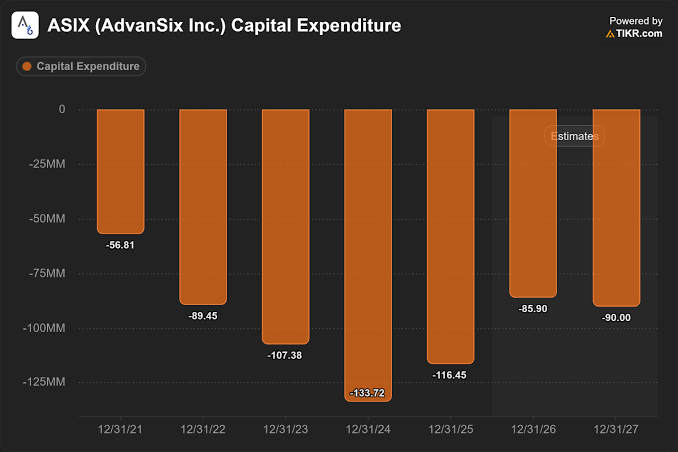
AdvanSix's results provide a useful snapshot of the challenges facing chemical producers in 2026.
Companies can face:
Higher pricing + lower volumes + weaker utilization + higher input costs = lower profitability.
This combination can be particularly difficult for integrated manufacturers with significant fixed production costs.
For procurement professionals, AdvanSix's results offer several signals.
Higher selling prices may continue as chemical producers attempt to recover input-cost increases.
At the same time, weaker volumes can lead manufacturers to adjust production schedules and inventory strategies.
Buyers should therefore monitor:
Contract pricing
Feedstock movements
Production rates
Plant operating schedules
Inventory availability
Regional demand
The 26% increase in Nylon sales provides a potentially positive signal.
If stronger nylon demand continues, it could provide a more meaningful contribution to AdvanSix's earnings recovery.
However, sustained improvement will depend on broader industrial demand and the company's ability to maintain margins.
The biggest uncertainty remains the Plant Nutrients business.
Agricultural demand, nitrogen pricing and sulfur input costs will continue influencing performance.
A recovery in fertilizer volumes could provide significant earnings leverage, while continued weakness could keep pressure on consolidated margins.
AdvanSix's Q2 2026 results demonstrate why revenue growth should not be interpreted as an automatic sign of financial recovery.
The company increased sales by 3%, but net income fell 90%, adjusted EBITDA declined 43% and the adjusted EBITDA margin contracted from 13.6% to 7.6%.
The central issue is therefore not whether AdvanSix can maintain sales growth.
It is whether the company can convert that revenue into sustainable margins and cash flow.
The recovery of Nylon and Chemical Intermediates provides some positive momentum, but Plant Nutrients, production volumes and raw-material costs remain critical variables.
For the broader chemical industry, AdvanSix offers a useful earnings-season benchmark: top-line resilience can coexist with severe bottom-line deterioration when pricing cannot fully compensate for volume and cost pressures.
AdvanSix Q2 2026 sales increased 3% to $421.3 million.
Net income plunged 90% to $3.2 million.
Adjusted EPS declined 85% to $0.19.
An 18% pricing benefit offset a 15% volume decline.
Plant Nutrients sales fell 16% and remained the largest earnings drag.
Nylon sales increased 26%, while Chemical Intermediates rose 18%.
Adjusted EBITDA declined 43% to $31.9 million.
Adjusted EBITDA margin fell from 13.6% to 7.6%.
Operating cash flow declined 52%, while free cash flow remained negative.
The quarter highlights the risk of margin compression despite revenue growth.
Featured Product
Found this useful?
Continue Reading

Chemours' Advanced Performance Materials segment delivered 8% year-over-year growth in Q2 2026, with data-center and semiconductor demand emerging as important drivers and reinforcing the growing link between specialty chemicals and AI infrastructure.

Orion's stronger Western demand versus softer Asian market conditions highlights a growing regional divide in specialty chemicals, offering an important 2026 benchmark for tracking global manufacturing demand, pricing and sourcing opportunities.