Europe's Structural Decline in Base Chemicals
Europe's chemical industry is facing a structural challenge that goes beyond the normal ups and downs of the economic cycle.
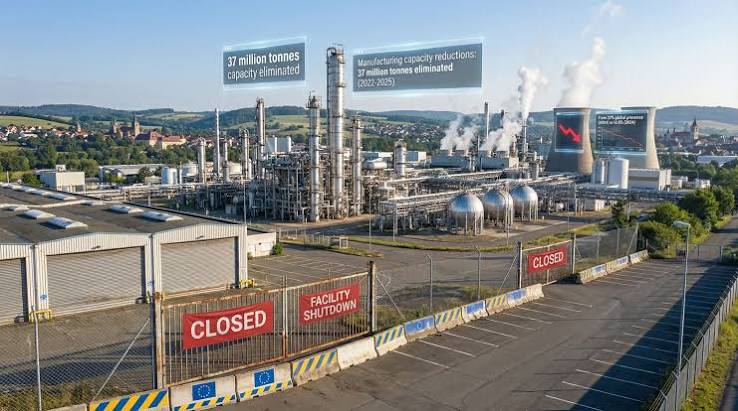
The clearest warning sign is the scale of capacity leaving the region. According to Cefic, European chemical plant closures surged sixfold from 2022, reaching a cumulative 37 million tonnes of capacity, equivalent to roughly 9% of Europe's chemical production capacity. The same analysis points to a sharp slowdown in new investment, raising concerns about the industry's long-term competitiveness.
The pressure is particularly severe in base chemicals and petrochemicals, where energy costs, global overcapacity, weak European demand and competition from lower-cost regions directly affect plant economics.
This raises a bigger question for Europe:
Is the region experiencing a temporary chemical downturn, or is part of its basic chemical manufacturing base becoming permanently uncompetitive?
Why Base Chemicals Are Under the Most Pressure
Base chemicals sit at the beginning of numerous industrial value chains.
They provide essential inputs for:
Plastics
Construction materials
Automotive products
Packaging
Textiles
Agriculture
Pharmaceuticals
Electronics
Consumer goods
Because these materials are often highly standardized, customers can switch between suppliers relatively easily.
That makes production cost extremely important.
A European plant facing structurally higher energy and carbon costs can therefore struggle against an overseas producer even when its technology and product quality remain competitive.
Energy Costs Are a Structural Disadvantage
Energy is one of the biggest problems.
Chemical production frequently requires substantial amounts of electricity, natural gas or other energy-intensive inputs.
Cefic's European closures analysis found that energy-cost competitiveness was cited in roughly half of closure announcements, making it the largest identified driver of shutdowns.
This matters because energy costs influence the economics of entire chemical value chains.
If the cost of producing a basic chemical rises, the disadvantage can propagate downstream into:
Feedstock → Base chemical → Intermediate → Polymer → Finished product
The problem therefore does not remain isolated to one plant.
Petrochemicals Are Particularly Vulnerable
Petrochemicals represent one of the clearest areas of structural pressure.
ICIS reported in early 2026 that approximately 9% of European chemical capacity was already scheduled for closure, with petrochemicals among the hardest-hit segments at around 14% of capacity.
This is significant because petrochemical facilities are typically large, capital-intensive operations.
Once a major cracker, polymer unit or derivative facility becomes economically unattractive, restarting it later may require enormous investment.
Permanent closures can therefore remove capacity for many years.
The Investment Gap Is More Important Than the Closure Number
Closures are only half of the story.
The more concerning issue is the gap between capacity being removed and capacity being added.
Cefic's data shows that while Europe has lost approximately 37 million tonnes of chemical capacity, new investment has slowed dramatically.
That creates a structural imbalance:
Old capacity is disappearing faster than new capacity is being built.
If this continues, Europe's chemical sector will gradually become smaller even if individual surviving companies remain profitable.
Weak Demand Makes the Problem Worse
Energy costs alone do not explain Europe's difficulties.
Demand has also been weak.
Cefic's Q1 2026 chemical trends report noted that despite modest improvement early in the year, weak demand, declining production and intensifying global competition continued to pressure the sector.
Industrial customers in sectors such as automotive and construction remain important sources of chemical demand.
When those industries slow down, chemical producers can see:
Lower order volumes
Reduced plant utilization
Margin compression
Higher unit costs
Delayed investment
This makes an already difficult cost structure even harder to sustain.
Capacity Utilization Remains a Warning Signal
Low utilization is especially damaging for basic chemicals.
These facilities generally depend on high utilization rates to spread fixed costs across large production volumes.
Germany's chemical output declined 4.3% year over year in Q1 2026, while capacity utilization improved sequentially to 75.1% but remained below what is considered a profitable level.
That illustrates the central problem.
A plant can technically remain operational while still generating inadequate returns.
Global Overcapacity Is Adding Pressure
Europe is not struggling in isolation.
Global chemical capacity has expanded rapidly, particularly in Asia.
China's enormous manufacturing base has increased competition across commodity chemicals, polymers and intermediates.
The result is a difficult combination:
Europe has higher production costs while global markets have more available supply.
That makes it difficult for European producers to raise prices enough to compensate for higher energy and regulatory expenses.
Chinese Competition Is Becoming More Difficult to Ignore
The competitive gap is increasingly visible in individual chemical markets.
A recent Financial Times report on Belgium's Citribel, for example, described European producers facing extremely low-priced Chinese citric acid imports while European companies contend with high energy costs and weak demand. The report said Chinese export prices were 40–50% below European production costs in that market.
Citric acid is not a classic base chemical, but the example demonstrates the broader competitive problem.
If Europe cannot compete on cost in one chemical value chain, similar pressure can eventually appear in adjacent products.
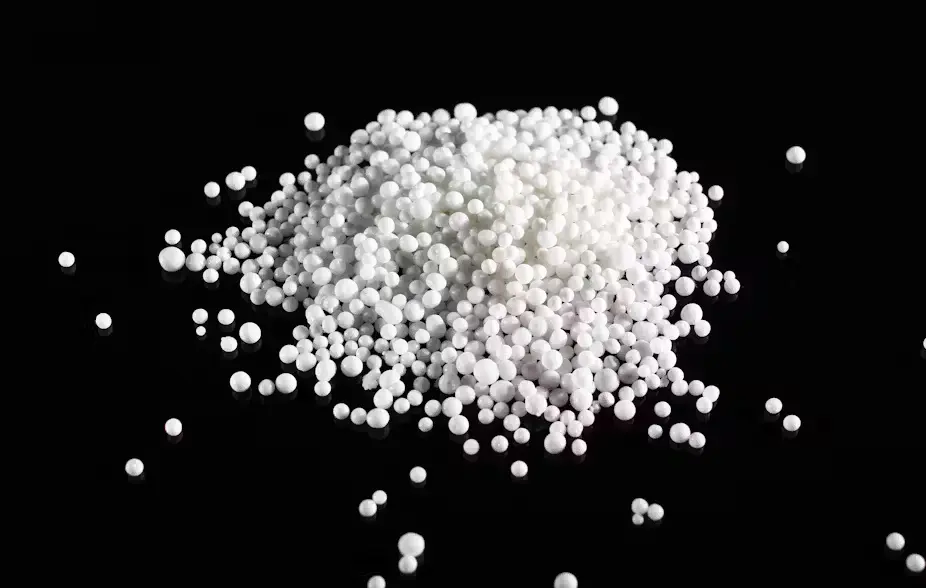
Ammonium Nitrate
Europe's Market Share Has Already Fallen
The structural shift is visible in global market shares.
Cefic's latest figures show that Europe's share of the global chemical market has fallen to approximately 13%, while China's share has risen to around 46%.
That is a dramatic change from two decades ago.
Europe is therefore not simply experiencing a bad year.
The global center of chemical manufacturing has been moving.
The Risk of Deindustrialization
The biggest concern is that individual plant closures can become self-reinforcing.
Consider the cycle:
1. High costs
European producers struggle to compete.
2. Lower utilization
Plants operate below optimal levels.
3. Lower profitability
Returns fall.
4. Investment declines
Companies delay expansion or modernization.
5. Capacity closes
Less production remains in Europe.
6. Imports increase
Customers rely more heavily on overseas suppliers.
7. Local ecosystems weaken
Suppliers, technical expertise and infrastructure decline.
This is how a temporary competitiveness problem can become structural deindustrialization.
Basic Chemicals Have a Strategic Role
The problem is that base chemicals are not ordinary commodities from a national-security perspective.
They support industries that governments consider strategically important.
These include:
Defense
Pharmaceuticals
Agriculture
Automotive
Electronics
Energy
Construction
If domestic base-chemical production disappears, downstream industries may become increasingly dependent on imports.
That creates a strategic vulnerability even if imported chemicals remain cheaper.
The UK Shows What Can Happen Further Downstream
The UK's chemical sector provides another warning.
A recent Imperial College London analysis reported by the Financial Times found that chemical-company closures doubled between 2020 and 2025, while the economic contribution of specialist chemical output fell sharply. The analysis warned that continued decline could affect capabilities supporting medicines, defense products, aerospace and electronics.
The UK example demonstrates that chemical-sector decline can eventually become an industrial-policy issue rather than simply a corporate profitability issue.
Europe Is Facing a Difficult Policy Trade-Off
European governments have several possible responses.
They can support:
Lower industrial energy costs
Investment incentives
Infrastructure upgrades
Trade defenses
Carbon-cost adjustments
New clean-production technologies
Strategic chemical capacity
But each option has limitations.
Subsidies cost governments money.
Tariffs can increase costs for downstream manufacturers.
Carbon policies may raise production expenses before cleaner alternatives become commercially competitive.
And energy infrastructure takes years to develop.
Decarbonization Adds Another Layer
Europe is also attempting to decarbonize its chemical industry.
That is strategically important, but it creates additional investment requirements.
Companies may need to invest in:
Electrification
Hydrogen
Carbon capture
Low-carbon feedstocks
Renewable power
Process efficiency
The challenge is timing.
A company may already be struggling with weak margins while simultaneously being asked to invest billions in the next generation of production technology.
BASF Illustrates the Tension
BASF's Ludwigshafen complex is one of the clearest examples.
The company recently reported improved utilization rates, partly because Middle East supply disruptions temporarily tightened global chemical markets. But BASF also acknowledged that the improvement does not eliminate its longer-term challenges, including weak European demand, global overcapacity and Asian competition.
BASF's restructuring has also reduced full-time employment at Ludwigshafen below 30,000, the lowest level since 1954.
That is a powerful indicator of how dramatically Europe's largest chemical complexes are being reshaped.
Temporary Price Relief Does Not Solve Structural Problems
Recent geopolitical disruptions have provided an unusual short-term benefit to some European producers.
Supply shortages can push prices higher and improve margins.
But this is not a sustainable solution.
Reuters reported that European chemical companies delivered stronger-than-expected Q2 results in 2026 through cost-cutting and restructuring, while many remained cautious because of weak industrial demand, Chinese overcapacity and geopolitical uncertainty. Analysts warned that renewed overcapacity could create deflationary pressure later.
In other words:
A temporary supply shock can improve earnings without fixing the underlying cost structure.
Logistics Is Another Structural Risk
Europe's chemical industry also depends heavily on infrastructure.
The Rhine is a particularly important example.
Low water levels in 2026 disrupted German industrial logistics, forcing chemical producers to use more expensive road and rail alternatives. Covestro declared force majeure at its Dormagen site because transport capacity could not be fully replaced.
This shows that competitiveness depends on more than factory economics.
Europe needs competitive:
Energy
Ports
Rail
Roads
Pipelines
Inland waterways
A chemical plant cannot remain competitive if the infrastructure connecting it to suppliers and customers becomes unreliable or expensive.
What This Means for Chemical Procurement
For buyers, Europe's structural decline creates a complicated sourcing environment.
On one hand, imported materials may offer lower prices.
On the other, shrinking European capacity can create:
Longer supply chains
Greater import dependence
Higher freight exposure
Tariff risk
Longer qualification processes
Greater disruption risk
Procurement teams therefore need to consider both price and supply security.
Dual Sourcing Will Become More Important
Companies that rely heavily on European production may increasingly need international alternatives.
At the same time, companies sourcing from Asia may want to maintain European suppliers as backup options.
That makes dual sourcing increasingly valuable.
A procurement strategy could therefore involve:
Regional supplier + international supplier + strategic inventory
rather than dependence on one geographic market.
M&A Will Accelerate
Structural decline also creates opportunities for consolidation.
Companies with stronger balance sheets can acquire distressed or underutilized assets at attractive valuations.
Potential buyers may be interested in:
Strategic production locations
Customer relationships
Integrated infrastructure
Specialty capabilities
Feedstock access
Existing permits
This means Europe's chemical restructuring could generate a significant wave of asset transactions even as overall capacity declines.
Divestitures Are Becoming Strategic Signals
A chemical asset sale should therefore not be viewed only as a financial transaction.
It can indicate that management no longer considers a particular production location strategically competitive.
When several companies make similar decisions, the pattern becomes more important than any individual deal.
The cumulative effect can reveal which chemical value chains Europe is gradually abandoning.
Base Chemicals May Become More Regional
The long-term outcome could be a more regional global chemical market.
Instead of Europe producing everything competitively for global export, the region may increasingly focus on:
Strategic chemicals
Specialty products
High-value materials
Advanced formulations
Technology-intensive production
Meanwhile, some commodity requirements may increasingly be met through imports.
That could improve short-term efficiency but increase Europe's dependence on foreign producers.
The West May Need to Pay for Resilience
The economics of the future may therefore be different.
Europe could choose to maintain certain chemical production capabilities even when they are not the lowest-cost global option.
That would effectively create a resilience premium.
The argument would be that maintaining domestic capacity provides value through:
Supply security
Employment
Strategic autonomy
Industrial know-how
Emergency capacity
Downstream competitiveness
The question is which products justify that premium.
What Investors Should Watch
Investors tracking Europe's chemical restructuring should monitor:
Plant closure announcements
Capacity utilization
European energy prices
New investment commitments
Import volumes
Chinese export pressure
Regional chemical price spreads
M&A transactions
Government support programs
Carbon-policy changes
The most important indicator may be the relationship between closures and new investment.
If closures continue greatly outpacing new capacity additions, the structural decline is likely continuing.
What Procurement Teams Should Watch
Procurement professionals should focus on:
Supplier concentration
How dependent is the company on one European producer?
Import exposure
Could replacement material come from outside Europe?
Trade policy
Could tariffs or anti-dumping measures change landed costs?
Logistics
Are alternative transport routes available?
Inventory
How much stock is necessary for critical materials?
Qualification
How quickly can an alternative supplier be approved?
These questions can help distinguish a temporary price opportunity from a long-term supply-chain risk.
The Bigger Question for Europe
Europe does not necessarily need to remain the world's largest chemical manufacturing region.
But it does need to determine which chemical capabilities are strategically important enough to retain.
Losing some high-cost commodity capacity may improve efficiency.
Losing too much of the upstream base could weaken the entire industrial ecosystem.
That distinction will become increasingly important as policymakers evaluate the future of European manufacturing.
Looking Ahead
Europe's structural decline in base chemicals is increasingly difficult to dismiss as a normal cyclical downturn.
The combination of 37 million tonnes of cumulative chemical capacity closures, weak demand, high energy costs, global overcapacity and sharply reduced investment points toward a deeper competitiveness problem.
Petrochemicals are among the hardest-hit segments, while European producers continue to face strong competition from Asia.
The short-term picture can still improve. Recent Q2 results show that cost-cutting, restructuring and temporary supply disruptions can support profitability.
But those improvements should not be confused with a full structural recovery.
The central issue is whether Europe can restore enough cost competitiveness, investment and demand to make new chemical capacity economically attractive.
If it cannot, the region may gradually move toward a smaller but more specialized chemical industry—one that depends increasingly on imports for basic materials while concentrating domestic production around higher-value and strategically important products.
For manufacturers and procurement teams, that means the question is no longer simply:
“Where can we buy chemicals most cheaply?”
It is increasingly:
“Which European chemical capabilities will still exist five, ten or fifteen years from now?”
That is the real intelligence question behind Europe's base-chemical decline.
Key Takeaways
Europe has lost approximately 37 million tonnes of chemical capacity, around 9% of total production capacity, according to Cefic.
Petrochemicals are among the hardest-hit segments, with roughly 14% of capacity scheduled for closure in one 2026 assessment.
High energy costs are the leading factor cited behind European chemical closures.
Weak demand and global overcapacity are compounding the energy-cost problem.
Europe's share of global chemical sales has fallen to around 13%, compared with China's approximately 46%.
BASF's restructuring and lower Ludwigshafen employment illustrate the depth of the adjustment facing major European producers.
Logistics infrastructure is another important competitiveness factor, as shown by 2026 Rhine disruptions.
Procurement teams should increasingly balance price optimization with regional supply security and supplier diversification.
The long-term outcome may be a smaller, more specialized European chemical industry with greater dependence on imported base chemicals.
觉得有用吗?