BASF's Ludwigshafen site once rebuilt itself from a company stripped of its patents, cut off from its suppliers and operating out of buildings that were roughly half destroyed. Today that same site is going through a very different kind of contraction, one measured in administrative job cuts and plant closures rather than wartime devastation. Placing the two moments side by side says a lot about how differently scale and decline can look for the same company.
From Wartime Cartel to Independent Company
BASF as it exists today was reconstituted on January 30, 1952, when the Allied powers finalized the breakup of IG Farben into three large successor firms, BASF, Bayer and Hoechst, along with nine smaller companies. IG Farben itself had been the world's largest chemical cartel before the war, formed in 1925 through a merger of BASF with Bayer, Agfa, Hoechst and several smaller firms.
The postwar BASF that emerged from that breakup bore little resemblance to the industrial giant it would later become. It lost its share of roughly 30,000 IG Farben patents, some of its trade secrets sold off for as little as one dollar. It was cut off from its prewar suppliers in Eastern Europe, and just over half of its Ludwigshafen buildings had survived intact, most filled with outdated equipment.
Rebuilding From Almost Nothing
West Germany's postwar chemical shortage gave BASF an immediate domestic market, and the company's nitrogen and ammonia production became the backbone of its recovery. By 1957, sales of those products were already approaching prewar levels.
Growth after that stayed steady rather than explosive at first. BASF's sales grew 59 percent between 1957 and 1962, trailing behind both Bayer and Hoechst during the same period. The turning point came once plastics and fertilizer prices stabilized, with sales jumping 19 percent in a single year once that stabilization took hold in 1963.
How BASF Became the World's Largest Chemical Company
BASF's path to global leadership was gradual rather than immediate. It took roughly a decade after the 1952 breakup for the company to move past its early lag behind Bayer and Hoechst, aided by consistent investment in its integrated Ludwigshafen production complex, the Verbund system that remains central to BASF's operations today.
That system, where one plant's byproduct becomes another plant's raw material, gave BASF a structural cost advantage that helped it eventually overtake its former IG Farben siblings and grow into the position it holds now as the world's largest chemical producer by revenue.
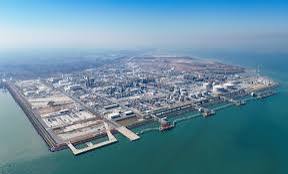
[IMAGE PLACEHOLDER 1] Dimensions: 1200 x 800 px AI Image Prompt: "A photorealistic wide aerial view of a sprawling integrated chemical production complex along a river, dozens of interconnected pipes and towers, industrial haze under daylight, no text, no labels, no logos."
The Current Ludwigshafen Contraction
More than seven decades after rebuilding from near collapse, Ludwigshafen is shrinking again, though this time the pressure comes from weak European demand, high energy costs and global overcapacity rather than wartime destruction.
BASF has cut $2 billion in annual costs since 2023 and plans to push that figure to $2.7 billion by the end of 2026. In 2025 alone, the company eliminated 11 percent of its senior executive roles and reduced its global workforce by 4,800 people, alongside selling its majority stake in its coatings business.
Specific changes at Ludwigshafen itself have included:
Closure of the site's caprolactam plant, one of its two ammonia plants and associated fertilizer facilities.
Significant downsizing of the company's internal IT division, which employs roughly 8,500 people, with roles shifting to new hubs in India and Malaysia.
Relocation of administrative services previously concentrated in Berlin, a move affecting more than 1,000 employees and drawing sharp criticism from the IGBCE union.
Sale of 4,400 company-owned apartments in the Ludwigshafen region to strengthen the balance sheet.
What's Actually Being Cut and What's Being Protected
The contraction has real limits, which is worth noting alongside the cuts. BASF signed a new site agreement with employee representatives in December 2025 promising to refrain from compulsory job reductions at the main Ludwigshafen plant for at least three years, covering January 2026 through December 2028, with a possible two-year extension if profitability targets are met.
Alongside that commitment, BASF pledged to spend between €1.5 billion and €2 billion annually to modernize the site. More than 30,000 workers remain employed at Ludwigshafen, still Europe's largest chemical plant and accounting for roughly a third of BASF's global workforce.
The pattern that emerges is a company cutting administrative overhead, non-core businesses and underperforming production lines hard, while protecting the core production workforce at its historic home site, at least for the next three years.
Ranking the Scale: Then Versus Now
Measuring the two periods against each other requires different yardsticks. The 1952 rebuilding started from a company with essentially no patents, insufficient raw materials and half-destroyed infrastructure, and it took roughly a decade of steady growth to establish the foundation for eventual global leadership.
The current contraction, by contrast, is happening at a company that remains the world's largest chemical producer, with a protected core workforce and continued capital investment even as it cuts administrative and overhead functions. It is a slimming down, not a rebuild from ruins. That distinction matters for how buyers should read the current headlines.
What Buyers Sourcing From BASF Should Watch
For chemical buyers with BASF in their supply chain, a few practical signals are worth tracking through the site agreement's 2026 to 2028 window.
Production continuity at Ludwigshafen's remaining Verbund facilities, since the protected-jobs agreement covers the core plant workforce rather than every individual production line.
Progress against the 2026 profitability targets, since meeting them determines whether the no-compulsory-cuts commitment extends beyond 2028.
Further divestments of non-core businesses, following the pattern set by the coatings business sale, which could affect which product lines remain under BASF's direct ownership.
The pace of the announced modernization spending, since €1.5 to €2 billion in annual investment is a meaningful signal of the company's confidence in the site's long-term role.
The Bottom Line for Buyers Sourcing From BASF
BASF's history shows a company capable of rebuilding from genuine collapse into global leadership over roughly a decade. Its current situation is a far less severe test, a cost-cutting cycle layered on top of a company that remains the world's largest chemical producer, with its historic home site protected from the deepest cuts through at least 2028.
Buyers should read the current headlines as restructuring within a still-dominant company, not as a rerun of 1952. The scale of the two moments simply is not comparable, even if both involve real change at the same Ludwigshafen address.
What's Actually Being Cut and What's Being Protected
The contraction has real limits, which is worth noting alongside the cuts. BASF signed a new site agreement with employee representatives in December 2025 promising to refrain from compulsory job reductions at the main Ludwigshafen plant for at least three years, covering January 2026 through December 2028, with a possible two-year extension if profitability targets are met.
Alongside that commitment, BASF pledged to spend between €1.5 billion and €2 billion annually to modernize the site. More than 30,000 workers remain employed at Ludwigshafen, still Europe's largest chemical plant and accounting for roughly a third of BASF's global workforce.
The pattern that emerges is a company cutting administrative overhead, non-core businesses and underperforming production lines hard, while protecting the core production workforce at its historic home site, at least for the next three years.
Ranking the Scale: Then Versus Now
Measuring the two periods against each other requires different yardsticks. The 1952 rebuilding started from a company with essentially no patents, insufficient raw materials and half-destroyed infrastructure, and it took roughly a decade of steady growth to establish the foundation for eventual global leadership.
The current contraction, by contrast, is happening at a company that remains the world's largest chemical producer, with a protected core workforce and continued capital investment even as it cuts administrative and overhead functions. It is a slimming down, not a rebuild from ruins. That distinction matters for how buyers should read the current headlines.
What Buyers Sourcing From BASF Should Watch
For chemical buyers with BASF in their supply chain, a few practical signals are worth tracking through the site agreement's 2026 to 2028 window.
Production continuity at Ludwigshafen's remaining Verbund facilities, since the protected-jobs agreement covers the core plant workforce rather than every individual production line.
Progress against the 2026 profitability targets, since meeting them determines whether the no-compulsory-cuts commitment extends beyond 2028.
Further divestments of non-core businesses, following the pattern set by the coatings business sale, which could affect which product lines remain under BASF's direct ownership.
The pace of the announced modernization spending, since €1.5 to €2 billion in annual investment is a meaningful signal of the company's confidence in the site's long-term role.
The Bottom Line for Buyers Sourcing From BASF
BASF's history shows a company capable of rebuilding from genuine collapse into global leadership over roughly a decade. Its current situation is a far less severe test, a cost-cutting cycle layered on top of a company that remains the world's largest chemical producer, with its historic home site protected from the deepest cuts through at least 2028.
Buyers should read the current headlines as restructuring within a still-dominant company, not as a rerun of 1952. The scale of the two moments simply is not comparable, even if both involve real change at the same Ludwigshafen address.