

Article
Jun 19, 2026schedule5 Min Read
Personal Care Ingredients: Cocamidopropyl Betaine, Glycerin.
The personal care ingredients market is navigating a dual challenge in 2026: elevated feedstock costs
Full Reportarrow_forward


prodchem
Jun 18, 2026
For more than a decade, the chemical industry has been flooded with announcements about revolutionary bio-based technologies. Venture-backed startups promised to replace petroleum feedstocks, reduce carbon emissions and transform industrial manufacturing.
Many of those promises never materialized.
Some companies struggled with production economics. Others faced scale-up challenges, feedstock constraints or weak customer adoption. The result was a growing gap between pilot-scale success and commercial reality.
Yet 2026 tells a different story.
Several categories of bio-based chemicals have successfully crossed the difficult threshold from laboratory innovation to industrial-scale production. These products are now generating meaningful volumes, attracting investment and becoming integrated into global supply chains.
The question is no longer whether bio-based chemicals can work. The question is which ones have actually achieved commercial viability.
The transition from pilot plant to commercial production remains one of the most difficult challenges in the chemical industry.
Common obstacles include:
High production costs.
Feedstock availability issues.
Process inefficiencies.
Capital-intensive scale-up requirements.
Limited customer willingness to pay premium prices.
Many early bio-based ventures underestimated how difficult it would be to compete against mature petrochemical supply chains operating at enormous scale.
As a result, only a relatively small number of technologies have successfully reached commercial maturity.
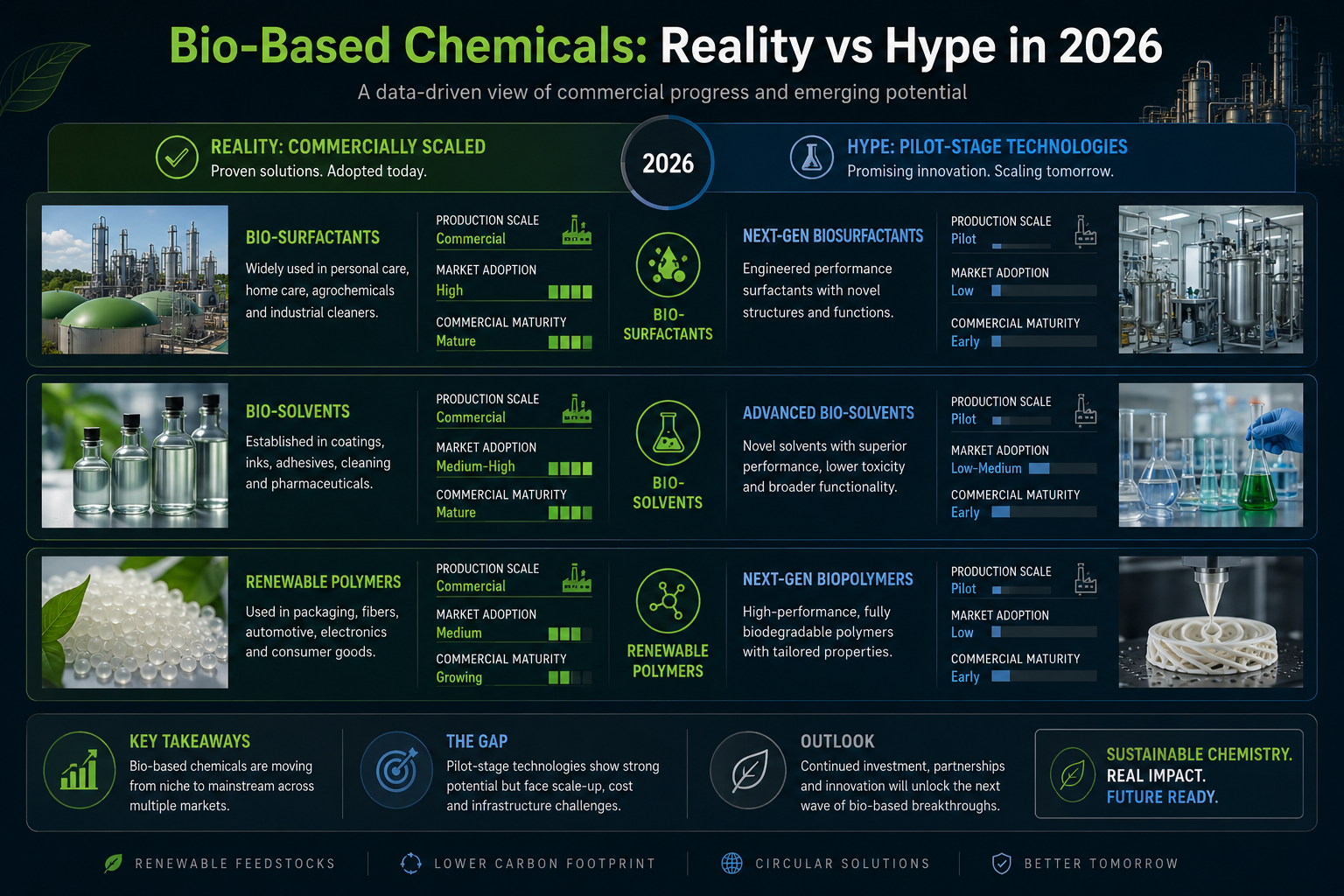
Among the most successful categories are bio-based surfactants.
Demand has been driven by:
Household cleaning products.
Personal care formulations.
Industrial cleaning applications.
Consumer sustainability preferences.
Major consumer brands increasingly require renewable-content ingredients that can reduce Scope 3 emissions without compromising product performance.
Several factors have enabled scaling:
Established feedstock availability.
Strong consumer demand.
Existing manufacturing infrastructure.
Regulatory support for sustainable ingredients.
Unlike many emerging technologies, bio-based surfactants offer performance characteristics comparable to conventional alternatives while benefiting from growing sustainability demand.
Bio-solvents have also achieved meaningful commercial penetration.
Applications include:
Coatings.
Industrial cleaning.
Printing inks.
Adhesives.
Agricultural formulations.
Several renewable solvent families now compete effectively in markets where environmental compliance and VOC reduction are important purchasing considerations.
Key growth drivers include:
Stricter environmental regulations.
VOC reduction requirements.
Sustainable product development initiatives.
Corporate carbon reduction goals.
While petrochemical solvents continue to dominate overall market volume, bio-solvents are increasingly becoming commercially relevant rather than merely experimental.
Perhaps the most visible success story involves renewable and biodegradable polymers.
Several materials have moved beyond demonstration projects and entered meaningful commercial production.
Examples include:
PLA (Polylactic Acid).
PBS (Polybutylene Succinate).
Bio-based polyesters.
Renewable packaging materials.
Growth is being supported by:
EU sustainability mandates.
Single-use plastics regulations.
Extended Producer Responsibility programs.
Consumer demand for sustainable packaging.
Packaging remains the largest opportunity because it offers the scale necessary to justify major production investments.
A major reason for recent progress is the improvement of industrial fermentation technology.
Modern biotechnology platforms have improved:
Yield efficiency.
Feedstock utilization.
Production consistency.
Process economics.
This has enabled chemicals such as:
Bio-based succinic acid.
Organic acids.
Specialty intermediates.
Renewable ingredients.
to move closer to economic competitiveness.
The industry is increasingly leveraging proven fermentation infrastructure rather than attempting entirely new manufacturing models.
Not every bio-based chemical category has achieved the same level of success.
Several segments remain largely confined to:
Pilot plants.
Demonstration facilities.
Limited-volume specialty production.
Common challenges include:
High production costs.
Limited feedstock availability.
Lack of downstream demand.
Poor economics versus petrochemical alternatives.
Many highly publicized bio-based molecules continue to struggle with the fundamental question every procurement team eventually asks:
"Can it compete economically at scale?"
For many technologies, the answer remains uncertain.
The chemical industry has learned an important lesson over the past decade.
Pilot success does not guarantee commercial success.
Meaningful commercialization requires:
Reliable production capacity.
Competitive pricing.
Supply chain stability.
Customer acceptance.
Sustainable profitability.
Procurement teams increasingly evaluate bio-based products using the same criteria applied to conventional chemicals.
Sustainability remains important, but supply reliability and economics ultimately determine adoption rates.
Government policy has played a major role in supporting successful bio-based chemicals.
Important drivers include:
Bio-based content requirements.
Packaging regulations.
Carbon reduction targets.
Circular economy initiatives.
Sustainable procurement programs.
These policies have helped create demand certainty, encouraging producers to invest in larger-scale manufacturing facilities.
Without regulatory support, many projects would likely have remained at demonstration scale.
The next phase of growth will likely focus on technologies that have already demonstrated commercial viability.
Procurement teams should monitor:
Bio-surfactant production expansion.
Renewable solvent adoption.
PLA and PBS capacity additions.
Feedstock availability.
Carbon accounting requirements.
Sustainability-driven purchasing mandates.
The strongest opportunities are likely to emerge from technologies that already have proven manufacturing economics rather than speculative next-generation concepts.
The bio-based chemicals industry is finally entering a more mature phase. After years of ambitious announcements and uneven commercialization, a select group of products has demonstrated the ability to scale successfully.
Bio-based surfactants, renewable solvents and certain polymer platforms have moved beyond pilot projects and become genuine industrial markets. Their success has been driven by a combination of regulatory support, technological improvements and growing customer demand for sustainable materials.
At the same time, many bio-based technologies remain stuck in the development stage, highlighting the difference between scientific feasibility and commercial viability.
For buyers, the lesson is clear: focus on bio-based chemicals that have already achieved production scale, proven economics and reliable supply chains. Those are the products most likely to shape the future of green chemistry over the coming decade.
Interested in sourcing commercially proven bio-based chemicals? Explore verified suppliers and sustainable chemical solutions on our platform today.

Featured Product
Found this useful?
Continue Reading
The personal care ingredients market is navigating a dual challenge in 2026: elevated feedstock costs

Cocamidopropyl betaine (CAPB) is an amphoteric surfactant derived from coconut oil and dimethylaminopropylamine.

INEOS is the largest private chemical company in Europe and one of the most acquisitive globally.