Europe's Chemical Production Decline Reshapes Global Supply Chains | ChemicalsBlog.com
Rankings & Industry Intelligence
schedule3 Min Read
Ranking Europe's Five-Year Chemical Production Decline: Germany Down 18%, UK Down 30%
terminal
prodchem
Aug 5, 2026
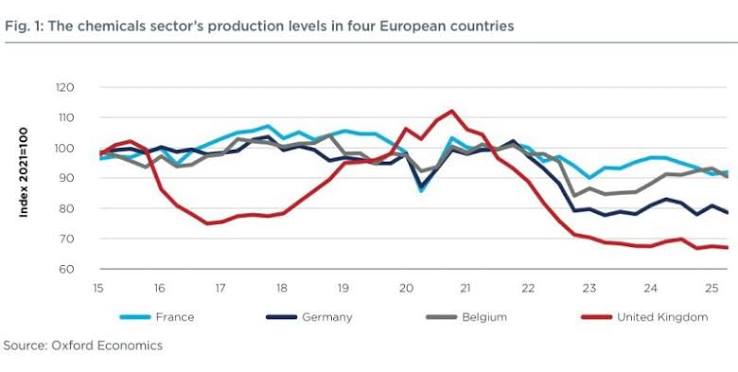
Europe's chemical industry has experienced one of its most challenging periods in recent history, with production declining sharply across several major manufacturing economies. Between 2019 and Q2 2025, Germany's chemical production fell by approximately 18%, while the United Kingdom recorded an even steeper 30% decline over the same period.
These figures highlight the structural pressures facing European chemical producers, including high energy costs, weaker industrial demand, inflationary pressures, geopolitical uncertainty, and increasing global competition. As Europe continues to adjust to changing market conditions, procurement teams and manufacturers are closely monitoring how these production declines may influence supply availability, investment decisions, and future trade flows.
Why Europe's Production Decline Matters
Europe remains one of the world's largest producers of industrial and specialty chemicals. Declining production across key manufacturing hubs can have significant consequences for global chemical supply chains.
Several factors have contributed to the downturn, including:
High energy and natural gas costs
Weak industrial and manufacturing demand
Rising operating and labor expenses
Increased competition from lower-cost production regions
Geopolitical uncertainty affecting trade and investment
Delayed capital investment in new production capacity
Because Germany and the UK are major suppliers of industrial chemicals, sustained production declines could influence global sourcing patterns and regional competitiveness.
Industrial chemicals such as Caustic Soda, Methanol, Acetic Acid, Hydrochloric Acid (HCl), Sulfuric Acid, and Hydrogen Peroxide are essential inputs for manufacturing across sectors including water treatment, pulp and paper, pharmaceuticals, mining, textiles, and specialty chemicals. Changes in European production capacity can influence the availability, pricing, and sourcing strategies for these widely traded chemical products.
The reduction in European chemical output is encouraging manufacturers and buyers to reassess sourcing strategies and production investments.
Potential market impacts include:
Reduced production volumes across selected chemical segments
Greater reliance on imported chemical products
Increased investment in lower-cost manufacturing regions
Supply chain diversification by global buyers
Continued pressure on European chemical competitiveness
Shifting global trade flows toward Asia and the Middle East
While production has weakened, Europe continues to play an important role in supplying high-value specialty chemicals and advanced manufacturing products.
Procurement Considerations
Procurement teams should closely monitor regional production trends when developing sourcing strategies.
Recommended actions include:
Diversify suppliers across multiple geographic regions
Monitor production and capacity utilization trends
Evaluate total landed costs rather than product price alone
Build strategic inventory for critical materials
Strengthen long-term partnerships with reliable suppliers
Track energy market developments that could affect production costs
A diversified sourcing strategy can help reduce exposure to regional production disruptions while improving long-term supply resilience.
Looking Ahead
The decline in European chemical production underscores the growing importance of operational efficiency, energy competitiveness, and supply chain resilience. Future recovery will depend on improvements in industrial demand, energy affordability, investment in modern manufacturing facilities, and supportive trade policies.
For procurement professionals and chemical manufacturers, monitoring production trends in Germany, the UK, and other European markets will remain essential for anticipating supply conditions and identifying emerging sourcing opportunities in the global chemicals market.
Key Takeaways
Germany's chemical production declined approximately 18% between 2019 and Q2 2025.
The UK's chemical production fell by approximately 30% over the same period.
High energy costs, weaker demand, and global competition continue to pressure European manufacturers.
Buyers are increasingly diversifying sourcing strategies beyond Europe.
Long-term competitiveness will depend on energy costs, investment, and industrial recovery.
B2B chemical procurementSupply chainglobal marketIndustrial ChemicalsIndustrial Chemical Demandglobal tradeEnergyChemical Procurement StrategyPetrochemicalsChemical Supply ChainIndustrial Chemicals Supply ChainprocurementEnergy CostEuropean Chemical MarketGermany Chemical IndustryEuropean Chemicals IndustryEuropean ChemicalsTradeChemGermany