South Korea's ten largest petrochemical groups have agreed to cut their combined naphtha cracking capacity by up to 3.7 million metric tons a year, roughly a quarter of the country's total. Across the sea, China's anti-involution policy promises something similar, less domestic competition and reduced oversupply, but has yet to deliver comparable capacity reductions. The gap between these two approaches is reshaping how buyers should think about regional supply through the rest of 2026.
One country is shutting plants. The other is still debating how to slow expansion. For anyone sourcing olefins or polymer feedstocks in Asia, that asymmetry matters more than either policy headline alone.
Why South Korea Is Cutting Cracker Capacity
South Korea's Ministry of Trade, Industry and Energy pushed the country's petrochemical producers into an unusually direct commitment. Executives from the ten largest groups signed an agreement to cut annual naphtha cracking capacity by between 2.7 million and 3.7 million metric tons, against a national base of roughly 14.7 million tons.
That works out to as much as a 25 percent reduction in national capacity. The government has asked companies to submit detailed closure plans, with restructuring negotiations expected to run through worker consultations before any cracker actually goes offline.
The rationale is straightforward. Olefin margins across the region have been under sustained pressure, and Seoul wants its producers shifting toward higher-value specialty products rather than continuing to compete on commodity ethylene and propylene volumes that no longer generate acceptable returns.
Where the Consolidation Is Concentrated
The restructuring is not spread evenly. It clusters around three major complexes.
Daesan, where Lotte Chemical and HD Hyundai are exploring a merger of their naphtha cracking operations, with HD Hyundai Oilbank expected to contribute assets in exchange for consolidated capacity.
Ulsan, where SK Innovation and Korea Petrochemical Industry Co are discussing a coordinated capacity reduction and possible facility merger.
Yeosu, the country's largest petrochemical hub, where seven crackers cluster around a single refinery, pushing GS Caltex, LG Chem and Lotte Chemical toward asset-sharing arrangements.
Yeochun NCC, jointly owned by DL Chemical and Hanwha Solutions, has already suspended one of its crackers due to liquidity pressure, though disagreement between the two shareholders has delayed a permanent closure decision.
A Naphtha Shortage Complicated the Timeline
Just as this restructuring was gathering momentum, a separate supply shock hit the region. Conflict-related disruption to Middle East naphtha supply forced LG Chem to shut its Yeosu cracker in March, and Yeochun NCC cut run rates to conserve feedstock as the country enforced a temporary naphtha export ban.
South Korea imports around 45 percent of its naphtha demand, with the large majority sourced from the Middle East, which left the restructuring conversation running alongside an acute feedstock crisis rather than in isolation. The dual pressure of voluntary capacity cuts and involuntary feedstock shortages has made 2026 an unusually disruptive year for Korean cracker operations.
China's Anti-Involution Policy: Rhetoric Versus Capacity Reality
China's leadership introduced its anti-involution campaign in early 2025 to address exactly the kind of oversupply South Korea is now cutting into. The policy targets neijuan, the cycle where excess capacity forces producers to cut prices to keep volumes moving, which then drags down margins across the whole sector.
Early signs looked promising in specific product lines. Caprolactam, a nylon intermediate, climbed roughly 5 percent after major producers agreed to a 20 percent output cut. China's petroleum and chemical industry prosperity index also rose for two consecutive months late last year.
That improvement did not hold. Analysts expect overcapacity to keep weighing on China's chemical sector through 2026, with weak domestic demand and mounting pushback against Chinese export volumes both working against the policy's stated goals.
Why China's New Capacity Keeps Undermining Its Own Policy
The core problem is structural. China is simultaneously trying to cut excess capacity and continuing to bring new capacity online, which cancels out much of the intended effect.
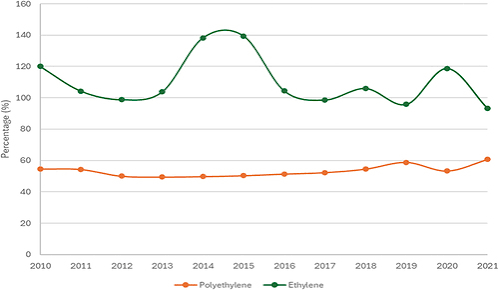
China's polypropylene capacity has grown sharply enough to push the country into net exporter status for the first time, even as anti-involution messaging targets oversupply directly.
New capacity in downstream, private-sector-dominated segments is often newly built and not yet depreciated, making voluntary closures financially costly for the companies that would need to absorb them.
Sector-specific interventions, such as efforts to address purified terephthalic acid overcapacity, have so far produced limited concrete results according to market participants.
The pattern suggests China is treating symptoms in individual product chains rather than resolving the underlying investment incentives that keep generating new capacity across the broader petrochemical sector.
What the Contrast Means for Regional Buyers
South Korea's cuts are real and measurable, backed by signed government agreements and specific tonnage targets. China's policy remains largely aspirational outside a handful of product-specific interventions like caprolactam.
For buyers, this asymmetry creates a few practical implications:
Korean-origin supply tightening is a genuine planning variable, not just a headline, given the specific complexes and tonnage already under negotiation.
Chinese oversupply is likely to persist as a pricing factor for commodity olefins and derivatives through 2026, even amid continued anti-involution messaging.
Regional price relationships may shift as Korean producers pull back from lower-margin commodity products and lean into specialty grades, potentially leaving gaps that Chinese exporters continue to fill.
What Procurement Teams Need to Know
Buyers sourcing olefins, polyolefins or downstream derivatives from either country should treat these as two different kinds of risk.
Track specific Korean complex-level news, particularly Daesan, Ulsan and Yeosu, since consolidation decisions are being negotiated site by site rather than as one national event.
Do not assume Chinese anti-involution announcements translate into near-term supply tightness, given the policy's limited track record so far.
Watch for Korean producers repositioning toward specialty products, which could reduce commodity-grade availability even if headline capacity cuts move slowly.
Build flexibility into sourcing plans for any product line, like caprolactam, where China has shown it can execute coordinated output cuts when producers agree to act together.
The Bottom Line for Asian Petrochemical Buyers
South Korea and China are running two very different experiments in addressing the same regional overcapacity problem. One is cutting real tonnage under government pressure. The other is still working out whether its policy tools can overcome the financial incentives that keep new capacity coming online.
Buyers who track both stories individually, rather than assuming regional overcapacity is resolving as a single trend, will be better positioned to anticipate where genuine tightness emerges first.