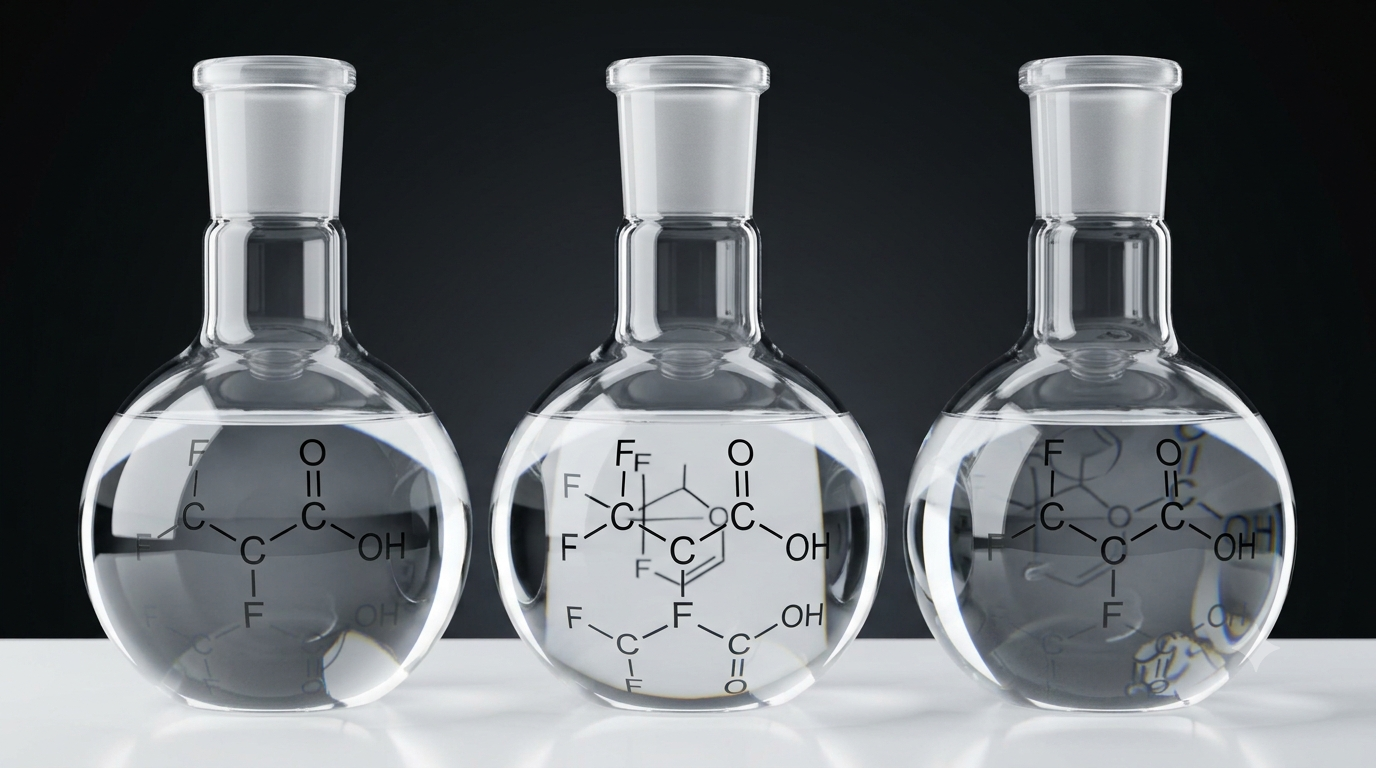
Regulatory authorities in Europe are advancing restrictions on chemicals that release trifluoroacetic acid (TFA) into the environment, a development that places billions of dollars in agrochemical sales at potential risk. TFA is a persistent, mobile degradation product formed when certain fluorinated compounds including many widely used fungicides, herbicides and insecticides break down in the environment. For procurement teams managing agrochemical purchases and growers relying on specific active ingredients, the TFA situation demands attention because regulatory timelines move faster than product development cycles.
What TFA Is and Why Regulators Care
Trifluoroacetic acid is a small, highly stable organic acid containing three fluorine atoms attached to an acetic acid backbone. The compound's stability stems from the strength of carbon-fluorine bonds, which are among the strongest in organic chemistry.
This same stability that makes fluorinated compounds valuable in agrochemicals also means TFA persists indefinitely once formed in the environment. European monitoring programs detect TFA in surface water, groundwater and drinking water at concentrations typically ranging from 0.1 to 10 micrograms per liter.
While these levels sit well below acute toxicity thresholds, regulators express concern about continual accumulation, ubiquitous presence and uncertainty about long-term exposure effects. The precautionary principle embedded in European chemical regulation favors restricting persistent substances even when immediate harm is not demonstrated.
Major Agrochemical Products at Risk
Numerous commercially important crop protection products contain fluorinated active ingredients that degrade to TFA through environmental processes including photolysis, hydrolysis and microbial metabolism.
Fungicides facing exposure include:
Fluoxastrobin, a strobilurin used in cereals and vegetables generating hundreds of millions in annual sales
Trifloxystrobin, another major strobilurin with structural elements that release TFA
Multiple triazole fungicides incorporating trifluoromethyl groups
Herbicides with TFA concerns:
Flufenacet, used for grass weed control in cereals with limited alternative options offering equivalent spectrums
Products containing trifluoroacetyl groups that hydrolyze to release TFA directly
Insecticide contributions:
The total number of agrochemical active ingredients that release TFA either directly or through degradation metabolites numbers in the dozens. Precise identification requires detailed metabolic studies for each compound under various environmental conditions.
The Regulatory Timeline
The European Chemicals Agency (ECHA) and national authorities in Germany, Netherlands and other countries are evaluating TFA through several regulatory processes that could culminate in restrictions.
The restriction process involves several stages:
Proposal development by member states or ECHA
Public consultation allowing industry and stakeholder input
Committee opinions from ECHA Risk Assessment Committee and Socio-Economic Analysis Committee
Final European Commission decision on restrictions
This sequence typically extends three to five years from initial proposal to enforceable restrictions. Germany submitted a restriction proposal for PFAS in 2023 that includes TFA and TFA-generating precursors within its scope.
If adopted in proposed form, this would phase out essentially all intentional uses of fluorinated compounds releasing TFA. Derogation periods could range from 18 months to 12 years depending on use category and availability of alternatives.
Which Companies Face Greatest Exposure
Every major agrochemical company markets products that could face TFA-related restrictions. The commercial exposure varies by portfolio composition but represents billions in aggregate annual revenue.
Company-specific exposure:
BASF - fungicide portfolio includes multiple triazoles and strobilurins with TFA-releasing structures
Bayer - markets fluopyram and other fluorinated fungicides that may contribute TFA
Syngenta - portfolio includes flufenacet herbicide and various fluorinated fungicides
Smaller specialists - companies with portfolios concentrated in specific fluorinated actives face proportionally larger exposure
A company deriving 30% to 50% of revenue from products that could be restricted faces existential challenges. Diversified majors where TFA exposure represents 10% to 20% of total business have better risk profiles.
Generic manufacturers producing off-patent fluorinated actives face economic disruption if restrictions eliminate markets for products representing major volume.
Why Fluorine Cannot Be Easily Removed
Replacing fluorinated agrochemical actives with non-fluorinated alternatives is not simply a matter of chemical substitution. The fluorine atoms in these molecules confer specific biological activities that are difficult to replicate.
Critical functions of fluorine in agrochemicals:
Enhances potency against target fungi, weeds or insects
Improves crop selectivity preventing damage to treated plants
Optimizes pharmacokinetic properties including uptake and translocation
Provides metabolic stability for appropriate field persistence
Removing fluorine while maintaining efficacy requires discovering entirely new molecular scaffolds, not minor structural modifications. These discovery programs face timelines of 10 to 15 years from initial hit identification through regulatory submission and commercial launch.
The probability of technical success for any individual discovery program remains low. Companies must pursue multiple programs in parallel to ensure that at least one or two survive to commercialization.
Impact on Crop Protection Programs
Farmers and crop advisors managing disease and pest control programs need to understand that regulatory restrictions could eliminate critical tools with limited immediate replacements.
Regional crop protection implications:
Cereal production in Northern Europe - depends heavily on triazole fungicides controlling septoria, rusts and other foliar diseases
Vegetable production - uses strobilurin fungicides controlling diverse pathogens across multiple crops
Grass weed management - herbicide options already limited given widespread resistance; losing flufenacet would further constrain control
If restrictions are implemented with 5 to 7 year derogation periods, the industry might successfully develop some alternatives limiting crop protection gaps. Shorter timelines of 18 months to 3 years would create immediate supply shortages.
Growers would need to rely on fewer modes of action increasing resistance development risk or accept higher disease pressure reducing yields.
Alternative Chemistry Strategies
Agrochemical companies are pursuing several strategies to develop non-fluorinated actives replacing products at TFA restriction risk.
Development approaches include:
Non-fluorinated analogs where fluorine gets replaced with chlorine, bromine or hydrogen substituents providing 70% to 90% efficacy
Novel scaffolds from high-throughput screening seeking hits against target enzymes then optimizing into development candidates
Biological products including microbial biopesticides and biochemical compounds offering alternatives for some applications
Integrated pest management intensification through crop rotation, resistant varieties and cultural practices
The realistic outcome involves portfolios combining multiple approaches. Some fluorinated actives get replaced with non-fluorinated synthetics, others with biologicals and some uses transition to more intensive IPM with reduced chemical dependence.
No single alternative completely solves the substitution challenge across all crop protection needs.
Economic Impacts Across the Value Chain
TFA restrictions would create economic impacts extending beyond agrochemical manufacturers to distributors, retailers, farmers and food supply chains.
Who bears the costs:
Manufacturers - absorb R&D costs developing alternatives plus revenue losses during transition periods
Distributors - face inventory write-offs if products become unsaleable due to restrictions
Retailers and cooperatives - must educate grower customers on alternatives and manage dissatisfaction when replacements perform less effectively
Farmers - experience higher crop protection costs if alternatives are more expensive or require more frequent applications
Food processors - could see commodity costs increase if agricultural input costs rise or yields decline
The aggregate economic impact of TFA restrictions affecting major fluorinated agrochemicals could reach billions annually across the agricultural value chain if substitution proceeds poorly.
Regional Regulatory Differences
European regulatory agencies are driving TFA restriction discussions given EU's precautionary regulatory philosophy. Other regions are monitoring European developments but have not initiated comparable restriction processes.
Geographic regulatory divergence:
Europe - precautionary framework favors restrictions based on persistence regardless of demonstrated harm
North America - risk-based frameworks require demonstrated harm not just hazard and persistence
Latin America and Asia - typically follow European and North American precedents with some lag
This regulatory divergence creates commercial complexities. Products restricted in Europe might remain fully registered in other regions where TFA is not prioritized as regulatory concern.
Agrochemical companies must decide whether to maintain global product portfolios accepting European market losses or to phase out products globally.
What Procurement Teams Should Do Now
Agrochemical buyers including distributors, cooperatives and large farming operations should assess exposure to TFA restriction risk and develop contingency strategies.
Action steps for procurement teams:
Identify at-risk products - determine which actives in current sourcing contain structures that release TFA
Engage suppliers - understand their strategies for addressing potential restrictions and timeline for alternative product development
Qualify alternatives - begin identifying and testing products that could substitute for at-risk actives even if currently more expensive
Reformulate programs - evaluate whether diversifying modes of action and integrating non-chemical approaches reduces dependence on specific chemistries
Monitor regulations - track developments through industry publications, regulatory announcements and supplier communications
Participate in consultations - provide input during public comment periods on agricultural necessity and economic impacts
Understanding restriction timelines and scope as early as possible maximizes adaptation time and preserves supply chain continuity.
Industry Response Strategies
Agrochemical industry associations including CropLife Europe are engaging actively with regulators arguing for risk-based assessment rather than hazard-based restrictions.
Industry advocacy efforts:
Funding research on TFA environmental fate, toxicology and exposure assessment to fill data gaps
Public commitments to reducing TFA releases through product stewardship and application technology improvements
Development programs for alternative actives demonstrating proactive responsibility
However, industry advocacy faces skepticism from environmental organizations that favor precautionary restrictions. The political dynamics favor restrictions in current European regulatory environment.
Industry efforts may succeed in extending derogation periods or narrowing restriction scope. Outright prevention of restrictions appears unlikely given momentum behind PFAS regulatory initiatives.
Science Versus Policy Tension
TFA exemplifies tension between science-based risk assessment and policy-driven precautionary regulation.
The diverging perspectives:
Scientific evidence shows TFA is ubiquitous and persistent but toxicology studies indicate low hazard at environmental concentrations
Risk assessment integrating exposure and hazard suggests low probability of adverse effects
Precautionary policy favors action on persistent substances regardless of demonstrated risk when substitution might be possible
The policy question becomes not "is TFA causing harm" but "do we accept continual accumulation of persistent substances in drinking water when alternatives could be developed."
Procurement professionals navigating this terrain must understand that regulatory outcomes do not always align with scientific consensus on risk. Political and social factors drive decisions independent of hazard or exposure evidence.
What Happens If Restrictions Take Effect
If European authorities implement TFA restrictions covering major agrochemical actives, the practical sequence involves several phases.
Post-restriction market dynamics:
Initial restriction adoption provides derogation periods during which affected products remain legal but face sunset dates
Companies wind down production, clear inventory and accelerate alternative product commercialization
Buyers transition purchasing to alternatives and reformulate crop protection programs
Affected products become unavailable in European markets though potentially remaining legal in other regions
Growers adapt using alternative chemicals, biologicals or enhanced IPM with likely efficacy declines for some applications
Market consolidation could occur as smaller companies lacking R&D capabilities exit segments where major products face restriction. Larger companies with diverse portfolios gain market share.
The long-term outcome depends on how successfully industry develops effective alternatives within restriction timelines.
The Broader PFAS Context
TFA restrictions occur within broader regulatory initiatives targeting per- and polyfluoroalkyl substances (PFAS) as a chemical class. European authorities increasingly view thousands of fluorinated compounds as inherently problematic due to persistence.
This class-based approach creates uncertainty for all fluorinated agrochemicals regardless of specific environmental behavior. Products that do not release TFA but contain other perfluorinated structures could face restrictions under PFAS frameworks.
Industry argues for substance-by-substance assessment allowing beneficial uses when risks are acceptable. Regulators counter that class-based approaches are necessary given the impossibility of assessing thousands of individual substances.
The ultimate scope of PFAS restrictions remains uncertain but could extend far beyond TFA to affect fluorinated agrochemicals comprehensively.
Long-Term Outlook for Fluorinated Chemistry
Fluorinated active ingredients have provided enormous value to agriculture through enhanced efficacy and improved crop selectivity. The regulatory trajectory toward restricting persistent fluorinated compounds threatens to eliminate this entire chemical space from future agricultural use in Europe.
Post-fluorine agrochemistry directions:
Innovation focusing on non-fluorinated structures or compounds that rapidly defluorinate to non-persistent metabolites
Greater reliance on biological products, RNA interference technologies and breeding for resistance
Precision agriculture reducing overall chemical dependence
Reversible fluorination approaches where fluorine provides biological activity but gets cleaved rapidly after application
The transition will be difficult, expensive and potentially incomplete. Procurement teams managing agricultural input portfolios need strategic vision, supplier partnerships and flexibility to adapt as regulatory and technology landscapes evolve.
Regulatory timelines are compressed relative to product development cycles, creating supply continuity risks that cannot be solved through traditional procurement approaches alone.
Ready to source Ammonium Sulphate from verified global suppliers? Explore competitive offers on our platform today.