AI-Driven Chemical Manufacturing: Smart Production Trends
Artificial intelligence is changing how chemical manufacturers manage production, maintain equipment and control industrial processes. From automated production lines to predictive maintenance systems, AI-driven chemical manufacturing is helping companies improve operational efficiency while responding to growing demands for product consistency, cost control and sustainable production.
Chemical manufacturing involves complex reactions, temperature controls, pressure management and strict quality requirements. Traditional production methods often depend on manual monitoring and fixed operating parameters. Smart production technologies allow manufacturers to analyse operational data continuously, identify potential problems and make more informed decisions. As digital transformation accelerates, AI is becoming an important part of modern chemical production strategies.
How AI Is Transforming Chemical Manufacturing
AI-driven chemical manufacturing combines machine learning, industrial sensors, data analytics and automated control systems to improve production activities. These technologies collect information from manufacturing equipment and use it to identify patterns, predict operational changes and support production decisions.
Unlike conventional automation, which follows predefined instructions, AI systems can analyse changing conditions and adjust recommendations based on incoming information. This makes them particularly useful in chemical plants where multiple variables influence production quality and efficiency.
Intelligent Process Monitoring
Chemical production requires continuous monitoring of variables such as temperature, pressure, flow rates and chemical concentrations. AI-powered monitoring systems analyse these measurements to identify unusual changes before they affect production.
Manufacturers can use these insights to:
Identify process irregularities during production.
Monitor operating conditions across different production units.
Detect variations that could affect product consistency.
Support faster decisions when production conditions change.
This approach helps production teams maintain more consistent operating conditions and reduce dependence on manual inspections.
Automated Production Management
AI also supports automated production management by coordinating information from different manufacturing systems. Integrated platforms can help production teams monitor equipment, manage production schedules and identify opportunities to improve resource allocation.
For manufacturers operating multiple production lines, connected systems provide a broader view of plant performance. They can also help coordinate activities between production, maintenance and quality-control departments.
Predictive Maintenance and Equipment Reliability
Equipment reliability plays a major role in chemical manufacturing. Reactors, pumps, compressors, heat exchangers and industrial pipelines require regular maintenance to maintain safe and consistent operations.
Traditional maintenance schedules often rely on fixed inspection intervals or equipment breakdowns. Predictive maintenance uses AI and machine learning to analyse equipment performance and identify patterns associated with possible failures.
Identifying Equipment Problems Earlier
Sensors installed on industrial equipment collect information about vibration, temperature, pressure and operating performance. AI models analyse these measurements to identify unusual behaviour that may indicate developing equipment problems.
Maintenance teams can use these predictions to investigate equipment before an unexpected interruption affects production. This supports more informed maintenance planning and helps reduce unnecessary inspections.
Improving Maintenance Planning
Predictive systems can also help manufacturers prioritise maintenance activities according to equipment condition and operational importance.
For chemical producers, potential benefits include:
Reduced unplanned downtime: Early identification of equipment abnormalities helps teams investigate problems before they interrupt production.
Better maintenance scheduling: Maintenance activities can be coordinated around equipment condition and production requirements.
Improved asset utilisation: Manufacturers can make more effective use of existing machinery.
More informed spare-parts planning: Maintenance forecasts can support inventory decisions and reduce the risk of unavailable replacement components.
Predictive maintenance does not eliminate equipment failures. However, it gives maintenance teams additional information to manage reliability more effectively.
Smart Factories and Industrial Automation
Smart factories connect production equipment, digital platforms and industrial control systems to create a more integrated manufacturing environment. AI plays an important role by analysing information generated across these connected operations.
Robotics and Automated Material Handling
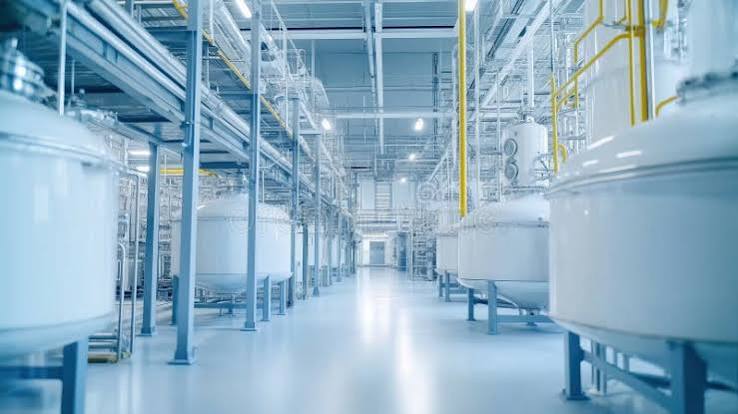
Industrial robots are increasingly useful for repetitive material-handling and manufacturing tasks. In chemical facilities, automated systems can support activities such as packaging, palletising, material transportation and handling operations designed for controlled environments.
When integrated with AI-based monitoring, robotic systems can respond to production requirements and coordinate tasks with other equipment. This can improve workflow consistency and reduce the amount of repetitive manual work required from employees.
Digital Twins in Chemical Production
A digital twin is a virtual representation of a physical production asset or process. It uses operational data to reflect the behaviour of real equipment and manufacturing systems.
Chemical manufacturers can use digital twins to examine production conditions, evaluate process changes and understand how different operating parameters influence performance.
For example, a manufacturer can model changes in reactor operating conditions before applying adjustments to the physical production process. This allows engineers to evaluate possible outcomes in a controlled digital environment.
AI Applications in Quality Control and Product Development
Product consistency is essential in chemical manufacturing because variations in composition, purity and physical properties can affect downstream applications. AI-powered quality-control systems help manufacturers identify patterns that traditional inspection methods may overlook.
Intelligent Quality Inspection
Machine learning models can analyse laboratory results, production measurements and sensor data to identify variations in product characteristics.
These systems can help manufacturers:
Detect deviations from established product specifications.
Identify production conditions associated with quality variations.
Monitor batch-to-batch consistency.
Support faster investigation of manufacturing problems.
AI-based quality monitoring can also help manufacturers identify relationships between raw material characteristics and final product quality.
Faster Research and Development
AI is creating new opportunities in chemical research and product development. Machine learning models can analyse chemical data, predict material properties and support the evaluation of potential formulations.
Researchers can use computational models to narrow down possible experimental options before conducting physical laboratory testing. Generative AI can also assist with technical documentation, research workflows and the organisation of scientific information.
These applications can support more efficient research activities, although laboratory validation remains essential before manufacturers commercialise new products or processes.
Energy Efficiency and Sustainable Chemical Production
Energy consumption is a major operational consideration for chemical manufacturers. Processes involving heating, cooling, separation, compression and material conversion can require significant amounts of energy.
AI-based optimisation systems can analyse energy consumption alongside production data to identify inefficient operating conditions. Manufacturers can use these insights to improve resource management without compromising product specifications or process requirements.
Optimising Energy and Resource Consumption
AI systems can support energy management through several applications:
Process optimisation: Analysing operating parameters to identify opportunities for more efficient production.
Utility management: Monitoring steam, electricity, cooling water and compressed-air consumption.
Waste reduction: Identifying production variations that contribute to off-specification materials.
Resource planning: Improving coordination of raw materials and production schedules.
The International Energy Agency identifies industrial AI applications as an important opportunity for improving manufacturing efficiency and reducing energy consumption. However, actual results depend on the process, technology and quality of implementation.
Supporting Environmental Monitoring
Chemical manufacturers must also monitor emissions, wastewater and industrial waste. AI-enabled monitoring systems can analyse environmental measurements and highlight unusual changes that require investigation.
Combined with established environmental-control equipment, these systems can support more consistent monitoring and improve the availability of operational information for environmental management.
Challenges Facing AI Adoption in Chemical Manufacturing
Despite its potential, implementing AI across chemical manufacturing facilities involves technical, financial and organisational challenges. Many facilities operate established equipment and legacy control systems that were not originally designed for advanced data integration.
Data Quality and System Integration
AI models depend on accurate and reliable information. Inconsistent sensor readings, incomplete production records and disconnected software platforms can reduce model performance.
Manufacturers may need to improve data collection, standardise information formats and integrate older equipment with modern digital systems before deploying advanced AI applications.
Investment and Technical Expertise
Implementing smart production technology requires investment in sensors, software, computing infrastructure and employee training.
Chemical manufacturers also need professionals who understand both industrial processes and digital technologies. Collaboration between process engineers, data specialists, maintenance teams and automation professionals is therefore important.
Cybersecurity and Operational Safety
Connected production systems create additional cybersecurity considerations. Manufacturers must protect industrial networks, production records and operational technology against unauthorised access.
AI recommendations must also undergo appropriate technical validation. Chemical plants involve safety-critical operations where incorrect decisions can affect equipment, employees and production environments. Human oversight, established safety procedures and independent control protections remain essential.
What the Future Holds for Smart Chemical Production
The next stage of AI-driven chemical manufacturing will likely focus on connecting individual digital applications into integrated production systems. Instead of using separate tools for maintenance, quality control and process optimisation, manufacturers are moving towards connected platforms that share operational information across departments.
More Adaptive and Autonomous Operations
AI-supported control systems are expected to become more capable of responding to changing production conditions. Physics-informed models, advanced process control and reinforcement learning are among the approaches being explored to improve industrial decision-making.
However, fully autonomous chemical plants remain a longer-term objective in many applications. Complex processes still require engineering validation, safety controls and human supervision.
Greater Integration Across Supply Chains
Smart production will also influence how chemical manufacturers coordinate with suppliers, distributors and industrial buyers.
AI-based forecasting can help businesses analyse demand patterns, monitor inventory requirements and plan production according to expected market conditions. Better coordination between procurement and manufacturing teams can also support more informed raw material purchasing decisions.
For global chemical buyers, improved production visibility may eventually provide better information about product availability, manufacturing schedules and supplier reliability.
Chemical manufacturers are also exploring generative AI and AI assistants to support technical teams. These tools can help employees retrieve information from operating procedures, equipment manuals and production records, allowing them to access relevant information more efficiently.
The World Economic Forum's 2026 outlook for intelligent industrial operations highlights a shift towards connected systems in which people and intelligent technologies work together across production and supply chains. This direction suggests that future factories will depend increasingly on integrated digital capabilities rather than isolated automation projects.
World Economic Forum+1
What Manufacturers Should Prioritise
Companies planning to adopt AI should focus on practical improvements rather than implementing technology without a clear operational objective.
Important priorities include:
Start with measurable needs: Identify recurring production problems, equipment downtime or quality-control issues that AI could help address.
Strengthen data infrastructure: Improve sensor reliability, production records and connections between existing systems.
Invest in employee capabilities: Train engineers and production teams to understand AI-supported tools and interpret their recommendations.
Maintain human oversight: Establish validation procedures and clear responsibilities for decisions involving production safety.
Expand successful applications: Test AI solutions on a manageable scale before introducing them across additional production facilities.
The future of chemical manufacturing will depend on how effectively businesses combine industrial experience with digital innovation. Manufacturers that build reliable data systems and introduce AI gradually can develop more efficient and adaptable production operations.

Titanium Dioxide
Found this useful?