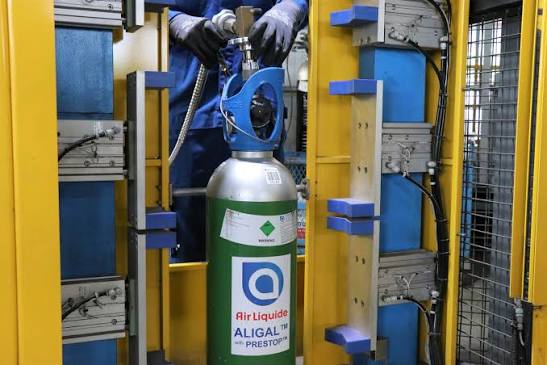
Air Liquide's Purity Standards Have Direct Relevance to Food-Grade Gas Supply
Air Liquide's investment in ultra-high-purity gas production for its Arizona semiconductor facility is primarily aimed at supporting advanced chip manufacturing. However, the underlying purity engineering, quality control, and gas-handling standards have broader relevance to the food and beverage industry.
Food-grade gases are used in applications such as modified atmosphere packaging (MAP), beverage carbonation, food processing, freezing, and storage. While the required specifications vary by application, the broader principle is the same: consistent gas purity and reliable supply are critical to product quality and process control.
This makes developments in high-purity industrial-gas infrastructure relevant to food ingredient and food-processing supply chains as well.
Why Gas Purity Matters
Food and beverage manufacturers depend on gases that meet appropriate food-grade specifications and regulatory requirements.
Key applications include:
Modified atmosphere packaging
Beverage carbonation
Food processing
Fresh-food preservation
Freezing and chilling
Storage and transportation
Packaging process control
Consistent gas quality can help manufacturers manage oxidation, microbial growth, product shelf life, and packaging performance.
Cross-Industry Purity Intelligence
Air Liquide's semiconductor investment illustrates how technologies developed for highly demanding industries can influence adjacent applications.
1. Semiconductor Manufacturing
Chip fabrication requires extremely high-purity gases because trace contaminants can affect sensitive manufacturing processes.
2. Food & Beverage
Food-grade gases similarly require controlled purity and handling to prevent contamination and maintain product specifications.
3. Quality Systems
Advanced monitoring, purification, storage, and distribution systems can support increasingly sophisticated gas-quality requirements.
4. Supply Reliability
Both industries depend on uninterrupted access to critical gases, making production capacity and distribution infrastructure important procurement considerations.
Food and beverage manufacturers commonly use Carbon Dioxide (CO₂) for beverage carbonation and Nitrogen (N₂) for modified atmosphere packaging and food preservation. Other gases, including Oxygen (O₂) and Argon, can also serve specialized food-processing and packaging applications where controlled gas composition is required.

Barium Chloride Dihydrate
Market Implications
Investment in high-purity gas infrastructure could have broader benefits for industrial and food-grade gas supply chains.
Potential implications include:
Improved gas purification technologies
Stronger quality-control systems
Greater regional production capacity
More sophisticated gas monitoring
Increased supply reliability
Technology transfer across end markets
The food and beverage industry may benefit indirectly as industrial-gas suppliers improve purification and distribution capabilities for demanding customers.
Competitive Intelligence
Food ingredient and beverage companies can monitor industrial-gas investments to understand potential changes in regional supply capabilities.
Useful indicators include:
New gas-production facilities
Purification capacity
Regional distribution infrastructure
Supplier investments
Food-grade certification capabilities
Storage capacity
Cylinder and bulk-gas logistics
Tracking these developments can help buyers understand where future food-grade gas capacity may become available.
Procurement Considerations
Food and beverage manufacturers should evaluate food-grade gas suppliers based on both product specifications and supply-chain reliability.
Important factors include:
Food-grade certification
Gas purity
Quality-control systems
Traceability
Production location
Bulk versus packaged supply
Storage and distribution capabilities
Business continuity planning
For critical applications such as MAP and beverage carbonation, supplier reliability can be as important as the headline price.
Looking Ahead
Air Liquide's Arizona investment demonstrates how demanding semiconductor applications continue to push the boundaries of industrial-gas purification and quality management.
Although the project is designed for semiconductor manufacturing, the broader technological improvements can have relevance across other markets that depend on controlled gas purity.
For food and beverage manufacturers, monitoring developments in industrial-gas purification, certification, and regional infrastructure can provide useful insight into future supply capabilities and sourcing options.
Key Takeaways
Air Liquide's Arizona facility is focused on semiconductor-grade gas requirements.
High-purity gas technologies can have applications beyond semiconductor manufacturing.
Food-grade gases are important for MAP, carbonation, preservation, and food processing.
Purity control, traceability, and supply reliability are critical across both industries.
Industrial-gas infrastructure investments can provide useful intelligence for food and beverage procurement teams.
Found this useful?