
Albemarle's Q2 2026 Earnings Beat: What a 23.8% EPS Surprise Means for Chemical Buyers
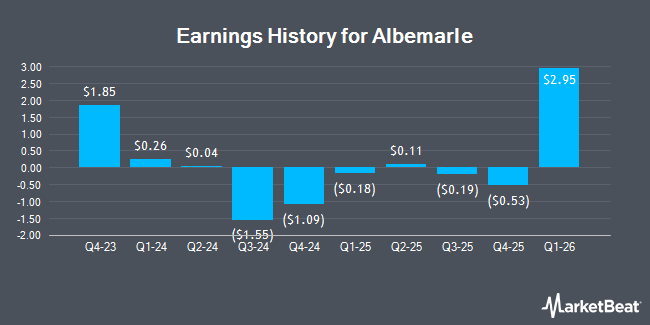
Albemarle closed out the second quarter of 2026 with adjusted earnings of $3.75 a share, well ahead of the $3.03 consensus estimate analysts had penciled in. That works out to a 23.8% surprise, one of the sharper beats among chemical producers reporting this season. Revenue told a similar story, coming in at $1.74 billion against a $1.59 billion forecast, a 9.4% upside surprise.
For a company that reported a loss just a year earlier, the turnaround is striking. It also carries real weight for anyone buying lithium derivatives or specialty chemicals tied to battery supply chains.
What Drove the Earnings Surprise
The rebound traces almost entirely to lithium pricing. Albemarle's Energy Storage segment, which supplies lithium hydroxide and lithium carbonate for battery manufacturing, saw its average realized price jump roughly 60% to 73% year over year, landing near $20 per kilogram of lithium carbonate equivalent.
That pricing recovery combined with higher shipped volumes to reshape the segment's economics almost overnight.
Energy Storage net sales reached $1.28 billion, up 78% from a year earlier.
Segment adjusted EBITDA climbed 229% to roughly $723 million.
Production volume held at 65,000 tons of lithium carbonate equivalent, an 11% increase.
Specialties, the smaller of Albemarle's two main segments, also contributed. Net sales there rose 20% to $424 million, with adjusted EBITDA up 61% to $118 million on better pricing and productivity gains.
Breaking Down the Q2 2026 Numbers
Company wide, net income attributable to Albemarle reached $480 million, compared with just $22.9 million in the same quarter last year. Adjusted EBITDA more than doubled, rising 155% to $858 million, and the enterprise EBITDA margin expanded to 49%, a sharp jump from around 25% a year earlier.
Cash generation matched the earnings story. Operating cash flow came in at $710 million, with more than 80% cash conversion, and free cash flow reached $638 million. Investors responded quickly. Shares rose 4.3% in premarket trading following the release.
Adjusted EBITDA and adjusted EPS are non-GAAP measures Albemarle uses to strip out one-time items, so buyers comparing quarters should keep that distinction in mind when reading company commentary.
Segment Performance and What It Signals
The gap between Albemarle's two segments is worth a closer look. Energy Storage now accounts for the bulk of both revenue and profit growth, reflecting how tightly the company's fortunes are bound to lithium market cycles.
Specialties, covering bromine based flame retardants and other performance chemicals, grew more steadily and with less volatility. For buyers sourcing outside the battery supply chain, that segment's performance may be the more useful benchmark.
A few points worth watching:
Lithium pricing sensitivity remains the single biggest swing factor for Albemarle's full year results, with the company outlining 2026 EBITDA scenarios ranging from under $1 billion to over $4 billion depending on where average prices land.
Specialties guidance was raised for the year, pointing to steadier demand in that segment regardless of lithium price swings.
Capital spending for 2026 was trimmed to roughly $500 million, suggesting management is prioritizing balance sheet discipline even as earnings recover.
What This Means for Procurement Teams
A beat this size does not happen in isolation. It reflects a lithium market that tightened faster than most analysts expected heading into the quarter. Buyers negotiating supply contracts for lithium hydroxide, lithium carbonate or related battery chemicals should treat this report as confirmation that pricing power has shifted back toward producers, at least for now.
That shift has practical implications. Contracts negotiated on the assumption of soft lithium pricing may need revisiting. Buyers with flexibility in timing might also want to lock in volumes before further price appreciation, particularly if downstream battery demand continues to firm up through the second half of the year.
Albemarle itself flagged that Q3 2026 results are expected to decline sequentially, tied to lower energy storage volumes and inventory timing. That is a useful reminder that even strong quarters in this market can be followed by softer ones, so buyers should avoid reading a single beat as a permanent shift in the pricing floor.
Looking Ahead to 2027
Albemarle's growth plans extend well beyond this quarter. The company's CGP3 processing restart is expected to reach full run rate in early 2027, supporting a production growth trajectory toward 240,000 to 260,000 tons of lithium carbonate equivalent by that year. A direct lithium extraction project at the Salar de Atacama is also moving forward in phases, though it remains subject to permitting and technology validation.
For buyers planning multi-year sourcing strategies, these expansion timelines matter as much as the current quarter's numbers. Supply growth on this scale, if it lands on schedule, could eventually ease some of the pricing pressure that drove this quarter's surprise.
What Buyers Should Do Now
Albemarle's Q2 2026 results confirm that lithium and specialty chemical pricing has firmed up meaningfully compared with the past year. Buyers should treat this earnings beat as a market signal rather than a one-off event, while staying alert to the sequential softening the company itself has flagged for the next quarter.
Reviewing existing contracts, watching lithium price benchmarks closely and building in flexibility for the next few reporting cycles will serve procurement teams better than reacting to a single quarter's headline number.
2-Ethyl Hexanol
Found this useful?