
Aluminium Hydroxide: Industrial Uses in Flame Retardants and Plastics
Aluminium hydroxide has become an important industrial material for manufacturers looking to improve fire safety in plastics, rubber and construction products. Also known as aluminium trihydrate (ATH), this white inorganic powder offers flame-retardant and smoke-suppressing properties that make it useful across several manufacturing sectors.
Unlike conventional flame retardant additives that rely on chemical reactions involving halogens, aluminium hydroxide works through heat absorption and water release. This mechanism helps reduce combustion intensity while supporting the development of halogen-free plastic formulations.
For chemical traders, manufacturers and procurement managers, aluminium hydroxide represents an important raw material in the growing market for fire-resistant materials. Understanding its technical properties, industrial applications and purchasing requirements helps businesses select suitable grades for their production needs.
What Is Aluminium Hydroxide and How Does It Work?
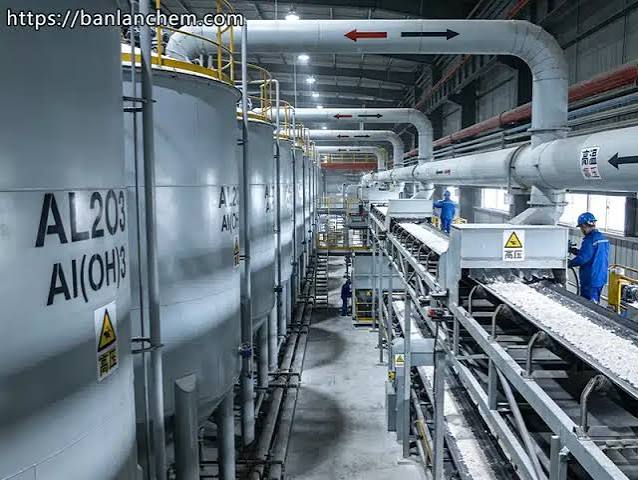
Aluminium hydroxide has the chemical formula Al(OH)₃ and is commonly supplied as a fine white powder. Manufacturers primarily produce industrial-grade material by processing bauxite through the Bayer refining process, which extracts alumina from the ore.
During production, aluminium-containing solutions undergo controlled precipitation to form aluminium hydroxide. Manufacturers then wash, filter and dry the material to achieve the required purity and particle size.
Flame Retardant Mechanism
The main advantage of aluminium hydroxide comes from its behaviour when exposed to high temperatures. It undergoes an endothermic decomposition process, meaning it absorbs heat while releasing chemically bound water.
The reaction can be represented as:
\[ 2Al(OH)_3 \rightarrow Al_2O_3 + 3H_2O \]
This process supports fire resistance through several mechanisms:
Heat absorption: The decomposition reaction consumes thermal energy, helping cool the surrounding polymer material.
Water vapour release: Released water vapour dilutes combustible gases and reduces the intensity of combustion.
Protective layer formation: Aluminium oxide remains on the material's surface and helps create a barrier against heat and oxygen.
Smoke suppression: Its inorganic composition and decomposition behaviour help reduce smoke generation in suitable polymer formulations.
These properties make aluminium hydroxide a widely used mineral-based flame retardant.
NETZSCH Analyzing & Testing+2
Major Applications of Aluminium Hydroxide in Flame Retardants
Fire safety requirements influence material selection across electrical, construction and transportation industries. Aluminium hydroxide helps manufacturers develop products that resist ignition and reduce fire-related risks.
Electrical Wires and Cable Insulation
Cable manufacturers use aluminium hydroxide in polymer compounds designed for wire insulation and external sheathing. Electrical cables installed in commercial buildings, industrial facilities and transportation infrastructure require materials that can limit fire propagation.
ATH works particularly well in suitable polyolefin and ethylene vinyl acetate (EVA) formulations. Its smoke-suppressing properties also make it useful in applications where smoke generation creates additional safety concerns.
Manufacturers must select the correct particle size and loading level to maintain flexibility, electrical performance and processing characteristics.
Construction Materials and Building Components
The construction industry uses aluminium hydroxide in several fire-resistant materials, including:
Wall panels and decorative surfaces: Helps improve the fire performance of polymer-based building components.
Solid surface materials: Supports fire-resistant formulations used in countertops and interior finishing products.
Polyester composites: Provides flame-retardant properties in unsaturated polyester resins used for construction applications.
Protective coatings: Serves as a mineral component in selected coating formulations designed to improve fire performance.
These applications are particularly relevant for manufacturers supplying commercial buildings, public infrastructure and industrial facilities.
Rubber and Industrial Products
Rubber manufacturers incorporate aluminium hydroxide into selected compounds to improve fire performance and reduce smoke generation.
Common applications include industrial rubber components, cable materials and specialised rubber products used in environments where fire safety matters.
However, the high filler loading required for effective flame retardancy can influence elasticity and mechanical strength. Manufacturers must therefore balance fire performance with the physical requirements of the finished product.
Aluminium Hydroxide in Plastic Manufacturing
Plastic manufacturers use aluminium hydroxide as both a functional flame retardant and an inorganic filler. Its compatibility with selected polymer systems allows producers to develop materials with improved fire performance without relying entirely on conventional halogenated additives.
Polyethylene and Polypropylene
Polyethylene (PE) and polypropylene (PP) are widely used thermoplastics across packaging, construction, electrical equipment and consumer goods.
Aluminium hydroxide can improve the flame-retardant performance of selected formulations, particularly when manufacturers use suitable processing temperatures and additive combinations.
Typical applications include cable insulation, plastic enclosures and industrial components. However, manufacturers must ensure that processing temperatures remain compatible with the thermal stability of ATH.
PVC and Other Polymer Compounds
PVC manufacturers use aluminium hydroxide in selected formulations for flooring, cable sheathing and construction products.
It can also support flame-retardant systems in acrylic materials and thermosetting resins. In these applications, the mineral additive contributes to heat absorption and smoke suppression while serving as a functional filler.
Engineering Plastics and Composite Materials
Manufacturers also consider aluminium hydroxide for selected composite and resin applications where fire resistance forms part of the product specification.
Its effectiveness depends on the polymer matrix, processing conditions, particle distribution and interaction with other additives. Not every engineering plastic can accommodate ATH because some polymers require higher processing temperatures.
This makes compatibility testing essential before large-scale production.
Key Factors Affecting Aluminium Hydroxide Performance
The performance of aluminium hydroxide depends on more than its chemical composition. Manufacturers must evaluate several technical characteristics before selecting a grade for their formulations.
Particle Size and Distribution
Particle size influences how aluminium hydroxide disperses throughout a polymer matrix. Fine particles generally provide better distribution when manufacturers use suitable mixing conditions.
Poor dispersion can create inconsistent material properties and reduce the effectiveness of the flame-retardant system. Procurement teams should review particle size specifications, including D50 and D99 values, when comparing suppliers.
Purity and Chemical Composition
Industrial manufacturers require consistent chemical composition to maintain product quality. Impurities such as iron compounds, silica and residual alkali can influence colour, processing behaviour and the performance of the final formulation.
Buyers should examine the supplier's technical data sheet for:
Aluminium hydroxide purity.
Iron oxide and silica content.
Sodium oxide concentration.
Moisture and loss on ignition.
pH and physical appearance.
Consistent specifications help manufacturers maintain reliable production standards across different batches.
Surface Treatment and Compatibility
Some aluminium hydroxide grades receive surface treatments to improve compatibility with polymer materials. Treatments involving fatty acids or silane-based compounds can improve dispersion and reduce interactions that negatively affect processing.
The correct treatment depends on the polymer type, production method and required mechanical properties. Manufacturers should request application-specific recommendations before selecting treated or untreated grades.
Benefits and Limitations for Industrial Manufacturers
Aluminium hydroxide offers several advantages for businesses developing fire-resistant products. However, its technical limitations require careful consideration during formulation and procurement.
Main Industrial Benefits
Halogen-free formulation: Supports the development of flame-retardant materials without introducing halogens through the ATH additive itself.
Smoke suppression: Helps reduce smoke generation in suitable polymer systems.
Multiple applications: Works in selected thermoplastics, thermosetting resins, rubber and coating formulations.
Filler functionality: Can contribute to the overall filler content of industrial compounds.
Commercial availability: Different particle sizes and surface-treated grades allow manufacturers to select materials for specific applications.
Technical Limitations
Despite its benefits, aluminium hydroxide does not suit every plastic manufacturing process.
Its decomposition generally begins within a temperature range that limits its use in high-temperature polymer processing. Manufacturers commonly consider processing temperatures below approximately 200°C, although the exact suitability depends on grade and process conditions.
Another challenge involves the relatively high loading levels needed to achieve effective flame retardancy. Excessive mineral content can increase compound density and stiffness while reducing flexibility, elongation and impact performance.
Manufacturers must therefore evaluate the complete formulation rather than selecting additives based only on their fire-retardant properties.
Mechanism, Types, & Applications+2
Global Supply Chain and Procurement Considerations
Aluminium hydroxide procurement requires attention to product specifications, supplier reliability and transportation conditions. Since manufacturers use different grades across multiple applications, purchasing decisions should focus on technical suitability rather than price alone.
Selecting the Right Supplier
Chemical buyers should evaluate suppliers according to several factors:
Product consistency: Confirm that each batch meets the required purity and particle size specifications.
Technical documentation: Request a technical data sheet (TDS), safety data sheet (SDS) and certificate of analysis (COA).
Production capacity: Check whether the supplier can support regular bulk orders and long-term requirements.
Packaging options: Evaluate standard bags, palletised shipments and bulk packaging according to storage and transportation needs.
Technical support: Prefer suppliers who can recommend suitable grades for specific polymer systems.
Storage and Transportation
Aluminium hydroxide generally requires dry and properly managed storage conditions. Moisture exposure can affect powder handling and create difficulties during compounding.
Procurement teams should use sealed packaging and store material in clean, dry warehouses. They should also prevent contamination from other chemicals and maintain suitable inventory controls.
For international shipments, buyers should verify packaging integrity, product documentation and consistency between the ordered specifications and delivered material.
Understanding Price and Supply Factors
Aluminium hydroxide purchasing costs can vary according to several commercial and production factors.
These include:
Bauxite and alumina processing costs.
Energy consumption during production.
Product purity and particle size requirements.
Surface treatment and specialised processing.
Freight charges and international shipping conditions.
Order quantities and supplier availability.
Buyers requiring specialised grades may face different cost structures from those purchasing standard industrial material. Comparing suppliers through technical specifications helps procurement teams identify the most suitable commercial offer.
Market Outlook and Future Industrial Demand
Demand for aluminium hydroxide remains connected to the development of fire-resistant materials across electrical, construction and industrial manufacturing sectors.
The expansion of electrical infrastructure, renewable energy installations and modern building systems creates opportunities for manufacturers supplying flame-retardant polymer compounds. Cable insulation, protective coatings and composite materials remain important application areas.
Growing Interest in Halogen-Free Materials
Manufacturers increasingly consider halogen-free flame-retardant systems when developing products for applications with specific environmental and fire-safety requirements.
Aluminium hydroxide supports this direction because it provides a mineral-based flame-retardant option. Its use can also help manufacturers reduce dependence on certain halogen-containing additives, depending on the overall formulation.
However, halogen-free formulations still require proper fire testing, material evaluation and compliance with applicable industry standards.
Product Development and Technical Innovation
Research and product development continue to focus on improving the performance of aluminium hydroxide in polymer applications.
Important development areas include:
Surface modification: Improving compatibility between mineral particles and polymer matrices.
Particle engineering: Developing specialised particle sizes for better dispersion and processing.
Advanced formulations: Combining aluminium hydroxide with other additives to improve fire performance.
Mechanical property improvements: Reducing the negative effects of high filler loading on flexibility and material strength.
These developments can help manufacturers expand the use of aluminium hydroxide in applications where fire safety and material performance must work together.
Key Considerations for Chemical Buyers
Aluminium hydroxide offers practical advantages for plastic manufacturers, cable producers, rubber processors and construction material suppliers. Its heat-absorbing behaviour, water release and smoke-suppressing properties make it a valuable component in selected flame-retardant formulations.
However, successful procurement requires attention to purity, particle size, surface treatment and compatibility with the intended polymer. Buyers should also evaluate processing temperatures and conduct formulation testing before approving a supplier for regular production.
Building relationships with reliable chemical suppliers can help manufacturers maintain consistent material quality and manage procurement requirements more effectively.
Aluminium Nitrate
Found this useful?