Deep-Sea Rare Earth Extraction Requires Novel Maritime Logistics Infrastructure
Deep-Sea Rare Earth Extraction Requires Novel Maritime Logistics Infrastructure
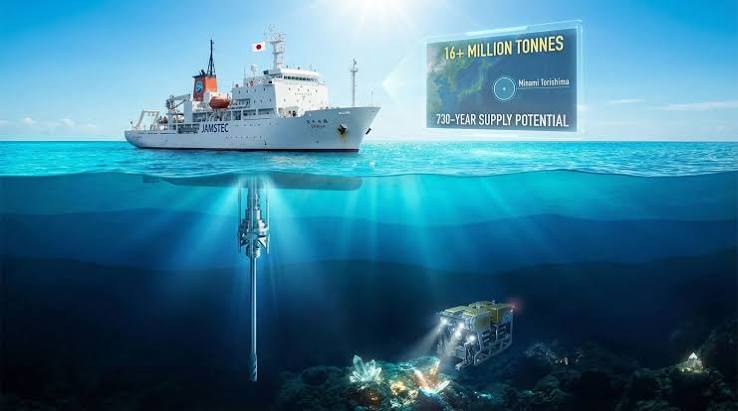
Japan’s effort to recover rare-earth-rich mud from the seafloor near Minamitorishima is as much a logistics and engineering challenge as it is a resource play. Operating at depths of 5,000–6,000 meters requires extraction, lift, transfer and onshore handling systems that have little precedent in traditional rare earth mining. The project therefore hinges on the creation of novel maritime logistics infrastructure capable of reliably moving large volumes of seabed material from the abyssal plain to processing facilities on land.
Conventional rare earth supply chains begin with open-pit or underground mining, followed by truck or rail transport to nearby concentrators and refineries. Deep-sea recovery inverts that model. Material must first be gathered and lifted through thousands of meters of water column, transferred to surface vessels under open-ocean conditions, and then shipped over long distances to mainland processing sites. Each step introduces technical demands—pressure-tolerant collection systems, continuous vertical transport, vessel station-keeping, and weather-resilient offshore handling—that standard mining logistics never confront.
Building a New Operational Chain
Test lifts conducted in 2026 have demonstrated the basic feasibility of recovering mud from extreme depth using specialized pipes and support vessels. Scaling to trial rates of hundreds of tons per day will require more robust and continuous systems: reliable subsea collection, efficient riser or pumping technology, onboard dewatering or storage, and shuttle or bulk-carrier connections to shore. Port infrastructure on the receiving end must also accommodate a new type of feedstock—fine, seawater-laden mud—whose handling, storage and environmental controls differ from conventional mineral concentrates.
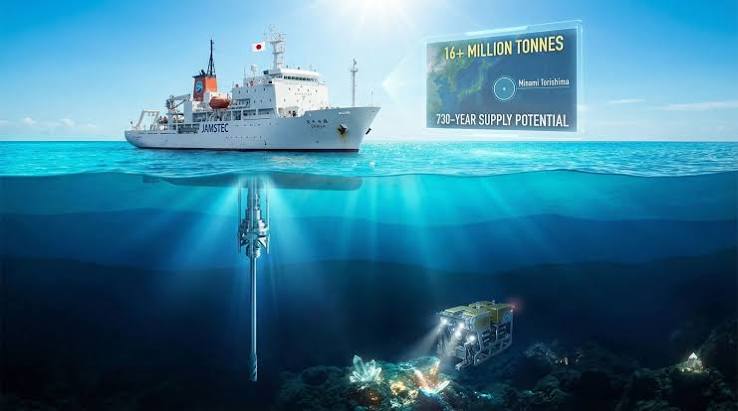
These requirements extend beyond single vessels. A functioning deep-sea rare earth operation would need a coordinated fleet, dedicated support bases, real-time monitoring and maintenance regimes suited to remote Pacific locations, and regulatory frameworks covering both maritime safety and environmental protection. The logistics architecture is therefore being designed essentially from first principles rather than adapted from existing mining practice.
Implications for Resource Development Timelines
For the specialty materials and critical-minerals marketplace, the infrastructure dimension helps explain why Japan’s program is measured in years and decades rather than months. Even after resource confirmation, the capital and engineering effort required to stand up a full maritime extraction and transport chain remains substantial. Success would create a new class of ocean-derived mineral logistics with potential relevance to other deep-sea resource efforts. Failure to solve the lift-and-transport problem at acceptable cost would keep the resource stranded regardless of its in-situ grade.
Japan’s deep-sea rare earth project thus illustrates a core truth of unconventional resource development: the mineral is only as accessible as the logistics system that can deliver it. Building that system—distinct in every major respect from land-based rare earth mining—remains the central operational challenge standing between seabed deposits and any future contribution to global supply.

Ammonium Sulphate - Taiwan
Found this useful?