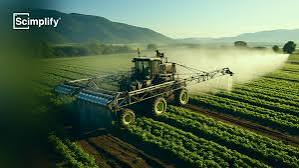
Crop protection is moving beyond the traditional model of applying more chemicals across larger areas.
A new generation of agricultural technologies is combining drones, biological inputs, artificial intelligence, precision application and data-driven pest management to make crop protection more targeted and potentially more sustainable.
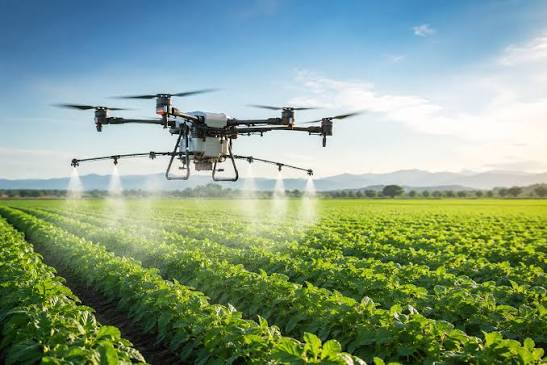
Agricultural drones are already being used for crop monitoring, pesticide spraying, fertilizer application and biological-agent delivery. Recent research shows particularly rapid adoption across Asia and Latin America.
At the same time, biological crop-protection technologies are advancing through improved microbial formulations, mass rearing, genomics, RNA-based approaches and precision-release systems.
The result is a different crop-protection model:
Detect → Decide → Target → Apply → Measure
Rather than treating an entire field uniformly, producers can increasingly identify where intervention is needed and choose the most appropriate input.
Why Crop Protection Is Changing
Traditional crop protection has generally relied on broad field applications of synthetic pesticides.
That model remains important, but producers face growing pressure to improve:
Digital agriculture offers one response.
Drones can collect high-resolution field information while also performing targeted application. Biological inputs can provide additional pest-management options alongside conventional chemistry.
Together, these technologies can change how crop-protection decisions are made.
Drones Are Becoming More Than Flying Sprayers
Agricultural drones are often associated with pesticide application, but their role is considerably broader.
Modern UAV platforms can support:
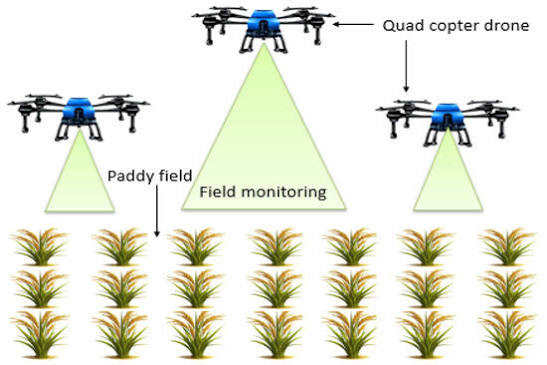
Crop monitoring
Pest detection
Disease identification
Fertilizer application
Pesticide spraying
Seed distribution
Biological-agent release
Crop-growth measurement
Reviews published in 2026 describe a rapid expansion of agricultural drone applications and increasing integration with multispectral, thermal and other sensing technologies.
That makes the drone less like a piece of spraying equipment and more like a mobile agricultural data-and-application platform.
Precision Spraying Changes the Economics
The economic argument for drones is not simply that they can spray faster.
Their larger advantage may be the ability to apply inputs when and where they are most needed.
Research on drone plant protection in Chinese maize production found that drone adoption was associated with 29% lower operating costs and 90% lower pesticide exposure time, while yield loss declined by about 4.6%. However, pesticide expenditure per application did not fall.
That distinction matters.
Drone technology can improve operational efficiency without necessarily reducing the amount farmers spend on crop-protection products.
More Precision Does Not Automatically Mean Less Pesticide
This is one of the most important realities of the new crop-protection model.
A precision system may allow farmers to treat specific areas more efficiently, but better timing can also encourage additional applications.
The Chinese maize research found that drone users increased pesticide application frequency by about 33%, primarily during later crop-development stages.
So the real objective should not simply be:
Use less pesticide.
It should be:
Use the right intervention at the right place and time.
That can improve economic and environmental efficiency even when total application behavior does not move in one direction.
AI Adds an Intelligence Layer
The next step is connecting drones with artificial intelligence.
A drone can collect:
Images
Multispectral data
Thermal information
Crop-height measurements
Vegetation indices
AI models can then attempt to identify:
Pest infestations
Disease symptoms
Nutrient deficiencies
Crop stress
Weed pressure
This creates the foundation for automated crop-protection decisions.
But there is an important caveat.
A 2026 meta-analysis of 121 UAV pest and disease studies found that 89% lacked truly independent test datasets, while only 11% evaluated models on independent fields. The researchers concluded that reported AI performance often does not yet translate reliably to real-world field conditions.
In other words, the technology is promising—but validation matters.
The New Model Is Closed-Loop Crop Protection
The most powerful system combines detection and intervention.
The process looks like:
Drone imaging → AI diagnosis → Prescription map → Targeted application → Follow-up imaging
The drone can identify a problem, generate a treatment map, apply the intervention and then return later to measure the result.
Recent research describes this shift toward closed-loop frameworks linking diagnosis with precision spraying.
That could fundamentally change crop protection from a periodic activity into a continuous management system.
Technology is only half of the transformation.
The other half is the input itself.
Biological crop-protection products include:
Microbial pesticides
Beneficial insects
Parasitoids
Entomopathogenic fungi
Biological fungicides
Natural compounds
Microbial formulations
Recent research highlights advances in mass rearing, genomics, microbial symbioses, RNA-based technologies and improved biological-control formulations.
These technologies can complement rather than simply replace conventional pesticides.
Drones Can Deliver Biological Agents
This is where the two trends become particularly interesting.
Drones are increasingly being investigated for the precision deployment of biological control agents.
Potential applications include releasing:
Parasitoids
Predatory insects
Microbial agents
Entomopathogenic fungi
A 2026 review describes drone-assisted biological-control systems using imaging, GPS and automated release mechanisms to improve timing and spatial accuracy.
That creates a new combination:
Digital detection + biological intervention.
Trichogramma Shows the Potential
One example is drone-assisted release of Trichogramma parasitoids for controlling crop pests such as corn borers.
Research cited in the 2026 biological-control review describes UAV systems that can improve distribution across large fields and reduce untreated gaps.
One reported field system achieved more than 97% field coverage while improving release accuracy through optimized flight paths.
The significance is broader than one biological agent.
It demonstrates that drones can potentially turn biological crop protection from a labor-intensive process into a scalable precision operation.
Biological crop protection has historically faced challenges around:
Precision technologies can help address some of these limitations.
If a biological product needs to be applied under specific conditions, better monitoring and more precise deployment can increase the probability of achieving the desired result.
That could make biological inputs more commercially practical.
The rise of biological products does not make chemistry irrelevant.
Quite the opposite.
Formulation remains critical for:
Stability
Storage
Compatibility
Application
Dispersion
Shelf life
Field performance
For chemical suppliers, this creates opportunities around adjuvants, solvents, stabilizers, carriers and formulation ingredients that can support both conventional and biological crop-protection systems.
Conventional Pesticides Are Not Disappearing
The new model should not be interpreted as the end of synthetic crop protection.
Synthetic chemistry remains essential for controlling many pests and diseases.
Instead, the industry is moving toward integrated pest management, where different tools are combined according to the specific agricultural problem.
A future crop-protection program could therefore combine:
This is more realistic than expecting one technology to replace everything else.
Resistance Management Could Become More Sophisticated
Pesticide resistance is one of the industry's persistent challenges.
Repeated use of the same chemistry can increase selection pressure on pest populations.
Precision application and biological-control technologies can potentially help diversify control strategies.
A 2026 review argues that UAV-enabled targeted delivery can reduce overall insecticide dosage in some applications and may help address resistance and environmental concerns, although drift and non-target effects still require careful management.
The future may therefore involve more deliberate combinations of chemical and biological control.
Precision Agriculture Connects Crop Protection With Fertilizer Management
The same drone infrastructure used for pest management can also support nutrient management.
UAV imagery can identify crop-growth differences and nutrient stress.
Recent work using multispectral UAV data and machine-learning models has demonstrated the potential to estimate crop biomass and nitrogen status for precision nitrogen management.
That means one agricultural platform could potentially support:
Crop health + nutrients + pests + disease + application decisions
The value of the technology increases as more agricultural decisions are connected to the same data infrastructure.
The New Crop-Protection Market Is More Data-Driven
This creates a major change in the industry's value chain.
Historically, value was concentrated around:
Active ingredient → Formulation → Distribution → Farmer
The emerging model adds several new layers:
Sensors → Data → AI → Diagnosis → Input selection → Precision application → Measurement
That means agricultural technology companies can increasingly participate in a market historically dominated by agrochemical manufacturers.
Agrochemical Companies May Need to Become Technology Companies
The competitive question for crop-protection manufacturers is changing.
Owning an effective active ingredient remains valuable.
But companies may increasingly need to understand:
Where the product should be applied
When it should be applied
How much should be applied
Which crops need it
Which biological products can complement it
How performance should be measured
The strongest companies may therefore combine chemistry, biology and digital agriculture.
Data Could Become a New Competitive Asset
A crop-protection company that has access to large datasets linking:
Crop conditions
Pest pressure
Weather
Product application
Yield
Treatment outcomes
could potentially develop better recommendations than a company with only laboratory data.
That creates a new form of competitive advantage.
The active ingredient remains important, but the knowledge surrounding its optimal use can become equally valuable.
Smallholder Agriculture Could Be a Major Opportunity
Agricultural drones are not limited to large farms.
Service-based drone models can allow farmers to access UAV technology without owning the equipment themselves.
The 2026 Chinese maize study specifically identified drone plant protection as a promising service-based model for smallholder systems.
This could be important in countries where farm holdings are fragmented and individual farmers cannot justify expensive equipment.
But Adoption Still Has Barriers
The transition will not happen uniformly.
Key barriers include:
A recent review of biological-control advances also identifies high operating costs, technological accessibility and regulatory constraints as important limitations.
Regulation Will Shape the New Model
Crop-protection technology sits at the intersection of several regulatory systems.
Companies may need to consider:
The technology may advance faster than regulation in some markets.
That creates both opportunities and uncertainty.
Procurement Is Changing Too
Agricultural procurement teams will increasingly need to evaluate more than the price of a pesticide.
They may need to compare:
Active ingredients
Biological alternatives
Formulation quality
Application technology
Drone-service costs
Treatment frequency
Labor requirements
Yield outcomes
The relevant metric becomes cost per effective crop-protection outcome, rather than simply cost per kilogram of product.
What This Means for Chemical Suppliers
The transformation creates opportunities beyond traditional pesticides.
Potential demand can emerge for:
Suppliers that can support both conventional and emerging crop-protection technologies may be better positioned as the market evolves.
What This Means for Investors
Investors should look beyond drone sales or biological-product launches.
Important indicators include:
1. Adoption
Are farmers actually using the technology?
2. Economics
Does precision application generate measurable returns?
3. Biological efficacy
Do biological products perform reliably outside controlled trials?
4. Data quality
Can AI models work across different crops, regions and seasons?
5. Integration
Are chemistry, biology and digital platforms being combined?
6. Regulatory progress
Can new products and application technologies scale commercially?
The Biggest Opportunity Is Integration
The most interesting development is not drones alone.
It is the combination of:
Drones + AI + Biological Inputs + Conventional Chemistry + Data
Each technology solves a different problem.
Drones provide mobility and precision.
AI provides interpretation.
Biological inputs provide additional control mechanisms.
Synthetic chemistry provides proven efficacy.
Data connects the system.
Together, they create a more flexible crop-protection model.
Looking Ahead
The face of crop protection is changing from a product-centered industry toward a precision-management industry.
The farmer of the future may not simply ask:
Which pesticide should I buy?
The question could become:
Which part of the field needs treatment, what is causing the problem, which intervention is most effective, and how can it be applied precisely?
Drones, AI and biological inputs are moving the industry toward that model.
The transition will not eliminate conventional agrochemicals. Instead, it is likely to make crop protection more integrated, data-driven and application-specific.
For chemical manufacturers, the opportunity is to participate in this broader ecosystem through active ingredients, formulation technologies and specialty inputs.
For agricultural buyers, the opportunity is to combine chemical, biological and digital tools to improve the economics of every treatment.
And for the crop-protection industry as a whole, the strategic advantage may increasingly come not from how much input is sold, but how intelligently that input is deployed.
Key Takeaways
Agricultural drones are expanding beyond spraying into monitoring, diagnosis, fertilizer application and biological-agent delivery.
AI and UAV imaging are creating the foundation for more targeted crop-protection decisions.
Real-world AI validation remains a major challenge; many published models have limited independent field testing.
Biological-control technologies are advancing through better formulations, mass rearing, genomics and precision deployment.
Drone-assisted release of biological agents could make biological crop protection more scalable.
Precision application can improve operating efficiency without necessarily reducing pesticide expenditure per application.
The future crop-protection model is likely to combine conventional chemistry, biological inputs, AI and precision application.
Procurement will increasingly focus on cost per effective treatment rather than input price alone.
Chemical suppliers can benefit from demand for active ingredients, adjuvants, formulation chemicals and biological-support materials.
The biggest long-term opportunity lies in integrating chemistry, biology and digital agriculture.