Fungal Enzyme PFAS Research Could Inform Future EPA Bioremediation Approval Pathways
Per- and polyfluoroalkyl substances, commonly known as PFAS, remain one of the most difficult chemical contamination challenges facing environmental remediation specialists. Their persistence has increased interest in technologies capable of breaking down these compounds rather than simply transferring them from one environmental medium to another.
Research into fungal enzyme systems is creating another potential pathway.
Scientists are investigating whether biological systems can contribute to PFAS degradation, potentially opening the door to remediation approaches that are less dependent on conventional treatment technologies. If the research progresses from laboratory experiments to validated field performance, fungal enzymes could eventually become part of the technology portfolio considered for contaminated-site cleanup.
However, that pathway remains developmental. Promising degradation research does not automatically translate into an approved commercial remediation technology.
Why PFAS Remediation Is So Difficult
PFAS compounds are valued for properties such as chemical stability, water and oil resistance and durability. Those same characteristics make them persistent in environmental systems.
Conventional remediation approaches can remove PFAS from contaminated water or soil, but removal does not necessarily mean destruction.
A treatment that concentrates PFAS into another material can create a secondary waste-management requirement.
This has increased interest in destructive remediation technologies, which aim to break down PFAS molecules into less problematic substances.
Biological degradation could eventually complement physical and chemical treatment methods if researchers can demonstrate reliable destruction under practical environmental conditions.
What Fungal Enzymes Could Add
Fungi produce diverse enzymes that allow them to break down complex organic materials in natural environments.
Researchers are exploring whether some fungal enzyme systems can interact with highly persistent fluorinated compounds and contribute to their degradation.
The potential attraction is significant.
An effective enzyme-based process could potentially operate under comparatively moderate conditions and may offer opportunities for integration with existing treatment systems.
However, PFAS chemistry is highly diverse. A treatment that works effectively on one compound may not necessarily work on another.
That means researchers need to establish the range of PFAS compounds affected by a particular biological system and determine whether degradation represents genuine destruction rather than transformation into other persistent compounds.
Laboratory Results Are Only the First Step
Promising laboratory findings are important, but environmental remediation requires a much higher level of evidence.
A technology moving toward practical deployment would need to demonstrate several characteristics.
Effectiveness: Can the system consistently reduce target PFAS concentrations?
Destruction: Does it actually break down PFAS rather than transfer or transform them?
Byproducts: What compounds are produced during degradation?
Reliability: Does performance remain consistent under different environmental conditions?
Scalability: Can the process operate beyond laboratory volumes?
Cost: Can treatment compete economically with existing technologies?
Environmental safety: Does the biological treatment introduce additional ecological risks?
These questions determine whether research can move toward practical remediation.
EPA Pathways Would Require Strong Evidence
The context for fungal enzyme research is particularly relevant to the U.S. Environmental Protection Agency because remediation technologies must meet applicable regulatory and site-specific requirements before widespread adoption.
A new biological treatment technology would need to demonstrate that it can achieve meaningful cleanup objectives while controlling secondary risks.
The exact regulatory pathway would depend on the technology, application and site.
Therefore, research demonstrating PFAS degradation should be viewed as a potential foundation for future technology development rather than evidence that an EPA-approved fungal remediation pathway already exists.
This distinction is important for chemical suppliers and environmental service companies evaluating emerging technologies.
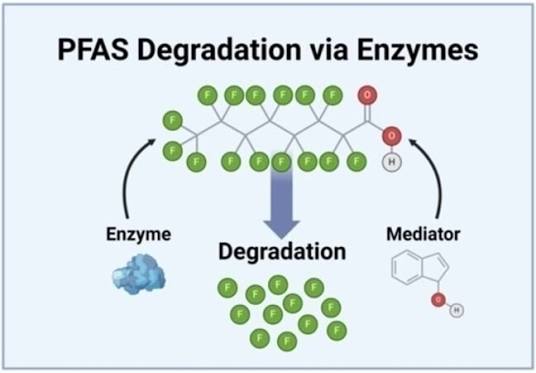
Destruction Versus Removal Matters
One of the most important considerations in PFAS remediation is whether a technology achieves destruction.
Traditional treatment systems can capture PFAS from contaminated water, but the concentrated material still requires management.
A biological process capable of breaking down PFAS could potentially address this problem at a molecular level.
However, proving destruction requires detailed analytical testing.
Researchers need to understand the starting compounds, intermediate products and final products generated during treatment. Without this information, a reduction in measured PFAS concentrations does not necessarily prove that the underlying contamination has been eliminated.
This will likely remain a central issue for evaluating emerging biological technologies.
Environmental Conditions Could Determine Performance
Laboratory systems can operate under carefully controlled conditions. Contaminated sites are much more complicated.
Soil composition, groundwater chemistry, temperature, pH, competing contaminants and microbial communities can all influence treatment performance.
A fungal enzyme system that performs well in controlled experiments may behave differently when exposed to a complex environmental matrix.
Field testing would therefore become an important development stage.
Researchers would need to determine whether the technology remains effective under realistic conditions and whether operators can maintain consistent treatment performance.
Integration With Existing Treatment Systems
Fungal enzyme technologies may not necessarily replace established PFAS treatment methods.
A more realistic development pathway could involve integration.
For example, biological treatment could potentially be used as one stage within a broader remediation system, depending on future performance data.
This could allow operators to combine different treatment technologies according to site conditions.
Potential treatment trains could eventually incorporate biological processes alongside physical separation, adsorption or other destructive technologies.
The commercial value would depend on whether such integration improves overall treatment economics or performance.
Procurement Implications for Environmental Remediation
The development of new PFAS treatment technologies could eventually change procurement decisions for contaminated-site cleanup.
Environmental contractors and site owners may need to compare technologies based on more than initial treatment costs.
Relevant factors include:
PFAS destruction efficiency.
Treatment capacity.
Energy requirements.
Secondary waste generation.
Chemical consumption.
Operating conditions.
Monitoring requirements.
Field performance.
Regulatory acceptance.
Total lifecycle cost.
Emerging biological technologies will need to demonstrate advantages across several of these categories before they can compete with established approaches.
Analytical Testing Will Be Critical
PFAS remediation depends heavily on reliable analytical measurement.
As biological systems are developed, analytical programs will need to determine whether treatment reduces target PFAS concentrations and whether potentially harmful transformation products remain.
This could create additional demand for analytical services, laboratory testing and specialized environmental monitoring.
For chemical and environmental service suppliers, the development of new remediation technologies therefore represents a broader market opportunity beyond the treatment technology itself.
Technology Validation Could Take Time
Environmental remediation decisions often involve significant technical and regulatory scrutiny.
Even if a fungal enzyme system demonstrates strong laboratory performance, commercial adoption may require additional testing, pilot projects and field demonstrations.
Site owners are unlikely to deploy an unproven treatment at large scale without confidence in its effectiveness and regulatory acceptability.
This creates a potentially lengthy path:
Laboratory discovery → controlled testing → pilot treatment → field validation → regulatory evaluation → commercial deployment.
Each stage can identify technical limitations that need to be resolved before the next stage.
The Commercial Opportunity Could Extend Beyond PFAS
Research into fungal enzymes may also contribute to broader environmental biotechnology.
Fungi produce a wide range of enzymes capable of interacting with complex organic compounds. Improved understanding of these biological systems could support research into other persistent contaminants.
For chemical and environmental technology companies, this makes fungal biotechnology an area worth monitoring beyond its immediate PFAS application.
The key question is whether researchers can translate biological activity into reproducible industrial processes.
What Procurement Teams Should Monitor
Environmental procurement teams can track the development of fungal PFAS remediation without treating early research as commercially available technology.
Important indicators include:
Peer-reviewed evidence of PFAS degradation.
Identification of effective enzyme systems.
Evidence of complete destruction.
Analysis of degradation products.
Pilot-scale treatment results.
Field demonstrations.
Treatment economics.
Regulatory evaluations.
Commercial partnerships between researchers and remediation companies.
These signals can help distinguish promising science from technologies approaching practical deployment.
What Chemical and Environmental Companies Should Do Now
Companies involved in PFAS remediation can prepare for emerging biological technologies by:
Monitoring research: Track credible developments in fungal and enzyme-based degradation.
Building technical partnerships: Engage with research organizations where appropriate.
Evaluating treatment compatibility: Determine whether biological approaches could complement existing systems.
Strengthening analytical capabilities: Ensure testing can verify both PFAS removal and degradation products.
Following regulatory developments: Monitor how agencies evaluate emerging destructive technologies.
Avoiding premature claims: Distinguish laboratory research from commercially validated and regulatory-approved remediation.
This approach allows companies to identify future opportunities without overstating the maturity of the technology.
The Bottom Line for Chemical Procurement Teams
Fungal enzyme research offers an intriguing potential direction for PFAS remediation because it focuses on biological degradation rather than simply moving persistent chemicals into another waste stream.
However, the transition from laboratory research to an EPA-recognized remediation pathway would require substantial evidence. Researchers and technology developers would need to demonstrate reliable degradation, understand byproducts, validate performance under realistic conditions and establish that the approach can operate safely and economically at scale.
For procurement teams, the immediate opportunity is intelligence gathering. Monitoring fungal enzyme research, analytical advances, pilot projects and regulatory developments can provide an early view of whether biological PFAS destruction is moving toward commercial viability.

Activated Carbon (Granular) - India
Found this useful?