
Intelligence Check: How Many Merck Spin-Off Assets Has Sun Pharma Now Acquired?
Sun Pharmaceutical Industries' proposed $11.75 billion acquisition of Organon gives the Indian pharmaceutical company a major new position in the global healthcare market and creates an important intelligence point for tracking Indian pharma's appetite for assets created through large multinational divestitures. Organon was spun off from Merck in 2021, making the transaction particularly notable as Sun Pharma effectively moves to acquire an entire company created through Merck's portfolio separation.
For pharmaceutical investors, traders, distributors and procurement teams, the deal raises a broader question: how many major assets originating from multinational pharma divestitures have Indian drugmakers accumulated during 2026?
Organon Is the Major Merck Spin-Off Acquisition
The centerpiece of Sun Pharma's 2026 M&A strategy is Organon.
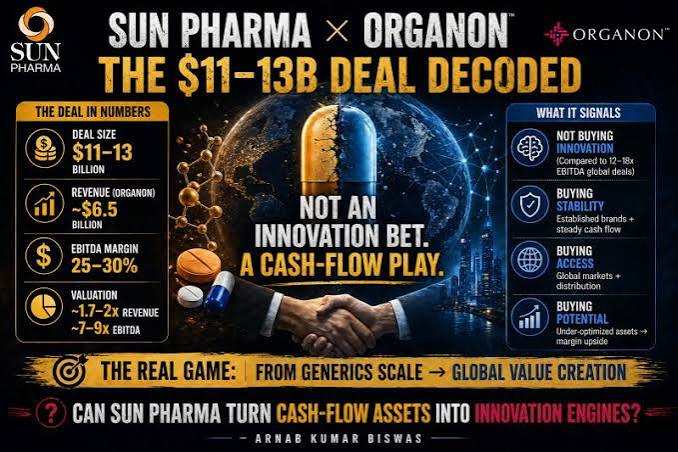
Sun Pharma agreed to acquire all outstanding Organon shares for $14 per share in cash, with the transaction carrying an enterprise value of approximately $11.75 billion. The acquisition remains subject to regulatory approvals and other closing conditions.
Organon itself was created through a 2021 spin-off from Merck, giving Sun Pharma exposure to a business that already operates as an independent global pharmaceutical company.
This makes Organon the clearest and most significant Merck-derived corporate asset now being brought into Sun Pharma's portfolio.
The Intelligence Count: One Major Spin-Off Company
Based on Sun Pharma's disclosed 2026 M&A activity, the answer to the headline intelligence question is one major Merck spin-off company: Organon.
That distinction matters.
Sun Pharma's history includes other transactions involving products and rights originating from Merck, but those should not automatically be counted as acquisitions of Merck spin-off companies.
For example, Sun Pharma's own investor presentation identifies ILUMYA as a 2014 business-development deal in which it acquired rights from Merck. It separately lists Organon under its 2026 major M&A moves.
Therefore, if the benchmark is specifically major corporate assets created through Merck spin-offs, Organon represents a distinct acquisition rather than simply another licensing transaction.
Why the Distinction Between Assets and Companies Matters
Pharmaceutical companies frequently acquire individual brands, drug rights, manufacturing operations or portfolios from larger multinational companies.
These transactions are different from acquiring an entire spin-off.
An acquisition such as Organon gives Sun Pharma access to:
A global commercial organization
Established pharmaceutical brands
Manufacturing infrastructure
Regulatory capabilities
International distribution networks
Research and development capabilities
Established relationships with healthcare providers
That makes the transaction strategically broader than acquiring a single medicine or therapeutic franchise.
A Major Expansion of Sun Pharma's Global Footprint
Organon operates across multiple pharmaceutical markets and has particular strength in women's health, biosimilars and established medicines.
The combination therefore expands Sun Pharma's global reach beyond its existing portfolio.
Industry observers will be watching whether Sun Pharma can use Organon's commercial infrastructure to accelerate growth in markets where it previously had a smaller presence.
The acquisition also reinforces Sun Pharma's strategy of using large-scale M&A to build a more diversified global pharmaceutical platform.
Sun Pharma Has a Long M&A Track Record
Organon is not Sun Pharma's first major international acquisition.
The company's own investor presentation highlights major transactions including:
Taro — 2010
Ranbaxy Laboratories — 2015
Concert Pharmaceuticals — 2023
Checkpoint Therapeutics — 2025
Organon — 2026
The presentation describes strategic M&A and business-development transactions as an important part of Sun Pharma's long-term value-creation strategy.
Organon therefore represents the latest and one of the largest steps in a long-running acquisition strategy.
Glacial Acetic Acid (99.8%) - China
The Scale of the Organon Deal Is the Bigger Intelligence Signal
The $11.75 billion enterprise value makes this transaction particularly significant.
Reuters described it as the largest overseas acquisition by an Indian pharmaceutical company.
That places the deal in a different category from the smaller bolt-on acquisitions that Indian pharmaceutical companies frequently use to expand individual therapeutic portfolios.
The transaction demonstrates that Indian drugmakers are increasingly capable of pursuing multinational pharmaceutical businesses at substantial scale.
Merck's Divestiture Strategy Creates Acquisition Opportunities
Merck's 2021 separation of Organon was part of a broader industry trend in which large pharmaceutical companies have separated mature or strategically distinct businesses from their core operations.
Once independent, these businesses can become potential acquisition targets for companies seeking:
Immediate revenue scale
Established brands
Global market access
Manufacturing capacity
New therapeutic categories
Commercial infrastructure
Organon's subsequent acquisition by Sun Pharma illustrates how a divested business can eventually return to the ownership structure of another major pharmaceutical company.
Indian Pharma Is Becoming a Major M&A Buyer
The Organon transaction also highlights the increasing international ambitions of Indian pharmaceutical companies.
Indian drugmakers have traditionally built global positions through generic medicines, contract manufacturing and smaller acquisitions.
Large transactions such as Organon indicate a willingness to acquire complete global platforms rather than simply individual products.
This could accelerate consolidation across the pharmaceutical industry.
The Transaction Also Adds Integration Risk
The scale of the acquisition creates significant integration requirements.
Sun Pharma will need to manage:
Multiple geographic markets
Different corporate cultures
Large commercial organizations
Manufacturing networks
Regulatory systems
Product portfolios
Employee integration
Financial consolidation
Credit analysts have already highlighted the operational and cultural complexity associated with integrating Organon's global footprint.
The transaction is currently expected to close in early 2027, subject to required approvals and closing conditions.
Procurement and Supply Chain Implications
For pharmaceutical procurement teams, the ownership change is worth monitoring well before closing.
Potential areas to track include:
Supplier agreements
Manufacturing arrangements
API sourcing
Packaging contracts
Distribution networks
Regulatory documentation
Vendor qualification
Regional production strategies
Large acquisitions can eventually lead to changes in purchasing structures as the acquiring company seeks procurement efficiencies across the combined organization.
What the Acquisition Means for Pharmaceutical Traders
Pharmaceutical traders should also monitor whether Sun Pharma's expanded portfolio changes regional product flows.
Organon's existing international footprint could give Sun Pharma greater access to markets where it previously had less direct exposure.
This could influence:
Product availability
Regional distribution
Licensing arrangements
Generic competition
Biosimilar supply
Established-brand sourcing
The impact will become clearer as integration progresses after closing.
Looking Ahead
Sun Pharma's Organon transaction provides a clear answer to the intelligence question: one major Merck spin-off company—Organon—is now the central Merck-derived corporate asset in Sun Pharma's 2026 acquisition strategy.
However, the more important signal is the scale of the transaction.
At $11.75 billion enterprise value, Organon represents a major step beyond conventional pharmaceutical bolt-on M&A and demonstrates the increasing ability of Indian drugmakers to acquire established multinational platforms.
For investors and pharmaceutical industry analysts, the next intelligence benchmark will be whether Sun Pharma follows Organon with additional large acquisitions of divested multinational assets.
If that pattern continues, Indian pharmaceutical companies could become increasingly important buyers of businesses that global pharma companies choose to spin off or divest.
Key Takeaways
Sun Pharma has agreed to acquire Organon, a company spun off from Merck in 2021.
The transaction has an enterprise value of approximately $11.75 billion.
Organon is the one major Merck spin-off company directly represented in Sun Pharma's 2026 M&A strategy.
Sun Pharma has previously acquired individual products or rights from Merck, but those should not be counted as acquisitions of Merck spin-off companies.
The Organon deal is significantly larger than a typical pharmaceutical bolt-on transaction.
Reuters described it as the largest overseas acquisition by an Indian pharmaceutical company.
Organon expands Sun Pharma's exposure to women's health, biosimilars and established medicines.
Integration of Organon's global operations will be a major post-deal challenge.
The transaction is expected to close in early 2027, subject to regulatory approvals and other conditions.
The deal could signal a broader rise in Indian pharma acquisitions of multinational divestiture assets.
Found this useful?