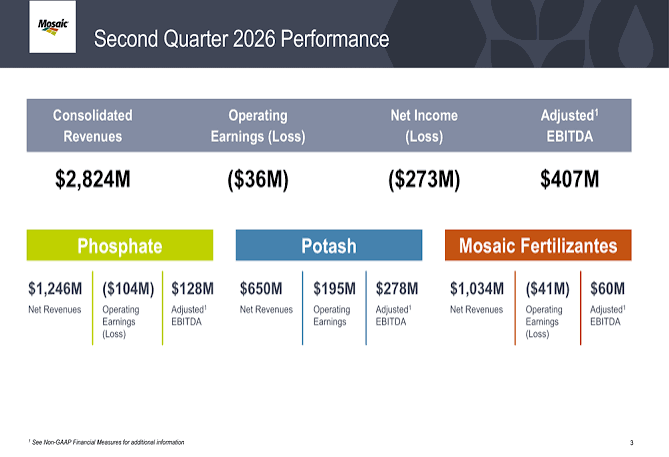
Mosaic's second quarter results landed with a split headline. Adjusted earnings per share came in at $0.13, ahead of the Zacks consensus estimate of $0.09. At the same time, the company reported a GAAP net loss of $273 million, or $0.86 per diluted share, a sharp reversal from the $411 million profit it posted in the same quarter last year.
Both numbers are accurate. Neither tells the full story on its own. For chemical and fertilizer buyers trying to read Mosaic's underlying health, the gap between the two is the real story this quarter.
Why the Numbers Look So Different
The difference comes down to $351 million in pre-tax notable items excluded from the adjusted figure. The largest single piece was a $162 million mark-to-market adjustment tied to Mosaic's equity stake in Ma'aden, the Saudi mining group. Add in $69 million of non-cash project write-offs and $49 million in foreign currency losses, and the GAAP result swings sharply negative even though core operations held up better than that number suggests.
This is not unusual for large diversified producers, but the size of the swing here is notable. Combined, these items reduced reported EPS by close to a dollar for the quarter.
Adjusted EPS: $0.13, beating the $0.09 consensus estimate.
GAAP diluted EPS: a loss of $0.86, driven mostly by one-time and non-cash items.
Adjusted EBITDA: $407 million, down from $566 million a year earlier.
Mosaic's three main segments told three different stories this quarter. Phosphate was the weakest performer operationally, posting an operating loss of $104 million even as net sales rose to $1.25 billion on stronger pricing. Lower sales volumes and elevated raw material costs, particularly sulfur, weighed heavily on margins.
Potash fared better. The segment delivered $195 million in operating earnings on $650 million in net sales, with average MOP prices around $275 per tonne and cash production costs held to just $84 per tonne. Mosaic Fertilizantes, the company's Brazilian operations, posted an operating loss of $41 million as sales volumes declined and parts of its commodity fertilizer production were idled due to sulfur affordability challenges.
Sulfur cost pressure shows up across nearly every segment this quarter. Q2 raw material costs included $522 per long ton for sulfur, and Q3 contracts have already settled higher at $705 per long ton on the US Gulf Coast.
What Drove the Phosphate Segment Weakness
Phosphate production was deliberately curtailed during the quarter. Mosaic idled its Faustina facility entirely and ran Bartow at roughly 40% of its target annual rate as of early July, a direct response to sulfur cost and supply pressure squeezing conversion economics.
That curtailment shows discipline rather than distress. Management chose to protect margins over chasing volume, a strategy that shows up clearly in the segment's adjusted EBITDA of $128 million, down from $217 million a year earlier but still positive despite the operating loss on a GAAP basis.
Cash Flow and Capital Allocation Signals
Operating cash flow told its own cautionary story, falling to $167.4 million for the quarter from $609.5 million a year earlier. Combined with capital expenditures of $320.3 million, the quarter produced negative free cash flow.
Management responded by trimming full year capital spending guidance to $1.2 billion, down from a prior $1.25 billion target. The company also completed the sale of its Carlsbad, New Mexico potash mine during the quarter and arranged a $1 billion term loan to refinance short-term commercial paper, both signals that liquidity management is a near-term priority.
A regular quarterly dividend of $0.22 per share was maintained despite the loss, which buyers watching Mosaic's financial stability may read as a signal of management's confidence in the underlying cash generation capacity once sulfur costs ease.
What This Means for Fertilizer Buyers
The adjusted EPS beat and the GAAP loss are not contradictory. They simply measure different things. Adjusted EPS strips out one-time and non-cash items to show a cleaner operating picture, while GAAP net loss reflects the full accounting reality, including a large equity mark-to-market swing that has little to do with fertilizer market fundamentals.
Buyers negotiating potash or phosphate supply contracts should focus less on either headline figure and more on the segment-level data. Potash economics remained solid this quarter, with cash costs well controlled and demand described by management as balanced heading into the third quarter. Phosphate economics are under real pressure from sulfur costs, and that pressure is likely to persist given where Q3 sulfur contracts have already settled.
Expect continued phosphate supply discipline through curtailments if sulfur costs stay elevated.
Potash supply looks more stable, with production targets around 9 million tonnes maintained for the year.
Brazilian fertilizer supply from Mosaic Fertilizantes may remain constrained while sulfur affordability issues persist.
What Buyers Should Do Now
Mosaic's Q2 2026 results are a reminder that headline earnings numbers rarely capture the full operating picture for a large diversified fertilizer producer. The adjusted beat reflects genuine operating resilience in potash and pricing gains across segments, while the GAAP loss reflects accounting items tied largely to an equity holding and non-cash write-offs rather than a collapse in core demand.
Buyers should track sulfur cost trends closely, since that single input is shaping phosphate supply decisions more than any other factor this quarter. Watching Mosaic's Q3 guidance on phosphate and potash volumes will offer a clearer read on where near-term availability and pricing are headed than either headline number from this report alone.