NovoNutrients' Loop Reactor Finds a Second Life in Bioindustrial Manufacturing
Biosphere's acquisition of a bioreactor previously operated by NovoNutrients for producing edible proteins and carotenoids from carbon dioxide has been characterized by a leading synthetic biology executive as one of the smartest bioindustrial manufacturing moves of the year. The transaction represents more than simple equipment transfer. It signals an emerging pattern in biotechnology where capital-intensive assets get redeployed across companies, applications and technology platforms as the sector matures beyond its venture-capital-fueled expansion phase into a more capital-efficient operational model.
For procurement professionals managing fermentation capacity, bioprocessing equipment and manufacturing partnerships, this acquisition illustrates several important trends. Specialized bioprocessing equipment retains significant value beyond its original application. Companies can acquire proven manufacturing capabilities at fractions of new-build costs. The secondary market for biotech assets is becoming more liquid and sophisticated as industry participants recognize opportunities to monetize stranded assets or acquire capacity without multi-year construction timelines.
What NovoNutrients Built and Why It Matters
NovoNutrients developed technology converting industrial carbon dioxide emissions into valuable food ingredients through microbial fermentation. The company's process used specialized bacteria that consume CO2 and hydrogen to produce single-cell protein suitable for animal feed and human food applications, along with carotenoid pigments used as natural colorants and nutritional supplements.
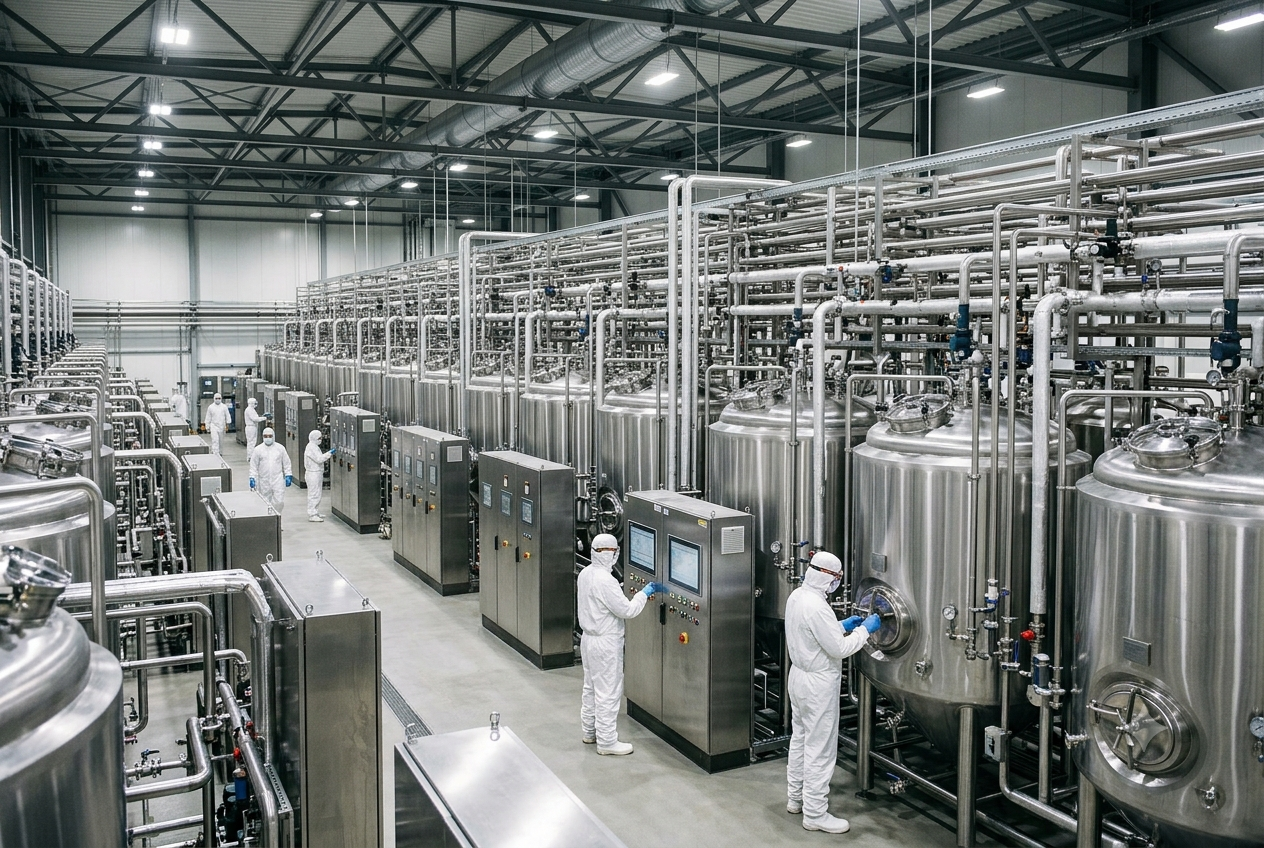
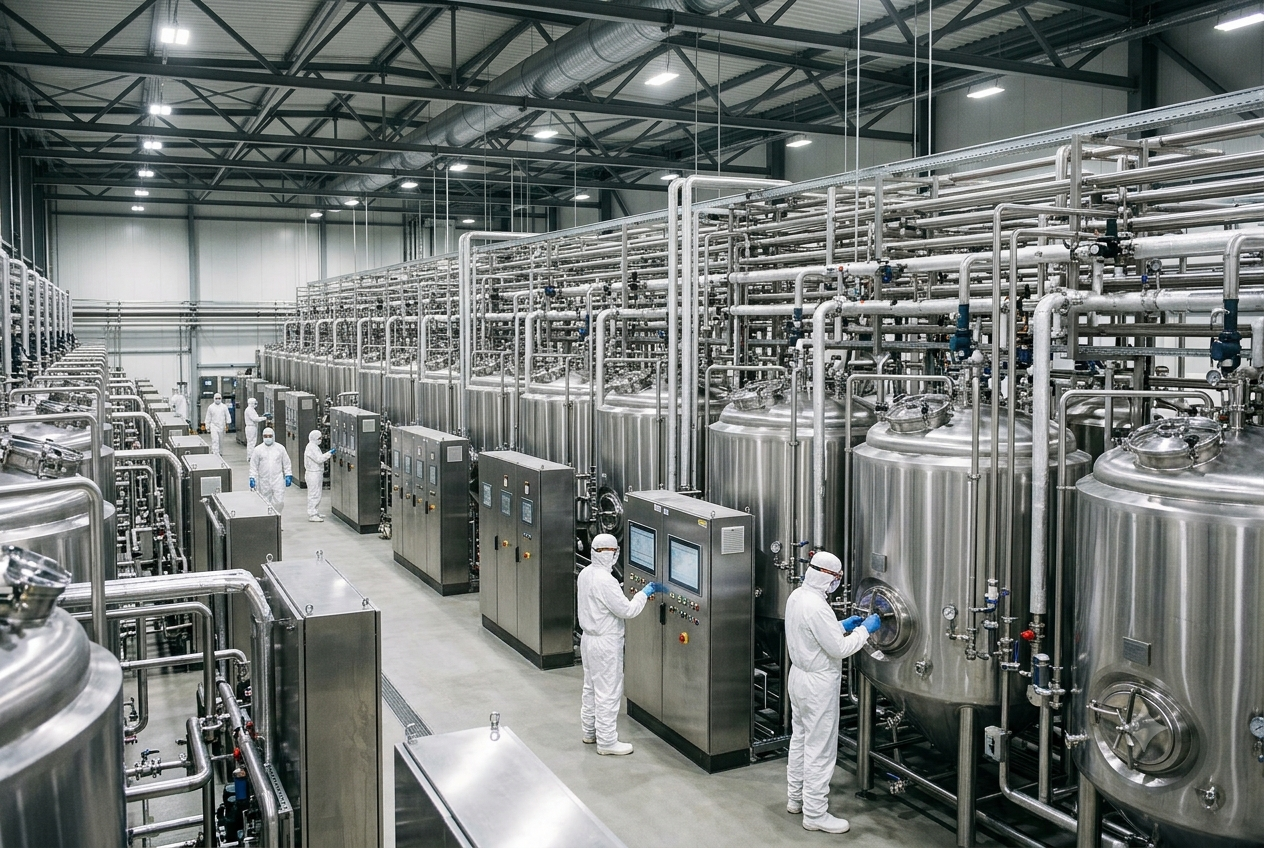
The bioreactor Biosphere acquired represents a loop reactor design optimized for gas fermentation applications where efficient gas-liquid mass transfer determines productivity. These reactors circulate fermentation broth through external loops containing gas injection points, heat exchangers and mixing zones that maximize contact between gaseous substrates and microbial cells.
Loop reactors cost significantly more than conventional stirred-tank fermenters due to specialized materials, pumping systems and instrumentation required for handling pressurized gases and maintaining the circulation patterns that drive performance. A commercial-scale loop reactor suitable for gas fermentation might cost $2 million to $5 million depending on capacity, materials of construction and automation level.
NovoNutrients invested in this equipment to demonstrate its technology at scale sufficient to attract customer commitments and additional funding. The reactor provided proof that the company's microbial strains and process design could operate continuously at productivities needed for commercial viability.
Why Companies Exit Despite Technical Success
NovoNutrients' technology worked from a technical standpoint. The company demonstrated CO2-to-protein conversion, achieved reasonable productivities and produced material meeting food safety and nutritional specifications. However, technical success does not guarantee commercial success in biotechnology.
Several factors cause biotech companies to exit or pivot despite functional technology. Market timing can be wrong, with customers not ready to adopt novel ingredients or production methods. Capital requirements for scaling beyond pilot stage often exceed what venture investors will provide, particularly for business models requiring heavy infrastructure investment before significant revenue generation.
Competitive dynamics also play a role. Multiple companies pursuing similar gas fermentation approaches create a race where only one or two winners may achieve sufficient market share to justify continued operation. Companies that fall behind in fundraising, partnerships or technology performance face difficult decisions about continuing operations versus monetizing assets and returning remaining capital to investors.
Regulatory pathways for novel food ingredients add uncertainty and expense that some companies cannot sustain. NovoNutrients' protein products would require GRAS notifications or novel food approvals in target markets, processes that extend 18 to 36 months and cost hundreds of thousands to millions of dollars without guaranteed approval.
The broader synthetic biology sector experienced a funding contraction in 2024 and 2025 as venture capital became more selective and public market valuations for biotech companies declined. Companies without clear paths to near-term profitability or without sufficient runway to reach major milestones struggled to raise additional capital regardless of technical merit.
Why Biosphere's Acquisition Is Considered Smart
A leading synthetic biology executive's characterization of this acquisition as one of the year's smartest bioindustrial manufacturing moves reflects several strategic and economic advantages Biosphere captured through the transaction. First, acquiring an existing bioreactor eliminates 12 to 24 months that new equipment procurement requires from specification development through fabrication, delivery, installation and commissioning.
Second, the acquisition cost likely represented a fraction of new equipment pricing. Companies liquidating assets in distressed circumstances or pivoting to new business models typically accept significant discounts to replacement cost. Buyers can acquire equipment for 20% to 40% of new cost when sellers face time pressure or limited buyer pools.
Third, the NovoNutrients reactor already demonstrated successful operation for gas fermentation applications similar to Biosphere's technology focus. This operational history reduces technical risk compared to new equipment designs that may encounter unforeseen issues during commissioning and scale-up.
Fourth, Biosphere received not just hardware but also the accumulated operating knowledge embedded in the reactor's design, instrumentation and control systems. NovoNutrients' engineers optimized circulation rates, gas injection strategies, temperature control schemes and other parameters through months or years of operation. This intellectual capital transfers with the physical asset, accelerating Biosphere's learning curve.
Fifth, the acquisition enhances Biosphere's credibility with potential customers, partners and investors by demonstrating manufacturing capability beyond laboratory or bench scale. A company with installed, operational bioreactor capacity signals seriousness and technical maturity that companies operating only at laboratory scale cannot match.
The Secondary Market for Bioprocessing Equipment
The biotech industry has historically underutilized secondary equipment markets compared to more mature industries like petrochemicals or pharmaceuticals where used equipment transactions are common. This pattern is changing as more biotech companies fail, pivot or rationalize assets following the venture capital expansion of the 2010s and early 2020s.
Specialized brokers and auction houses now facilitate bioprocessing equipment sales, connecting sellers with buyers across geographies and applications. Online platforms list fermenters, chromatography systems, filtration equipment and analytical instruments from companies liquidating or upgrading facilities.
Buyers benefit from immediate availability, lower costs and the ability to inspect equipment operating history and condition before purchase. Sellers monetize assets that otherwise might be scrapped or sit idle, recovering capital for redeployment or distribution to stakeholders.
The market particularly favors specialized equipment like gas fermentation reactors, high-pressure vessels and custom-designed systems where new fabrication involves long lead times and high costs. Commodity equipment like standard stainless steel tanks or pumps trades at lower margins due to abundant supply and shorter new-build timelines.
Capital Efficiency Pressures in Biotech Manufacturing
The biotech industry faces increasing pressure to demonstrate capital efficiency as investors shift from growth-at-any-cost models toward sustainable unit economics and faster paths to profitability. Companies that can bring products to market with lower capital intensity and shorter timelines receive better valuations and easier access to funding than those requiring massive infrastructure investment before revenue generation.
Acquiring used equipment rather than buying new represents one strategy for improving capital efficiency. A company that can establish manufacturing capability for $5 million using acquired equipment versus $15 million for new-build demonstrates better use of investor capital and reaches operational milestones faster.
This efficiency imperative extends beyond startups to established companies managing manufacturing networks. Pharmaceutical and chemical companies routinely evaluate make-versus-buy decisions, capacity utilization and asset optimization to maximize returns on manufacturing investments. Acquiring specialized equipment for new product lines or processes costs less and carries lower risk than building facilities from scratch.
Contract manufacturing organizations (CMOs) also participate in secondary equipment markets, acquiring reactors and processing equipment to expand service offerings without committing capital to new construction. A CMO that can offer gas fermentation services using acquired equipment captures business from multiple clients rather than building dedicated capacity for a single customer.
Technical Considerations in Equipment Redeployment
Transferring a bioreactor from one company to another involves more than physical relocation. Buyers must verify that the equipment suits their specific process requirements, that materials of construction are compatible with their feedstocks and products and that instrumentation and controls integrate with their operating systems.
For gas fermentation applications like both NovoNutrients and Biosphere pursue, loop reactor design features matter significantly. Gas injection configurations, recirculation pump specifications, heat transfer capacity and pressure ratings all affect productivity and product quality. A reactor optimized for one set of operating conditions may perform suboptimally under different pressure, temperature or gas composition parameters.
Buyers should conduct thorough technical due diligence including review of design documentation, inspection of critical components like pumps and heat exchangers, testing of instrumentation and controls and assessment of maintenance history. Equipment that operated reliably under previous ownership may require significant refurbishment if maintenance was deferred or if harsh operating conditions caused wear.
Installation at a new location requires planning for utilities including electricity, cooling water, compressed air and waste handling. The site must provide structural support for equipment weight and vibration loads. Permitting and regulatory compliance may require documentation that the equipment meets pressure vessel codes, electrical safety standards and environmental regulations.
Personnel training becomes essential when equipment arrives with complex control systems, operating procedures and safety protocols that new operators must learn. The acquiring company may negotiate for transitional technical support from the seller or from original equipment manufacturers to ensure smooth startup and avoid costly operational mistakes.
What This Transaction Signals About Gas Fermentation
Biosphere's acquisition of NovoNutrients' reactor provides a data point about the state of gas fermentation commercialization. Multiple companies invested in this technology platform over the past decade, building pilot and demonstration facilities to prove technical and economic viability. Some companies like LanzaTech achieved commercial operation producing fuels and chemicals from industrial waste gases. Others struggled to secure customers or funding and have exited.
The existence of available, proven gas fermentation equipment indicates both progress and consolidation in the sector. Progress because companies built substantial assets demonstrating that the technology works at scale. Consolidation because not all participants will succeed commercially, creating opportunities for stronger players to acquire capabilities at attractive valuations.
For chemical buyers monitoring gas fermentation as a potential source of amino acids, organic acids, proteins or specialty chemicals, this consolidation phase suggests the technology is maturing beyond pure research toward commercial viability. The companies that survive and acquire assets from those that exit will likely be the ones offering products at scale within the next three to five years.
Procurement teams should track which companies are investing in capacity, acquiring assets and announcing customer partnerships. These actions indicate serious commercial intent versus companies still seeking proof-of-concept funding or struggling to define viable business models.
Implications for Biotech Procurement Strategies
Procurement managers responsible for sourcing fermentation capacity, contract manufacturing services or bioprocessing equipment should recognize that secondary markets offer options beyond traditional new-build or CMO relationships. Several procurement strategies become viable when secondary equipment markets function effectively.
Opportunistic capacity acquisition allows companies to add manufacturing capability when attractive equipment becomes available rather than waiting for budget cycles or project approvals. A company planning eventual in-house production can accelerate timelines by acquiring equipment opportunistically when prices are favorable.
Technology validation through pilot assets enables companies to prove processes using acquired pilot-scale equipment before committing to commercial-scale investment. Buying a used 1,000-liter fermenter for process development costs far less than building dedicated pilot facilities.
Flexible manufacturing footprints become feasible when companies can add or remove capacity by acquiring or selling equipment based on demand fluctuations. This approach works better for modular equipment like fermenters than for integrated chemical plants but offers advantages in volatile markets.
Supply chain risk mitigation benefits from the ability to quickly add backup capacity or alternative production sites using acquired equipment. A company dependent on a single CMO for critical products can reduce risk by acquiring equipment that could be installed at an alternative location if primary supply fails.
Building relationships with equipment brokers, monitoring auction listings and maintaining technical capability to evaluate used equipment creates optionality that companies relying exclusively on new-build strategies lack.
The Competitive Dynamics of Asset Acquisition
Biosphere competed against other potential acquirers for NovoNutrients' reactor. Understanding the competitive dynamics in biotech asset acquisitions helps explain why some buyers succeed while others miss opportunities. Speed matters significantly. Companies that can evaluate opportunities quickly, make decisions without extended approval processes and close transactions rapidly win deals over slower competitors.
Financial capacity to pay cash rather than requiring complex financing arrangements or investor approvals provides competitive advantage. Sellers often prefer certainty and speed over maximum price, particularly in distressed situations or when ongoing holding costs are significant.
Technical expertise to evaluate equipment condition, assess integration requirements and estimate refurbishment costs enables confident bidding. Buyers uncertain about technical fit or hidden costs bid conservatively or decline opportunities that more knowledgeable buyers pursue aggressively.
Strategic fit and intended use affect valuation. A buyer planning to use equipment for similar applications to its original purpose values it higher than a buyer requiring extensive modifications. Biosphere's gas fermentation focus aligned closely with NovoNutrients' application, maximizing equipment value and reducing integration risk.
Existing relationships with sellers, brokers or industry networks provide early access to opportunities before they reach broader markets. Many biotech asset transactions occur through direct negotiations rather than public auctions, favoring buyers with strong networks.
Lessons for Emerging Biotech Companies
NovoNutrients' trajectory offers lessons for biotech companies navigating the path from technology development to commercial operation. Technical success proving that a process works at pilot or demonstration scale represents only one milestone among many required for commercial viability. Companies must also achieve market validation through customer commitments, regulatory approvals enabling product sales, competitive positioning versus alternatives and adequate capitalization to sustain operations through the commercialization timeline.
The company's decision to liquidate assets and exit rather than continuing operations despite functional technology suggests that one or more of these other requirements remained unmet. Understanding which specific factors prevented continued operation would provide valuable insights, though such details rarely become public.
For companies currently in similar positions pursuing novel fermentation technologies, alternative proteins or biobased chemicals, the NovoNutrients example emphasizes the importance of capital efficiency, realistic commercialization timelines and clear strategies for reaching profitability before capital exhaustion.
Investors funding such companies increasingly apply these lessons by requiring leaner operations, faster proof points and stronger customer validation before committing large growth-stage capital. The era of funding biotech companies through extended technology development without clear commercial traction has largely ended.
Looking Ahead to 2027 and Beyond
The transaction between Biosphere and NovoNutrients likely represents early examples of a broader trend toward asset redeployment and industry consolidation in biotech manufacturing. As more companies reach critical funding or business model decision points over the next several years, additional equipment will enter secondary markets and stronger companies will acquire capacity at favorable economics.
This consolidation should ultimately benefit the industry by concentrating resources in companies with viable business models, improving overall capital efficiency and accelerating the path to commercial-scale production for technologies that demonstrate both technical and economic merit.
Procurement teams managing ingredients, chemicals or materials that could be produced through emerging fermentation technologies should monitor this consolidation process. The companies that emerge as survivors and acquirers are likely to be the long-term suppliers offering commercial products at scale.
Building relationships now with companies making smart moves like Biosphere's asset acquisition positions buyers to access emerging supply options as they reach commercial readiness. Early engagement provides visibility into technology development, influence over product specifications and potential access to preferential pricing or capacity allocations.
The Biosphere-NovoNutrients transaction deserves the recognition it received from industry experts because it exemplifies strategic thinking, capital efficiency and opportunistic execution that create competitive advantages in capital-intensive industries. Procurement professionals who understand and apply similar principles in their own sourcing decisions will similarly outperform those who rely exclusively on conventional approaches.
Ready to source Citric Acid Anhydrous from verified global suppliers? Explore competitive offers on our platform today.
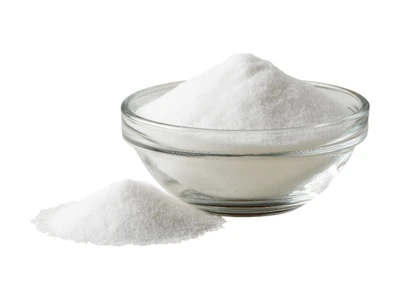
Citric Acid Anhydrous (E330)
Found this useful?