Ranking BASF's Historical Milestones: From IG Farben Breakup to Sub-30,000 Ludwigshafen Staff
BASF's history offers a useful case study in how a major chemical company can evolve through corporate restructuring, international expansion, technological development and changing industrial economics.
From the company's reestablishment in 1952 following the dissolution of IG Farben to the current contraction of its Ludwigshafen workforce, BASF's trajectory reflects several major transitions in the global chemical industry.
For investors, chemical suppliers and industry analysts, these milestones provide context for understanding how today's restructuring fits into BASF's much longer corporate evolution.
The 1952 Rebirth: BASF Starts Again
One of the most important milestones came on January 30, 1952, when Badische Anilin- & Sodafabrik Aktiengesellschaft was reestablished following the postwar dissolution and demerger of IG Farben.
The newly reestablished BASF initially consisted primarily of its traditional Ludwigshafen and Oppau operations and inherited a much smaller footprint than the former IG Farben conglomerate.
This created the foundation for the modern BASF.
1925: The IG Farben Merger
To understand the 1952 rebirth, it is necessary to look back to 1925.
BASF merged with Bayer, Agfa, Hoechst, Griesheim-Elektron and Weiler-ter Meer to create IG Farben, then one of the world's largest chemical companies. BASF ceased to exist as an independent corporation, with its Ludwigshafen operations becoming part of the new organization.
The merger represented an earlier period of chemical-industry consolidation driven by scale, technology and international competitiveness.
1945: Dissolution and Reconstruction
After World War II, the Allied Control Council ordered the dissolution of IG Farben.
At Ludwigshafen, reconstruction became the immediate priority. Production restarted in May 1945 with an approximately 800-person workforce, despite severe shortages of raw materials and fuel.
The eventual reestablishment of BASF in 1952 transformed this difficult postwar period into a new corporate beginning.
The 1950s: Plastics Change the Growth Model
BASF entered the postwar economic boom with a growing focus on plastics and petrochemicals.
The company's production of Styropor, developed in 1951, became an important commercial success, while polyethylene and other materials helped accelerate the industry's transition toward petrochemical production.
This period demonstrated BASF's ability to move beyond its traditional chemical foundations into higher-volume industrial materials.
1964: International Expansion Accelerates
BASF's transformation was not limited to Germany.
The company established BASF Antwerp in 1964, representing an important step in its international expansion. Its history shows a broader transition from a German chemical producer toward a multinational manufacturing organization.
International expansion would become increasingly important to BASF's future competitiveness.
The Verbund Model Becomes a Strategic Advantage
One of BASF's most important structural developments was the evolution of its Verbund production model.
The Ludwigshafen site became the model for BASF's integrated approach, connecting production plants, energy systems, raw materials, intermediates and logistics.
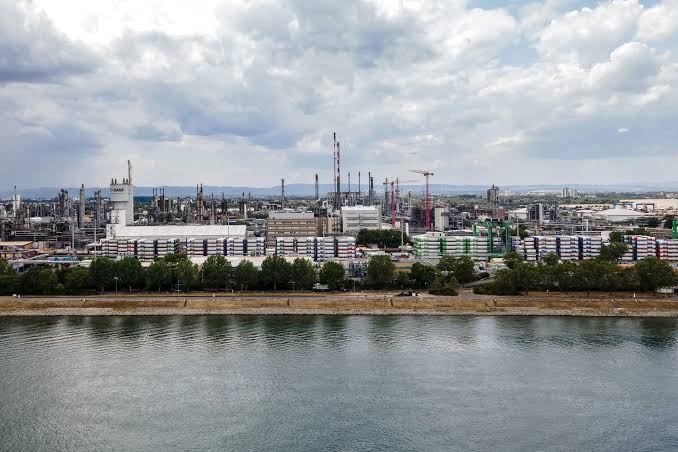
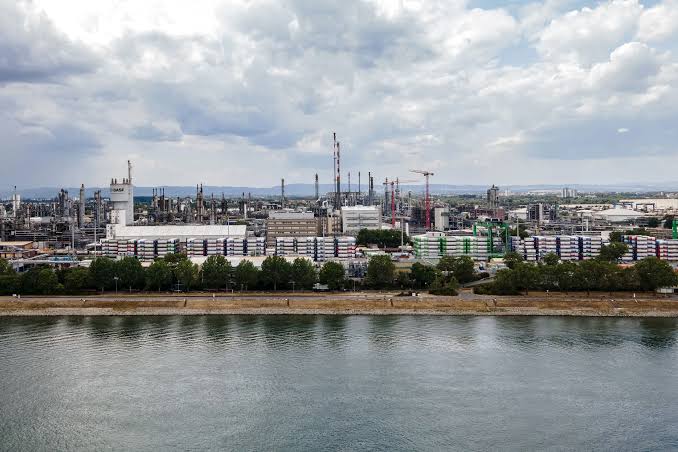
Today, Ludwigshafen remains BASF's largest integrated chemical complex and includes around 125 production plants.
The model creates efficiencies by allowing one production stream to supply another.
Globalization Changes BASF's Footprint
Over subsequent decades, BASF expanded production and investment across international markets.
By the turn of the millennium, BASF had developed a global network of Verbund sites across Europe, North America and Asia. The company increasingly relied on international production and markets rather than Germany alone.
This globalization created more flexibility—but also meant German sites increasingly had to compete against BASF's own international assets.
Ludwigshafen Becomes the Central Benchmark
Despite globalization, Ludwigshafen remained at the center of BASF's industrial identity.
The site houses numerous production facilities, corporate functions and operating divisions and historically employed roughly one-third of BASF's global workforce.
Its performance therefore provides an important indicator of BASF's broader European manufacturing strategy.
The Modern Challenge: European Cost Competitiveness
The chemical industry has changed significantly from the high-growth period of postwar Europe.
European producers now face stronger competition from regions with:
Lower-cost energy
Competitive feedstocks
New production capacity
Rapidly growing domestic markets
Different regulatory environments
These pressures have increasingly forced European chemical companies to reconsider their cost structures.
Ludwigshafen's Workforce Contraction
Against this historical background, the decline in Ludwigshafen employment becomes particularly significant.
The site's workforce has now fallen below 30,000 employees, a milestone that highlights the extent of restructuring at BASF's flagship German location.
The significance is not simply the number itself.
It represents a major change from the period when Ludwigshafen was expanding as the central engine of BASF's German industrial growth.
Contraction Does Not Mean Abandonment
The workforce reduction should not automatically be interpreted as BASF abandoning Ludwigshafen.
The site remains strategically important and continues to operate a highly integrated production network. BASF is also pursuing measures intended to improve the site's competitiveness.
The more relevant question is whether the site can become smaller but more efficient and strategically focused.
From Expansion to Selective Investment
BASF's current trajectory may represent a shift from broad industrial expansion toward selective investment.
The company can increasingly prioritize:
Competitive production
Higher-value products
Efficient assets
Technology-intensive operations
while reducing exposure to less competitive activities.
This is very different from simply shrinking every part of the German footprint.
The Historical Pattern Is the Real Intelligence Signal
BASF's history shows that the company has repeatedly adapted when the structure of the chemical industry changed.
The sequence is striking:
1925 — IG Farben consolidation
1945 — IG Farben dissolution
1952 — BASF reestablished
1950s–1960s — Plastics and international expansion
Later decades — Global Verbund development
2026 — Ludwigshafen workforce falls below 30,000
Each period reflects a different response to changes in technology, markets, regulation and industrial economics.
Why Investors Should Study the Timeline
Looking at BASF's current restructuring without historical context can make the workforce decline appear purely defensive.
The longer timeline suggests something more complex.
BASF has repeatedly changed its corporate structure and production footprint when the economics of the chemical industry changed.
The current restructuring may therefore represent another transition rather than simply a decline.
What Procurement Teams Should Watch
For chemical buyers, BASF's history also provides useful supply-chain intelligence.
Procurement teams should monitor:
Site-specific production changes
Capacity reductions
New investment
Product portfolio changes
Manufacturing relocation
Logistics infrastructure
Alternative BASF production locations
This is particularly important for chemicals sourced from highly integrated European facilities.
What Comes Next
The next stage of BASF's history will likely be defined by how effectively it balances its German industrial heritage with global cost competitiveness.
Ludwigshafen still provides significant advantages through its scale, integration, infrastructure and technical expertise.
But maintaining that advantage increasingly depends on operating the site efficiently.
The current workforce milestone therefore represents more than a historical statistic.
It is a signal that one of the world's most important chemical complexes is entering a different phase of its corporate life.
Key Takeaways
BASF was reestablished on January 30, 1952, following the postwar dissolution and demerger of IG Farben.
BASF had previously become part of IG Farben after the major 1925 chemical-industry merger.
Postwar BASF expanded through plastics, petrochemicals and international manufacturing.
The Ludwigshafen site became the foundation of BASF's integrated Verbund production model.
International expansion gradually reduced BASF's dependence on Germany as its only major manufacturing base.
Ludwigshafen remains a strategically important integrated chemical complex with around 125 production plants.
The site's workforce falling below 30,000 represents a major milestone in BASF's long-term corporate evolution.
Current restructuring reflects broader pressure on European chemical production economics.
Workforce contraction does not necessarily mean abandonment; BASF may be moving toward a smaller, more selective and efficient German footprint.
BASF's history demonstrates how corporate structure and manufacturing strategy can change as the global chemical industry evolves.
Glacial Acetic Acid (E260)
Found this useful?