
Ranking Mosaic's Potash Pricing Power: MOP Prices Rise Despite Volume Declines
Mosaic's potash business is providing an important example of pricing resilience in an otherwise uneven fertilizer market.
The company's MOP selling price increased to $275 per tonne from $261 per tonne a year earlier, according to the Q2 2026 figures referenced in the market discussion. The increase is notable because it occurred alongside lower sales volumes, creating a useful data point for assessing how much pricing power remains in the global potash market.
For fertilizer producers, the combination matters.
Higher realized prices can protect margins when volumes weaken, but sustained pricing power ultimately depends on supply availability, inventories, agricultural affordability, and the ability of producers to maintain disciplined production.
Mosaic's potash performance therefore offers a useful lens for evaluating the broader fertilizer market in 2026.
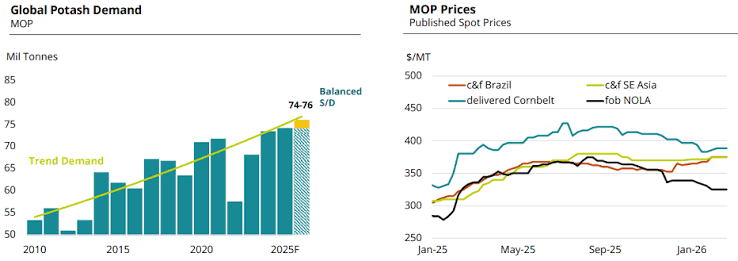
MOP Pricing Has Become an Important Earnings Driver
MOP, or muriate of potash, is one of the world's most widely traded potassium fertilizers.
For Mosaic, changes in realized MOP prices can have a significant effect on profitability.
The company's own sensitivity analysis illustrates this leverage. Mosaic previously estimated that a $10-per-tonne change in average MOP pricing could affect adjusted EBITDA by approximately $83 million, based on its 2025 cost structure and realized prices.
That makes even relatively modest changes in realized pricing financially meaningful.
Price Growth Despite Softer Volumes Stands Out
The key intelligence point is the divergence between price and volume.
When volumes decline but realized prices increase, several possible factors can be involved:
Tightening supply
Lower producer inventories
Stronger demand in key regions
Product mix changes
Customer willingness to accept higher prices
Reduced availability from competing suppliers
Producer pricing discipline
The Mosaic data therefore deserves attention beyond the company's own quarterly performance.
Potash Fundamentals Entered 2026 From a Stronger Position
Mosaic's first-quarter results already showed improving pricing conditions.
In Q1 2026, the company's Potash segment generated $667 million in net sales, compared with $570 million in Q1 2025.
Operating earnings increased to $177 million from $157 million, while adjusted EBITDA rose to $275 million from $240 million.
The improvement was driven in part by stronger realized prices.
Q1 MOP Pricing Was Already Higher
Mosaic's average MOP selling price reached $265 per tonne in Q1 2026, compared with $223 per tonne a year earlier.
That represented a substantial year-over-year improvement.
The later $275-per-tonne figure therefore fits into a broader pattern of stronger realized potash pricing rather than appearing as an isolated movement.
Pricing Is Offsetting Some Cost Pressure
Higher prices are particularly important because Mosaic's potash business is also facing cost pressure.
MOP cash cost of production increased to $84 per tonne in Q1 2026, compared with $78 per tonne in Q1 2025. Mosaic attributed some of the pressure to a stronger Canadian dollar and higher royalty expenses.
The combination illustrates why price realization matters so much.
Higher selling prices can absorb increases in production costs and preserve segment profitability.
Volume Declines Do Not Automatically Mean Weak Pricing Power
A common assumption in commodity markets is that lower volumes indicate weakening demand and therefore weaker pricing.
Potash can behave differently.
If supply is constrained at the same time that customers need to replenish inventories, producers can maintain or increase prices even when individual-company volumes decline.
This makes the relationship between volume and price particularly important to monitor.
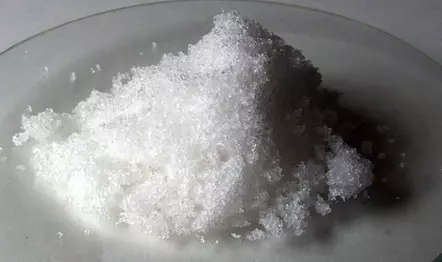
Aluminium Nitrate
Supply Discipline Remains a Major Factor
Potash markets are heavily influenced by production decisions.
When major producers reduce output, delay projects, or otherwise limit available supply, the market can tighten quickly.
That can support prices even when end-market demand is not exceptionally strong.
For investors, this means production discipline can be just as important as headline agricultural demand.
Mosaic's Production Outlook Remains Significant
Mosaic expected approximately 9 million tonnes of potash production for full-year 2026.
The company said stronger production at Esterhazy was expected to more than offset the volume impact of the Carlsbad divestiture.
That production target provides an important benchmark for evaluating whether higher prices can be sustained alongside sufficient supply.
The Carlsbad Divestiture Changes the Volume Picture
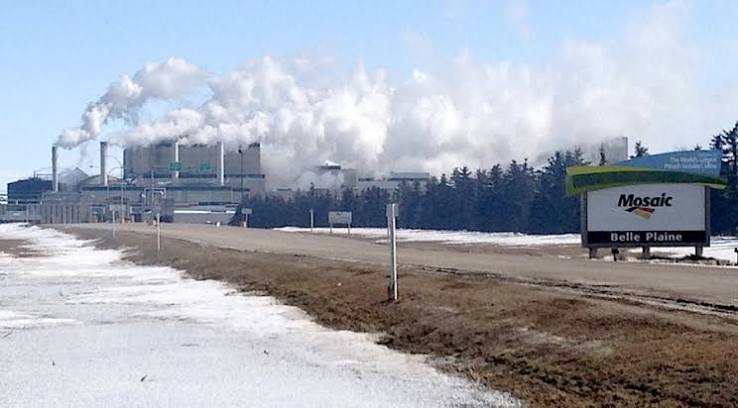
Mosaic completed the sale of its Carlsbad, New Mexico potash mine in April 2026.
The divestiture reduces Mosaic's asset footprint but is being offset at the group level by stronger expected production elsewhere.
This is relevant when comparing year-over-year volumes.
A decline in a particular period does not necessarily indicate broad deterioration in Mosaic's production capability.
Esterhazy Has Become Increasingly Important
Esterhazy is particularly important to Mosaic's potash strategy.
The company expects strong production from the operation to compensate for the volume effects of the Carlsbad divestiture.
Higher productivity from major mines can therefore allow Mosaic to preserve supply while maintaining a more disciplined overall production strategy.
China Remains a Critical Demand Market
China is one of the world's largest potash-consuming markets.
Mosaic's Q1 presentation pointed to low Chinese port inventories as a factor supporting the case for continued import demand in 2026.
Inventory levels are particularly important because they influence how aggressively buyers need to return to the international market.
Brazil Also Matters to Global Potash Economics
Brazil is another major fertilizer-consuming market.
Its agricultural production and acreage expansion can support long-term nutrient demand.
For global producers, Brazilian purchasing patterns can therefore influence the balance between available supply and international demand.
Affordability Is Still the Central Constraint
Higher fertilizer prices cannot rise indefinitely.
Farmers ultimately compare nutrient costs with expected crop economics.
If fertilizer prices rise too far relative to farm income, application rates can fall or purchasing can be delayed.
The strongest pricing environment is therefore one where fertilizer remains affordable enough to sustain demand while supply remains relatively disciplined.
MOP Prices Have a Direct Earnings Multiplier
Mosaic's pricing sensitivity makes the issue especially important.
A $10-per-tonne increase in average MOP pricing can have a substantial effect on adjusted EBITDA. Mosaic's latest sensitivity framework placed the impact at approximately $83 million per $10-per-tonne change.
That means the difference between $265 and $275 per tonne is not merely a market statistic.
It can materially influence financial performance.
Pricing Can Matter More Than Volume in the Short Term
Consider a simplified scenario.
If a producer sells fewer tonnes but realizes substantially higher prices, the reduction in volume may be partially or completely offset by higher revenue per tonne.
This is particularly valuable when production costs are relatively stable.
For Mosaic, the Q2 pricing data therefore provides an important counterpoint to the volume decline.
Gross Margin Provides the Better Test
Revenue per tonne alone does not establish pricing power.
Investors should also monitor:
Cash production costs
Royalties
Freight
Currency effects
Product mix
Gross margin per tonne
Mosaic's Q1 potash gross margin was $88 per tonne, compared with $80 per tonne in the prior-year quarter.
That suggests higher prices were already providing meaningful margin support.
Pricing Power Is Not the Same as Market Strength
It is important not to overstate what the MOP pricing increase means.
Higher prices do not necessarily prove that fertilizer demand is booming.
Pricing can rise because of supply constraints, inventory dynamics, regional availability, or producer discipline.
The correct interpretation is therefore more nuanced:
Mosaic appears capable of capturing higher realized prices even when its own sales volumes soften.
That is a meaningful form of pricing resilience, but it is not equivalent to unrestricted pricing power.
Raw-Material Inflation Remains a Complication
The broader fertilizer industry continues to face elevated input costs.
Mosaic has highlighted significant increases in phosphate rock, ammonia and sulfur costs over recent years.
While these inputs are particularly important for phosphate production, broader cost inflation affects the economics of fertilizer manufacturing and distribution more generally.
Potash's relatively strong pricing therefore provides an important buffer.
Potash Is Showing Greater Resilience Than Some Other Fertilizer Segments
Mosaic's first-quarter numbers demonstrate a notable divergence within the company's portfolio.
Potash generated positive operating earnings of $177 million, while the Phosphates segment recorded a $48 million operating loss.
That difference reinforces the importance of examining fertilizer markets by product rather than treating the sector as a single commodity.
Product-Specific Fundamentals Matter
Potash, phosphate and nitrogen fertilizers have different:
Production structures
Feedstock requirements
Geographic supply bases
Trade patterns
Inventory dynamics
Demand drivers
Consequently, pricing strength in MOP does not necessarily imply comparable strength in phosphate or nitrogen markets.
The Global Supply Base Supports Pricing Discipline
Potash production is concentrated among a relatively limited number of major producers and producing regions.
That structure can make supply changes more consequential.
When producers collectively maintain disciplined output, even moderate changes in demand can have an amplified effect on prices.
This is one reason potash pricing deserves close monitoring.
Mosaic's Commercial Execution Also Matters
Pricing power is not solely determined by the global market.
Individual producers can achieve different realized prices based on:
Customer relationships
Geographic exposure
Contract structures
Product mix
Timing of sales
Logistics
Market positioning
Mosaic's ability to capture higher realized MOP prices therefore also reflects its commercial execution.
The Difference Between FOB and Delivered Pricing
Another consideration is the pricing basis.
Mosaic reports MOP pricing on an FOB mine basis.
That means transportation and other downstream costs are not necessarily reflected in the reported selling price.
For customers, delivered fertilizer economics can therefore look different from the producer's reported mine-gate pricing.
Freight Can Change the Customer Economics
Global fertilizer buyers must consider the complete delivered cost.
That includes:
Producer price
Ocean freight
Port costs
Inland transportation
Storage
Handling
Financing
A higher FOB price can still be manageable for buyers if freight costs decline.
Conversely, even stable FOB prices can become more expensive if logistics costs rise.
Inventory Levels Remain a Key Indicator
For the rest of 2026, investors should closely monitor potash inventories.
Low inventories can support pricing because customers have less flexibility to delay purchases.
High inventories can create the opposite effect.
The Chinese inventory situation highlighted by Mosaic therefore deserves continued attention.
Agricultural Economics Will Ultimately Set the Ceiling
The longer-term ceiling for MOP pricing is determined by farmer economics.
Farmers need sufficient returns from crop production to justify nutrient application.
Strong crop prices and acreage expansion can support higher fertilizer demand.
Weak crop economics can eventually force prices lower.
What Would Confirm Sustainable Pricing Power?
Several indicators would strengthen the case that Mosaic's pricing improvement is sustainable:
Continued higher MOP realized prices
Stable or improving gross margin per tonne
Healthy international demand
Low inventories in major markets
Disciplined producer output
Strong agricultural affordability
Limited new low-cost supply
If several of these conditions persist, higher pricing could become more durable.
What Would Challenge the Pricing Story?
The opposite indicators would suggest the recent price improvement may be temporary:
Rising inventories
Weaker crop economics
Lower import demand
Increased producer output
Aggressive discounting
Falling benchmark prices
Higher freight costs
That is why a single quarterly price point should be viewed as one part of a larger market trend.
Ranking the Key Potash Pricing Signals
1. MOP Realized Price
Very High
The move toward $275 per tonne demonstrates continued price resilience.
2. Volume Performance
High
Lower volumes make the pricing improvement more significant.
3. Gross Margin Per Tonne
Very High
Shows whether higher selling prices are actually protecting profitability.
4. Chinese Inventory Levels
High
Low inventories can support continued import demand.
5. Producer Supply Discipline
High
Production decisions remain a major determinant of global potash pricing.
What This Means for Investors
For investors, Mosaic's potash business provides an important example of why commodity companies should not be evaluated solely on sales volumes.
A producer can sell fewer tonnes while improving profitability if pricing and cost management are strong enough.
The more important question is therefore:
How much margin is being generated on each tonne sold?
Mosaic's Q1 performance already showed that higher realized MOP prices could offset some cost pressure.
What This Means for Procurement Teams
For fertilizer buyers, higher MOP prices combined with softer volumes can be an early warning that supply availability remains relatively tight.
Procurement teams should therefore avoid assuming that lower producer volumes automatically mean lower purchasing prices.
Instead, buyers should monitor:
Producer pricing
Global inventories
Import demand
Crop economics
Freight
Regional supply availability
Producer operating rates
These indicators can provide a better view of future purchasing conditions.
The Broader Fertilizer-Market Lesson
Mosaic's potash performance highlights a broader trend in commodity chemicals and fertilizers.
Pricing power can emerge even in markets where headline volumes are not particularly strong.
The critical factors are often the interaction between supply discipline, inventories, customer affordability and producer cost structures.
That makes MOP pricing one of the more useful indicators for understanding fertilizer-market conditions in 2026.
Looking Ahead
Mosaic's rising MOP selling price is an important pricing-power data point because it occurred against a backdrop that was far from uniformly strong.
The company's Q1 potash results already showed higher prices supporting stronger earnings, with MOP pricing increasing to $265 per tonne from $223 per tonne a year earlier and adjusted EBITDA rising to $275 million from $240 million.
The company's Q2 guidance also called for 1.9 to 2.1 million tonnes of potash sales and MOP pricing of $260 to $280 per tonne, providing a clear range for evaluating subsequent performance.
If prices continue to hold near the upper end of that range while volumes remain subdued, it would strengthen the argument that potash producers retain meaningful pricing leverage.
If volumes recover while prices remain elevated, the signal would be even stronger because it would suggest that higher prices are not materially destroying demand.
The key issue for the remainder of 2026 will therefore be whether Mosaic can maintain favorable MOP pricing while controlling production costs and navigating global fertilizer demand.
For investors, that combination could be more important than volume growth alone.
For procurement teams, it reinforces the need to monitor potash market fundamentals early rather than waiting for price movements to appear in supplier contracts.
Key Takeaways
Mosaic's MOP pricing has shown significant improvement during 2026.
Q1 2026 MOP selling price reached $265 per tonne, compared with $223 a year earlier.
The referenced Q2 pricing figure of $275 per tonne highlights continued price resilience despite softer volumes.
Mosaic's Q2 guidance called for MOP pricing of $260-$280 per tonne and potash sales volumes of 1.9-2.1 million tonnes.
Potash adjusted EBITDA increased to $275 million in Q1, from $240 million a year earlier.
MOP cash production costs increased to $84 per tonne in Q1 from $78 a year earlier.
Mosaic estimates that a $10-per-tonne change in MOP pricing can materially affect adjusted EBITDA.
Low Chinese inventories provide a potential support for global potash demand.
Pricing strength does not necessarily mean fertilizer demand is booming; supply discipline and inventories can also drive price increases.
Procurement teams should monitor pricing, inventories, freight and regional availability together.
The sustainability of MOP pricing will depend on producer supply discipline and agricultural affordability.
Found this useful?