SABIC Q2 2026 Earnings Preview: The Numbers Behind Four Months of Disrupted Exports
SABIC Q2 2026 Earnings Preview: The Numbers Behind Four Months of Disrupted Exports
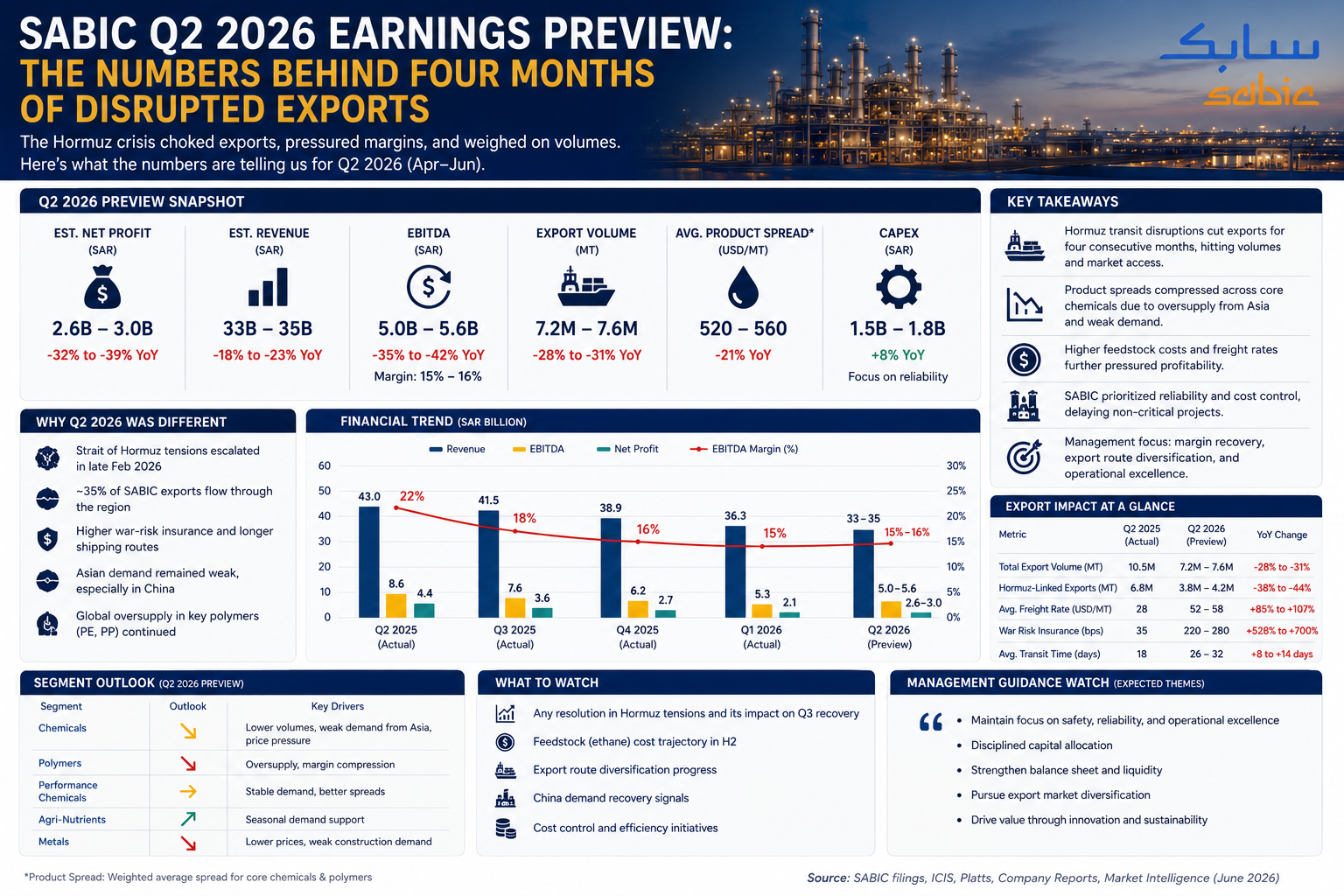
Few corporate earnings reports in 2026 carry as much importance for the global chemical industry as the upcoming July results from SABIC. For months, the Hormuz crisis disrupted one of the world’s most strategically important chemical export corridors, but no major producer absorbed that disruption more directly than SABIC. Unlike companies forced to shut down production due to operational constraints, SABIC remained largely production-ready throughout the crisis period. The company’s manufacturing infrastructure stayed functional, feedstock access remained intact, and domestic operations continued running. The real problem was exports. With shipping disruption, war risk insurance spikes, force majeure declarations across multiple contracts, and the inability to move product through normal commercial channels, SABIC spent much of the second quarter producing chemicals that global markets could not absorb through normal export routes.
The timing of recovery also matters. Saudi Arabia’s Ras Tanura terminal only resumed tanker loading operations during the final weeks of June, meaning the overwhelming majority of Q2 was spent under severely constrained export conditions. For much of the quarter, force majeure declarations effectively covered a substantial portion of SABIC’s international contract obligations, delaying deliveries and forcing customers to seek alternative suppliers across the United States, China, India, and North Africa. This creates an extraordinary financial situation heading into July earnings season. Investors are not simply waiting to see weaker quarterly numbers. They are waiting to understand the full financial cost of four months in which one of the world’s largest petrochemical exporters remained operational but commercially unable to move product at scale.

Why SABIC’s July Earnings Could Create Major H2 Pricing Opportunities for Chemical Buyers
The scale of the potential revenue impact is significant. SABIC typically operates as a $40–45 billion annual revenue company, making it one of the largest chemical producers globally. When that revenue profile is measured against four months of severe export disruption, the financial consequences become substantial. Even under conservative assumptions, if only half of SABIC’s normal export volume remained commercially constrained for four months, the implied revenue disruption could approach $13–15 billion in affected business activity during the crisis period. While SABIC benefits from the balance sheet strength of parent company Saudi Aramco, which provides substantial financial resilience during temporary market disruption, the Q2 report will likely become one of the clearest corporate measurements of the real economic damage the Hormuz crisis imposed on Gulf chemical producers.
For procurement professionals, however, the most important information may not be the earnings numbers themselves. The real value lies in management commentary. The central commercial question entering H2 2026 is whether SABIC intends to aggressively rebuild lost customer relationships by offering pricing incentives once Gulf supply normalizes further. Over the last four months, thousands of buyers previously dependent on Gulf-origin polymers, petrochemicals, intermediates, and industrial chemicals were forced to diversify toward alternative suppliers simply because SABIC could not deliver reliably under crisis conditions. Winning those customers back may require a fundamentally different pricing strategy during the second half of the year. Buyers watching this earnings release should focus less on reported revenue loss and more on forward guidance. If SABIC signals pricing flexibility, discounted contract terms, or aggressive commercial incentives to accelerate customer recovery, H2 2026 could create one of the strongest Gulf-origin sourcing opportunities chemical procurement teams have seen in years. The July earnings release may therefore reveal something far more important than the cost of the crisis. It may reveal how aggressively one of the world’s largest chemical producers intends to compete once recovery begins.
Looking for chemical procurement intelligence or supplier strategy insights? SABIC’s July earnings report may provide the first major indication of how Gulf chemical producers plan to price aggressively as they fight to recover lost customers in the post-crisis H2 market.

Acrylic Acid (99.5%) - China
Found this useful?