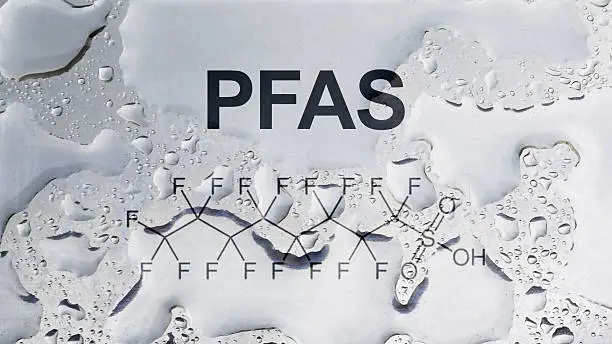
What "PFAS" Actually Means Under the New EU Structural Definition

What “PFAS” Actually Means Under the New EU Structural Definition
The biggest challenge in the EU's PFAS regulatory debate is hidden in three letters: PFAS.
The term sounds like it describes one family of chemicals, but it actually covers an enormous and structurally diverse group of substances. Under the EU restriction proposal, the key question is therefore not simply whether a product is marketed as “fluorinated.”
It is whether its molecular structure contains the chemical features that place it inside the regulatory definition of PFAS.
ECHA's proposed definition is based on a structural criterion: a substance is considered a PFAS if it contains at least one fully fluorinated methyl group (–CF₃) or methylene group (–CF₂–), with no hydrogen, chlorine, bromine or iodine attached to that carbon. (European Chemicals Agency)
That structural approach is what makes the proposed restriction potentially much broader than a list of familiar substances such as PFOA or PFOS.
PFAS Is a Structural Category, Not One Chemical
PFAS stands for per- and polyfluoroalkyl substances.
The important point is that PFAS is not a single chemical or even a small group of chemicals. ECHA describes PFAS as a highly diverse class that can include gases, liquids and high-molecular-weight polymers. (European Chemicals Agency)
The common feature is the presence of particular fluorinated carbon structures.
In simplified terms:
PFAS → fluorinated carbon structure → potentially thousands of substances
This is why searching only for specific substances such as PFOA or PFOS is not enough for EU compliance.
The Structural Test
The proposed EU definition essentially asks:
Does the substance contain at least one fully fluorinated –CF₂– or –CF₃ group?
The relevant structural elements are:
–CF₃ → a fully fluorinated methyl carbon
–CF₂– → a fully fluorinated methylene carbon
The carbon must not have hydrogen, chlorine, bromine or iodine attached to it. (European Chemicals Agency)
A simplified example:
–CF₂–CF₂–
contains fully fluorinated carbon atoms and therefore falls within the structural definition.
Similarly:
–CF₃
contains a fully fluorinated carbon and qualifies under the proposed definition.
This is fundamentally different from a regulatory system that simply publishes a finite list of chemical names.
Why the Structural Definition Matters
A substance-by-substance list has an obvious limitation.
Suppose regulators ban:
PFOS
PFOA
PFHxS
PFHxA
A manufacturer might potentially replace one restricted substance with a structurally similar substance that is not yet specifically listed.
A structural definition is designed to make that strategy much harder.
Instead of asking:
“Is this exact CAS number on the restriction list?”
companies need to ask:
“Does this molecule meet the structural definition?”
That is a much broader compliance exercise.
Not Every Fluorinated Substance Is Automatically PFAS
This is an important distinction.
The proposed definition does not simply say:
“Any molecule containing fluorine is PFAS.”
The fluorine needs to form the specified fully fluorinated carbon structures.
That means companies cannot determine PFAS status simply by searching a Safety Data Sheet for the word “fluorine.”
They may need information about the actual molecular structure.
This is particularly important for specialty chemicals, formulations and polymers where the commercial product name may reveal very little about the underlying chemistry.
What About the Proposed Exclusions?
The regulatory definition also contains structural exclusions.
ECHA's restriction-intention dossier specifies that certain substances containing only particular structural arrangements are excluded. One example involves structures such as:
CF₃–X
or
X–CF₂–X′
where X and X′ are restricted to specified chemical groups. (European Chemicals Agency)
This is why simply applying a rule such as “contains CF₃ = PFAS” can produce incorrect results.
The actual regulatory assessment requires looking at the complete molecular structure and the applicable exclusion criteria.
Why This Creates a Procurement Problem
For chemical procurement teams, this changes the way supplier compliance should be checked.
A traditional questionnaire might ask:
“Does your product contain PFOA or PFOS?”
That is increasingly inadequate.
A better questionnaire asks:
“Does the substance or mixture contain any substance falling within the applicable EU PFAS structural definition?”
The distinction is significant.
A supplier could truthfully state that its product contains no PFOA or PFOS while the product could still contain another substance that meets the broader PFAS definition.
PFAS Can Appear in Unexpected Places
ECHA identifies PFAS use across a wide range of industries, including:
Aerospace and defence
Automotive
Aviation
Electronics
Textiles
Food-contact materials
Construction
Household products
Firefighting
Medical articles
Food processing (European Chemicals Agency)
Their properties explain this breadth.
Many PFAS provide combinations of:
Heat resistance
Chemical resistance
Water repellency
Oil/grease repellency
Low friction
Surface protection
These characteristics make fluorinated chemistry attractive for demanding applications.
The same properties, however, contribute to the regulatory concern surrounding persistent fluorinated substances.
The Polymer Question
One of the most important implications is that PFAS is not limited to small molecules.
ECHA explicitly notes that PFAS can include high-molecular-weight polymers. (European Chemicals Agency)
That means companies should not automatically assume:
“It's a polymer, so the PFAS restriction does not apply.”
The relevant question is still the polymer's chemical structure and how the final regulatory text treats that particular substance or use.
This will be particularly important for sectors using fluoropolymers in high-performance applications.
Why “Short-Chain” vs. “Long-Chain” Is No Longer Enough
Chemical companies have historically used terms such as:
Long-chain PFAS
Short-chain PFAS
PFOA-related substances
PFOS-related substances
These classifications remain useful for understanding individual regulatory measures.
But they are not sufficient for understanding the proposed universal restriction.
ECHA itself notes that describing PFAS simply as long-chain or short-chain does not capture the full structural diversity of the PFAS class. (European Chemicals Agency)
This is why the new approach is fundamentally structure-based.
The Regulatory Definition vs. The Final Law
There is another important point for companies:
The structural definition discussed here is part of the proposed restriction framework; it should not be treated as though every detail is already the final enforceable law.
The PFAS restriction remains within the EU REACH restriction process. ECHA's Risk Assessment Committee adopted its opinion in March 2026, while the Socio-Economic Analysis Committee's draft opinion went through consultation in 2026. (European Chemicals Agency)
The final legal text, including the ultimate scope, derogations and implementation conditions, will determine the enforceable requirements.
That distinction matters when companies create compliance policies today.
What Chemical Companies Should Change Now
The structural definition suggests that companies should move away from name-based PFAS screening.
A stronger compliance workflow would look like this:
Step 1 — Identify fluorinated chemistry
Search raw materials, intermediates, additives, coatings and components for fluorinated structures.
Step 2 — Obtain molecular information
Do not rely only on commercial names or generic supplier declarations.
Step 3 — Apply the structural definition
Determine whether the substance contains the relevant –CF₂– or –CF₃ structural elements.
Step 4 — Check exclusions
Assess whether the complete structure falls within an applicable exclusion.
Step 5 — Map the application
Record exactly where the PFAS is used and what function it performs.
Step 6 — Assess alternatives
Determine whether a fluorine-free or otherwise compliant substitute exists.
Step 7 — Monitor the final restriction
The ultimate regulatory text will determine which uses receive restrictions, derogations or transition periods.
The Biggest Change: From Substance Lists to Molecular Intelligence
This may ultimately be the most important lesson for chemical-market intelligence platforms.
A database containing only:
Chemical name → CAS number → regulatory status
will not always be sufficient.
PFAS compliance increasingly requires:
Chemical structure → regulatory definition → use → concentration → exemption → alternative → regulatory deadline
That creates an opportunity for chemical intelligence platforms to incorporate structure-aware regulatory screening.
For procurement teams, such a system could automatically flag a supplier's product based on its molecular structure rather than waiting for a supplier to voluntarily identify every relevant PFAS.
Bottom Line
The new EU approach makes “PFAS” a structural question rather than simply a list of banned chemical names.
The central criterion is the presence of at least one fully fluorinated –CF₂– or –CF₃ carbon structure, subject to the detailed definition and exclusions in the restriction proposal. (European Chemicals Agency)
That has major implications for chemical manufacturers and buyers.
“PFAS-free” can no longer be evaluated simply by checking whether PFOA or PFOS is absent.
Companies need to understand the chemistry behind their products, map fluorinated substances across their supply chains and assess them against the evolving EU structural definition.
The regulatory shift is therefore also a data shift:
From checking chemical names to understanding chemical structures.
And for companies selling into Europe, that distinction could determine whether a product is considered compliant, restricted or in need of substitution.
Betaine Anhydrous
Found this useful?