

Article
Jun 18, 2026schedule5 Min Read
Vietnam's Growing Role in Chemical Manufacturing Supply Chains
Full Reportarrow_forward
prodchem
Jun 18, 2026
In today’s rapidly shifting global economy, supply chains are being redesigned at an unprecedented pace. One of the most significant transformations is happening in the chemical industry, where manufacturers are actively diversifying away from single-country dependence. As a result, Southeast Asia has emerged as a powerful new frontier for chemical manufacturing and trade. Countries such as Vietnam, Indonesia, and Thailand are now attracting strong investment in production facilities, raw material processing, and digital trading infrastructure.
This shift is not just about relocating factories. It represents a broader restructuring of global chemical supply networks, where cost efficiency, risk management, and digital connectivity are becoming just as important as production capacity.
Southeast Asia’s rise is driven by a combination of economic, geographic, and strategic advantages. For decades, the region has been known for manufacturing in electronics and textiles, but now chemicals are becoming a major growth sector.
One of the most important reasons is supply chain diversification. Global companies have learned from recent disruptions that relying heavily on one country creates risk. As a result, they are spreading production across multiple regions, and Southeast Asia offers a stable and cost-effective alternative.
Another key factor is competitive production costs. Labor, utilities, and operational expenses are generally lower compared to developed chemical hubs. This allows companies to maintain profitability while expanding capacity.
In addition, many Southeast Asian governments are actively supporting industrial growth through tax incentives, special economic zones, and infrastructure development, making it easier for foreign companies to establish chemical plants.
Vietnam has become one of the fastest-growing destinations for chemical manufacturing investment. The country benefits from a young workforce, political stability, and strong integration into global trade networks.
The chemical sector in Vietnam is particularly strong in:
Specialty chemicals
Coatings and adhesives
Agricultural chemicals
Downstream manufacturing inputs
Foreign investors are also attracted by Vietnam’s expanding industrial zones and export-oriented policies. As global companies shift production from China, Vietnam is increasingly being seen as a “next-generation manufacturing base.”
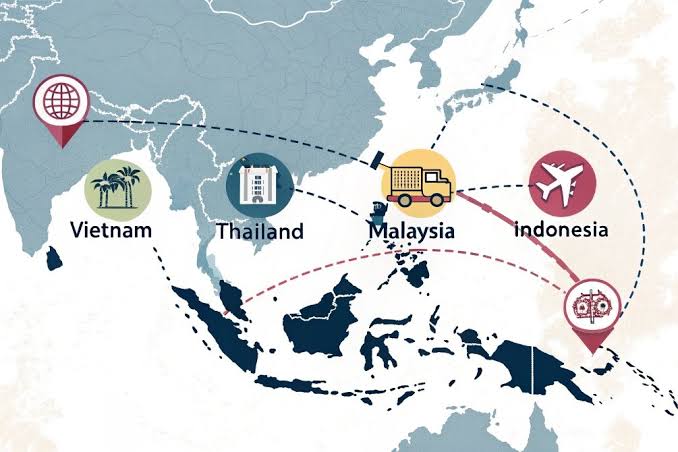
Indonesia plays a unique role in Southeast Asia’s chemical transformation due to its rich natural resource base. The country is a major producer of raw materials that feed directly into chemical manufacturing.
Two major strengths stand out:
Indonesia has become central to the global electric vehicle supply chain due to its large nickel reserves. This has led to rapid growth in downstream chemical processing industries connected to battery production.
Indonesia is also a global leader in palm oil production, which is increasingly being used to produce bio-based chemicals, surfactants, and industrial inputs.
Together, these industries are helping Indonesia move from a raw material exporter to a value-added chemical manufacturing hub.
Thailand is one of the most established chemical manufacturing hubs in Southeast Asia. Unlike emerging markets, Thailand already has a well-developed industrial base with strong infrastructure and logistics networks.
The country is especially known for:
Petrochemicals
Plastics and polymers
Integrated refinery-chemical complexes
Thailand’s Eastern Economic Corridor (EEC) has been a major driver of growth, attracting large-scale investments in advanced manufacturing and chemical processing. Its strategic location also makes it a key export gateway within ASEAN and beyond.
Alongside physical manufacturing growth, Southeast Asia is also undergoing a digital revolution in chemical trading.
Traditionally, chemical procurement relied heavily on manual negotiations, brokers, and offline networks. Today, however, digital B2B platforms and AI-powered marketplaces are changing how chemicals are bought and sold.
Key innovations include:
AI-based supplier matching
Real-time pricing transparency
Digital RFQ (Request for Quotation) systems
Automated compliance and documentation
Predictive demand analytics
These tools are making chemical trade faster, more transparent, and more efficient. Buyers can now compare suppliers across countries within minutes, while sellers can reach global markets without relying solely on intermediaries.
The rise of Southeast Asia as a chemical manufacturing hub has major implications for global trade patterns.
Countries that previously dominated chemical production are now facing competition from emerging ASEAN markets.
Companies are building multi-country sourcing strategies, reducing risk from geopolitical or logistical disruptions.
With more suppliers entering the market, pricing is becoming more competitive, benefiting buyers globally.
Digital integration allows for quicker product development, testing, and distribution across regions.
For international traders, distributors, and investors, Southeast Asia presents a wide range of opportunities.
Lower production and sourcing costs
Expanding industrial base
Government-backed incentives
Strong export orientation
Import-export of specialty chemicals
Raw material sourcing from Indonesia
Distribution partnerships in Vietnam and Thailand
Digital marketplace participation
Chemical manufacturing plants
Logistics and storage infrastructure
Digital trading platforms
Green and sustainable chemical production
Early entrants into this region are likely to benefit the most as infrastructure and industrial capacity continue to expand.
Despite strong growth, the region also faces certain challenges:
Regulatory differences between countries
Infrastructure gaps in emerging areas
Environmental compliance requirements
Dependence on global raw material prices
However, most governments are actively working to improve regulatory harmonization and environmental standards, making long-term prospects highly positive.
Southeast Asia is no longer just an emerging manufacturing region—it is rapidly becoming a strategic global hub for chemical production and trade. Vietnam’s specialty chemical growth, Indonesia’s resource-driven expansion, and Thailand’s industrial maturity together form a powerful regional ecosystem.
Supported by digital transformation and global supply chain diversification, the region offers significant opportunities for manufacturers, traders, and investors alike. As global demand for chemicals continues to grow, Southeast Asia is well-positioned to play a central role in shaping the future of the industry.
Found this useful?
Continue Reading
India’s polypropylene market is facing supply pressure as feedstock restrictions affect around 80% of domestic PP capacity. Buyers are evaluating imports, alternative suppliers and pricing strategies before further market changes.