5 Oleochemicals Every Chemical Trader Should Be Watching in 2026
5 Oleochemicals Every Chemical Trader Should Be Watching in 2026
In the oleochemicals market, price movements rarely happen in isolation.
A shift in crude palm oil prices, a change in biodiesel policy or a disruption in export flows can ripple across multiple product categories at the same time. For chemical traders, understanding which products are attracting the most market attention can provide valuable insight into future opportunities and risks.
In 2026, five oleochemicals stand out due to their trading activity, pricing dynamics and exposure to evolving supply conditions. While each serves different industries, they all share one important characteristic: their close relationship with crude palm oil markets.

The Five Oleochemicals Driving Market Attention
1. Stearic Acid
Stearic acid remains one of the most actively traded oleochemicals globally.
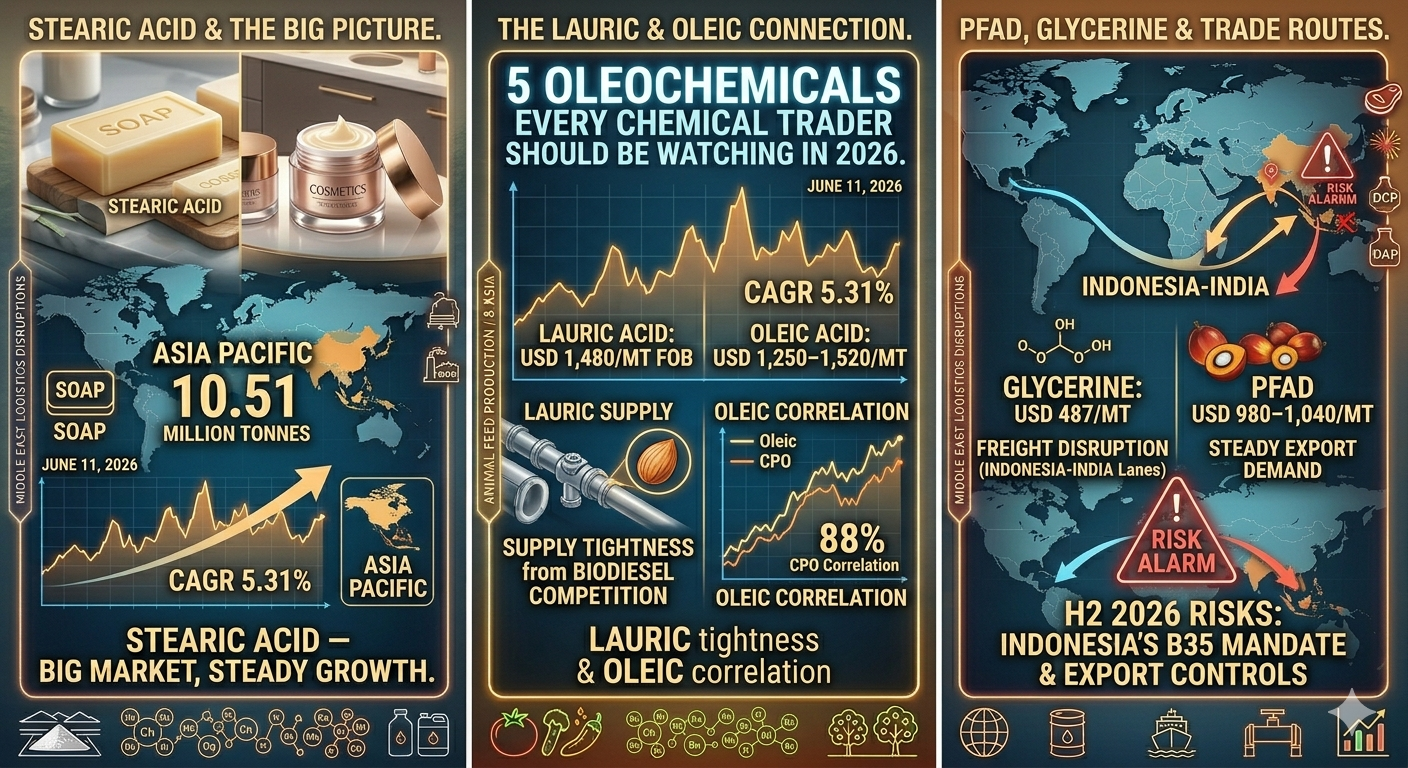
With a market size of approximately 10.51 million tonnes in 2026 and an expected growth rate of 5.31% CAGR, demand continues to be supported by applications across soap manufacturing, rubber processing, cosmetics, candles, PVC lubricants and plastic stabilisers.
Its broad industrial relevance makes it one of the most closely monitored products in the oleochemical value chain.
2. Lauric Acid
Lauric acid has attracted significant attention due to tightening supply conditions.
Trading around USD 1,480/MT FOB Indonesia, the market is experiencing pressure from increasing competition for palm-based feedstocks. As biodiesel production absorbs larger volumes of raw materials, availability for downstream oleochemical production can become constrained, creating price volatility and procurement challenges.
3. Oleic Acid
Oleic acid remains highly sensitive to developments in palm oil markets.
Current pricing ranges between approximately USD 1,250 and USD 1,520 per metric ton, with market behavior showing a strong correlation to crude palm oil trends. In fact, around 88% of its price movement is linked to crude palm oil fluctuations, making feedstock monitoring essential for traders active in this segment.
4. Crude Glycerine
Crude glycerine continues to be an important by-product market within the oleochemical industry.
At approximately USD 487/MT, pricing has been influenced by freight disruptions affecting key Indonesia–India trade routes. Because transportation costs play a significant role in market competitiveness, logistics conditions remain a major factor for buyers and traders.
5. Palm Fatty Acid Distillate (PFAD)
PFAD continues to maintain steady export demand across international markets.
Trading around USD 980–1,040/MT in Malaysia, the product remains an important feedstock for multiple industrial applications. Consistent demand has helped support market activity despite broader uncertainties affecting commodity markets.
Why Traders Are Watching Palm Oil More Closely Than Ever

Although each product has its own market dynamics, all five are ultimately linked to the same upstream driver: crude palm oil.
Changes in feedstock availability, production costs and export policies can influence pricing across the entire oleochemical chain. This relationship has become especially important in 2026 as supply-side developments in Indonesia continue to attract industry attention.
One of the most significant factors is Indonesia's B35 biodiesel mandate. By increasing domestic consumption of palm-based feedstocks, the policy can affect the volume of raw materials available for oleochemical production. As biodiesel demand rises, competition for feedstocks may place additional pressure on supply availability and pricing.
At the same time, discussions surrounding state export control plans have introduced another layer of uncertainty for market participants. Any changes affecting exports from one of the world's largest palm-producing nations could have implications across global supply chains.
For chemical traders, the key takeaway is clear: tracking individual oleochemicals is no longer enough. Understanding crude palm oil trends, biodiesel policies and export developments has become essential for evaluating market opportunities and managing procurement risks.
As the second half of 2026 approaches, stearic acid, lauric acid, oleic acid, crude glycerine and PFAD are likely to remain at the center of industry attention. Their performance will not only reflect conditions within their respective markets but may also serve as indicators of broader developments across the global oleochemical sector.
Looking for current oleochemical market intelligence or reliable sourcing options? Contact our team to discuss supply availability, pricing trends and procurement strategies for key palm-based chemicals.
Coconut Diethanolamide
Found this useful?