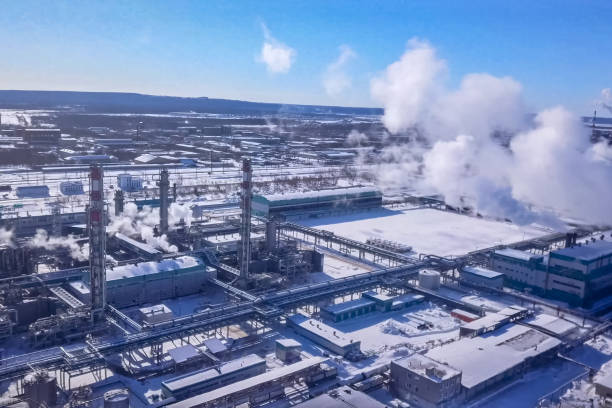
Asian Markets Align Chemical Inventory Requirements with Globally Harmonized System
OSHA Revises Permissible Exposure Limits for Industrial Solvents
OSHA's Approach to Solvent Exposure Limits
Industrial solvents are widely used in chemical manufacturing, coatings, adhesives, cleaning operations, pharmaceuticals and other industrial processes. Because many solvents can affect workers through inhalation or skin contact, controlling workplace exposure is an important occupational-safety requirement.
The U.S. Occupational Safety and Health Administration (OSHA) regulates workplace exposure to hazardous solvents through its standards for air contaminants, substance-specific standards, ventilation and hazard communication. OSHA's general-industry requirements are primarily contained in 29 CFR 1910 Subpart Z, including the air-contaminant requirements in 1910.1000. (OSHA)
However, it is important to distinguish between newly revised federal OSHA PELs and other occupational exposure limits. OSHA itself states that many of its PELs are outdated and that the mandatory federal limits in the Z-Tables remain enforceable unless changed through rulemaking. OSHA also provides alternative limits from organizations such as NIOSH, Cal/OSHA and ACGIH for comparison and worker-protection purposes. (OSHA)
What Are Permissible Exposure Limits?
A Permissible Exposure Limit (PEL) is an OSHA-enforceable limit for worker exposure to a hazardous substance.
Depending on the chemical, an OSHA limit may be expressed as:
8-hour Time-Weighted Average (TWA): The average exposure permitted during an 8-hour work shift.
Short-Term Exposure Limit (STEL): A limit applying over a shorter exposure period, commonly 15 minutes.
Ceiling limit: A concentration that must not be exceeded at any time, subject to the applicable OSHA standard.
Peak exposure limit: A maximum concentration that may be permitted for a specified short period under certain standards.
For example, OSHA's general air-contaminant standard establishes 8-hour TWAs for substances without a ceiling designation, while ceiling limits must not be exceeded during the applicable work period. (OSHA)
Federal OSHA PELs Are Not Uniformly Updated
The idea that OSHA has recently revised all industrial-solvent PELs requires some clarification.
OSHA states that many federal PELs were adopted shortly after the Occupational Safety and Health Act was enacted in 1970 and have not subsequently been updated. The agency notes that scientific and industrial developments have demonstrated that some of these limits may not provide sufficient protection. (OSHA)

This creates an important distinction for manufacturers: a workplace may technically comply with a federal OSHA PEL while a newer occupational exposure limit from another authoritative organization is considerably lower.
OSHA therefore publishes annotated tables comparing federal PELs with limits from NIOSH, Cal/OSHA and ACGIH. OSHA recommends that employers consider these alternative limits because exposures below an older federal PEL may still present health concerns. (OSHA)
Examples of Solvent Exposure Limits
Different solvents have different regulatory requirements.
For example, OSHA's current standard for toluene establishes a general-industry PEL of 200 ppm as an 8-hour TWA, together with a 300 ppm ceiling and a specific peak provision. OSHA also lists a substantially lower ACGIH TLV of 20 ppm TWA for comparison. (OSHA)
For methylene chloride, OSHA has a substance-specific standard establishing a 25 ppm 8-hour TWA PEL and a 125 ppm 15-minute STEL. (OSHA)
For benzene, OSHA's substance-specific standard establishes a 1 ppm 8-hour TWA and a 5 ppm 15-minute STEL. (OSHA)
These differences demonstrate why chemical companies need to assess each solvent individually rather than applying one general workplace exposure limit.
Why Solvent Exposure Requires Strong Controls
Industrial solvent exposure can occur during:
Mixing and formulation
Chemical transfer
Cleaning and degreasing
Coating and printing
Adhesive production
Equipment maintenance
Laboratory operations
Storage and handling
Spill response
OSHA identifies solvent exposure as a potential workplace hazard and recommends exposure evaluation, appropriate ventilation, control of dermal exposure and PPE where necessary. (OSHA)
In chemical manufacturing facilities, exposure can also vary significantly depending on the process. An enclosed automated system may produce very different exposure levels from manual charging or open-container operations.
Importance of Industrial Hygiene Monitoring
Companies should not rely exclusively on the concentration listed on a chemical's Safety Data Sheet (SDS) or assume that the absence of an obvious odor means exposure is safe.
OSHA's occupational chemical database provides information on chemical properties, exposure limits and sampling methods. The agency lists PELs for approximately 400 substances across its regulatory framework. (OSHA)
Workplace exposure assessments can help companies determine whether employees are exposed above applicable limits. Depending on the substance and operation, monitoring may involve personal breathing-zone sampling, area monitoring or other appropriate industrial-hygiene methods.
Ventilation and Engineering Controls
Engineering controls are an important part of solvent exposure management.
Possible controls include:
Local exhaust ventilation
Closed transfer systems
Automated chemical dispensing
Enclosed process equipment
Vapor recovery systems
Improved process isolation
Leak detection and maintenance programs
OSHA's solvent guidance specifically identifies ventilation as a method for reducing solvent concentrations in workplace air. (OSHA)
Where engineering and administrative controls cannot adequately control exposure, employers may need to use respiratory protection and appropriate personal protective equipment in accordance with applicable OSHA requirements.
Hazard Communication Remains Important
Solvent exposure management also connects with OSHA's Hazard Communication Standard, 29 CFR 1910.1200.
Chemical manufacturers and employers need to ensure that workers receive appropriate information about hazardous chemicals, including information contained in Safety Data Sheets and labels.
OSHA notes that its Hazard Communication Standard requires SDSs to include applicable OSHA PELs as well as relevant occupational exposure limits such as ACGIH TLVs and other limits used or recommended by the chemical manufacturer, importer or employer preparing the SDS. (OSHA)
What Chemical Manufacturers Should Do
Companies handling industrial solvents should consider the following compliance measures:
Identify all solvents used in the workplace.
Check the applicable OSHA PEL for each substance.
Review substance-specific OSHA standards where applicable.
Compare federal PELs with current occupational exposure limits from recognized organizations.
Conduct workplace exposure monitoring where exposure may occur.
Evaluate ventilation and other engineering controls.
Address skin and eye exposure in addition to inhalation exposure.
Maintain accurate SDSs and workplace labels.
Train employees on solvent hazards and safe handling procedures.
Review exposure controls whenever processes, chemicals or equipment change.
What the Developments Mean for the Chemical Industry
For chemical manufacturers, solvent exposure compliance is increasingly dependent on more than simply checking whether workplace concentrations remain below an older federal PEL.
OSHA's own assessment acknowledges that many federal PELs have not kept pace with newer scientific information. Its annotated PEL tables therefore provide employers with additional occupational exposure limits for consideration alongside legally enforceable OSHA requirements. (OSHA)
This makes regular review of exposure limits, workplace monitoring and engineering controls particularly important for facilities that use large quantities of volatile or toxic solvents.
As regulatory and scientific information continues to develop, chemical manufacturers can reduce workplace exposure risks by maintaining strong industrial-hygiene programs and keeping their chemical safety procedures aligned with the most current applicable requirements.
Sources
OSHA – Permissible Exposure Limits: Annotated Tables
OSHA Annotated PELsOSHA – Air Contaminants, 29 CFR 1910.1000
OSHA Air Contaminants StandardOSHA – Solvents: Standards
OSHA Solvent StandardsOSHA – Occupational Chemical Database
OSHA Chemical DatabaseOSHA – Toluene Occupational Exposure Limits
OSHA Toluene Exposure Limits

Alum
Found this useful?