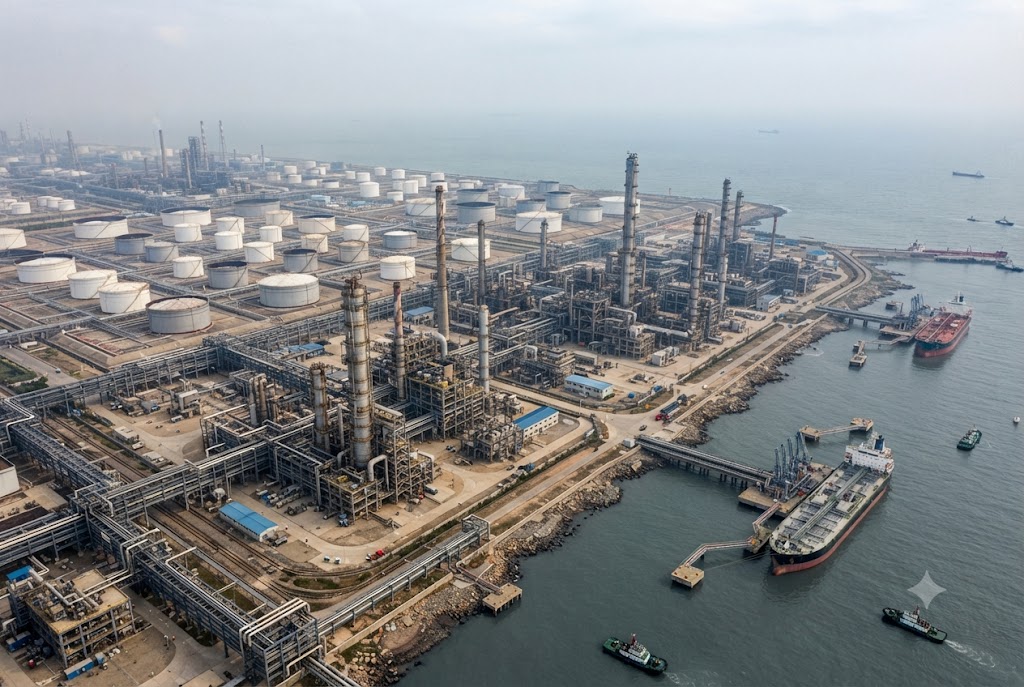
Chinese oil refiners have sharply reduced output to the weakest level in nearly four years after crude imports plunged to an eight-year low. As the world's largest crude processor outside the United States, any meaningful pullback in China's refinery runs sends ripple effects across global energy and chemical markets. For procurement teams sourcing petrochemical feedstocks, these shifts warrant close attention.
This contraction is not a seasonal blip. With less crude arriving at ports, refiners are cutting throughput because supply is not available to sustain previous run rates. That distinction matters for buyers looking to gauge whether product availability will tighten in the months ahead.
Why Crude Imports Fell to an Eight-Year Low
Several factors have combined to push China's crude inflows to multi-year lows:
Weaker fuel demand continues to weigh on consumption. Accelerated adoption of electric vehicles has eroded gasoline demand growth, while broader economic pressures have tempered diesel consumption.
Unfavorable refining margins have discouraged purchases. When domestic crack spreads fail to cover high crude costs, refiners cannot justify importing large volumes for processing.
Tighter import quotas have directly limited activity. Many of China's independent refiners, often referred to as teapots, saw their crude import quota allocations reduced, curbing their ability to secure cargoes.
Shift in stockpiling strategy removed a key source of demand. After a period of aggressive build-up, the pace of crude additions to strategic and commercial reserves has slowed considerably.
Procurement constraints for certain grades have added friction. Changes in freight economics, payment considerations and grade preferences have made some cargoes less viable for buyers.
How Refinery Throughput Fell to a Four-Year Low
Lower import volumes translate directly into lower processing. With less crude available, Chinese refiners have scaled back run rates across multiple facilities. State-owned majors have trimmed utilization more selectively, while independent refiners have pulled back more aggressively to preserve margins.
This has driven national refinery throughput down to levels not seen since early in the previous four-year window. The scale of the cut reflects both the depth of import weakness and the speed at which margin-sensitive refiners react when conditions turn unfavorable.
Feedstock Implications for the Chemical Sector
When refinery runs fall, the supply of several key petrochemical feedstocks contracts in tandem:
Naphtha availability tightens. Steam crackers relying on naphtha as a primary feedstock face increased competition and firmer domestic pricing.
LPG output declines. Lower throughput reduces refinery-sourced propane and butane volumes, placing pressure on olefin producers and other chemical users that rely on liquefied petroleum gases.
Aromatics supply contracts. Less crude processing typically pulls back reformer output, tightening availability of benzene, toluene and xylene streams used across multiple derivative chains.
Byproduct streams shrink. Units such as hydrotreaters and sulfur recovery systems process fewer barrels, reducing byproduct sulfur volumes that feed into fertilizer and industrial chemical markets.
For buyers with exposure to these streams, the current environment means monitoring both domestic Chinese availability and import arbitrage opportunities more closely than usual.
China's refining sector includes both state-owned majors like Sinopec and PetroChina alongside independent refiners concentrated in Shandong province.
Independent refiners, known as "teapots," face disproportionate pressure during crude supply disruptions. They typically:
Lack long-term crude supply contracts that state majors secure
Operate smaller, less efficient facilities with higher per-barrel costs
Face tighter financing and credit access during market stress
Have less vertical integration into downstream petrochemicals or retail
When crude imports plunge and costs spike, independent refiners cut hardest and fastest. Many may shut entirely rather than operate at severe losses.
This matters for chemical buyers because independent refiners supply meaningful volumes of naphtha, aromatics and solvents into regional markets. Their cutbacks or closures remove supply that does not quickly return even if crude availability improves.
Gasoline and Diesel Surplus Becomes Deficit
Chinese refiners historically ran at high utilization producing gasoline and diesel beyond domestic demand, exporting surplus volumes across Asia.
With production cut to four-year lows, that surplus evaporates. China may shift from net exporter to net importer of refined products for first time in years.
This affects chemical markets because:
Refiners optimize for fuel production over petrochemical feeds when crude is scarce
Naphtha and aromatics become even tighter as refiners prioritize gasoline and diesel
Regional refined product markets tighten with Chinese exports withdrawn
Singapore, South Korea and other refining hubs gain pricing power
The shift from Chinese surplus to deficit fundamentally changes Asian refined product and petrochemical feedstock balances.
Alternative Crude Sources Cannot Fill the Gap Quickly
China's crude import decline reflects both reduced demand and supply constraints. Even if demand remained strong, alternative crude sources cannot instantly replace lost Gulf barrels.
Why substitution is difficult:
Russian crude exports to China face infrastructure limits on pipeline and rail capacity
Atlantic basin crude requires much longer shipping, tying up capital and logistics capacity
West African and Latin American barrels carry freight premiums over traditional Gulf sources
Refinery configurations optimized for Middle East crude grades perform less efficiently on alternative slates
Even when alternative barrels are available, refiners need time to adjust operations, secure logistics and validate product quality from different crude inputs.
This means the refining cutback likely persists for months even if crude prices moderate or Hormuz transit resumes partially.
Strategic Petroleum Reserve Role
China holds substantial Strategic Petroleum Reserve volumes that could theoretically supplement commercial imports during shortages.
However, SPR releases face several constraints:
Government controls limit how much and when refiners can access strategic stocks
SPR oil grades may not match specific refinery requirements
Commercial refiners hesitate to rely on strategic reserves for regular operations
Policy priorities balance economic support with maintaining emergency reserves for genuine crises
SPR draws can moderate the import decline but cannot fully offset it. Refiners still need consistent commercial crude flows to maintain stable operations.
What This Means for Global Oil Markets
Chinese crude import demand declining to eight-year lows removes significant buying pressure from global oil markets.
Market effects include:
Downward pressure on crude prices as major buyer pulls back
Middle East producers facing reduced demand for their flagship crude grades
Alternative crude sources competing harder for remaining Chinese demand
Potential for OPEC+ production adjustments responding to weaker demand
For chemical buyers, crude price movements create complex dynamics. Lower crude prices normally help feedstock costs. But if China's refining cuts create feedstock scarcity, prices for naphtha and aromatics may rise even if crude falls.
The relationship between crude, refined products and petrochemical feedstocks becomes decoupled during severe supply chain disruptions.
Procurement Strategy Adjustments
Chinese refinery output hitting four-year lows while crude imports reach eight-year lows demands immediate procurement response.
Tactical actions this month:
Assess exposure to China-sourced feedstocks, solvents and intermediates across your entire portfolio
Contact Chinese suppliers requesting clarity on production plans and allocation policies
Activate alternative suppliers from South Korea, Singapore, Japan, India, Middle East and US
Build inventory of critical China-sourced materials before allocation tightens further
Strategic positioning for next quarter:
Diversify supply base reducing concentration in Chinese sources for materials where alternatives exist
Qualify multiple regional origins rather than optimizing purely on current cost
Adjust contract structures allowing volume flexibility if Chinese supply becomes unreliable
Engage with logistics providers on alternative shipping routes and lead times
Medium-term considerations:
Reevaluate whether operations dependent on Chinese chemical supply should relocate or restructure
Build stronger relationships with non-Chinese petrochemical producers
Consider vertical integration or tolling arrangements with refiners outside China for critical feedstocks
Monitor Chinese policy signals on refining sector consolidation and capacity management
When Does Chinese Refining Recover
The critical question is whether the four-year production low represents temporary disruption or structural reset.
Optimistic recovery scenario:
Hormuz situation resolves allowing Gulf crude imports to resume
Chinese economic stimulus drives fuel demand recovery
Refiners return to 80%+ utilization within 6-9 months
Petrochemical feedstock availability normalizes
Structural change scenario:
Chinese government pursues refinery capacity reduction through consolidation
Slower structural economic growth permanently reduces petroleum demand
Refined product exports from China do not return to historical levels
Petrochemical feedstock sourcing shifts permanently toward other Asian producers
Most likely mixed outcome:
Partial recovery over 12-18 months to 80-85% of pre-disruption levels
Some marginal capacity permanently exits through closures
China remains major refining center but less dominant than 2020-2023 period
Regional petrochemical supply chains rebalance with more distributed sourcing
Procurement strategies should work across all scenarios rather than betting on single outcome.
The Bottom Line for Chemical Buyers
China's refinery output falling to a four-year low while crude imports hit an eight-year low removes significant feedstock supply from Asian petrochemical markets. Naphtha, aromatics, solvents and chemical intermediates that global supply chains increasingly depended on now face reduced availability and rising costs.
For procurement teams, this means:
Immediate need to diversify away from concentrated Chinese feedstock and intermediate sourcing. Activation of alternative suppliers across South Korea, Southeast Asia, India, Middle East and potentially US or Europe. Contract and relationship management preparing for allocation scenarios and potential supplier financial stress. Strategic reassessment of operations dependent on reliable Chinese petrochemical supply.
The teams that recognize this as fundamental supply chain disruption requiring active response will maintain better cost positions and supply security than those assuming quick return to normal Chinese export volumes.
China's refining crisis creates opportunity for some and risk for others. Your procurement strategy determines which side you end up on.
Ready to source Benzene from verified global suppliers? Explore competitive offers on our platform today.