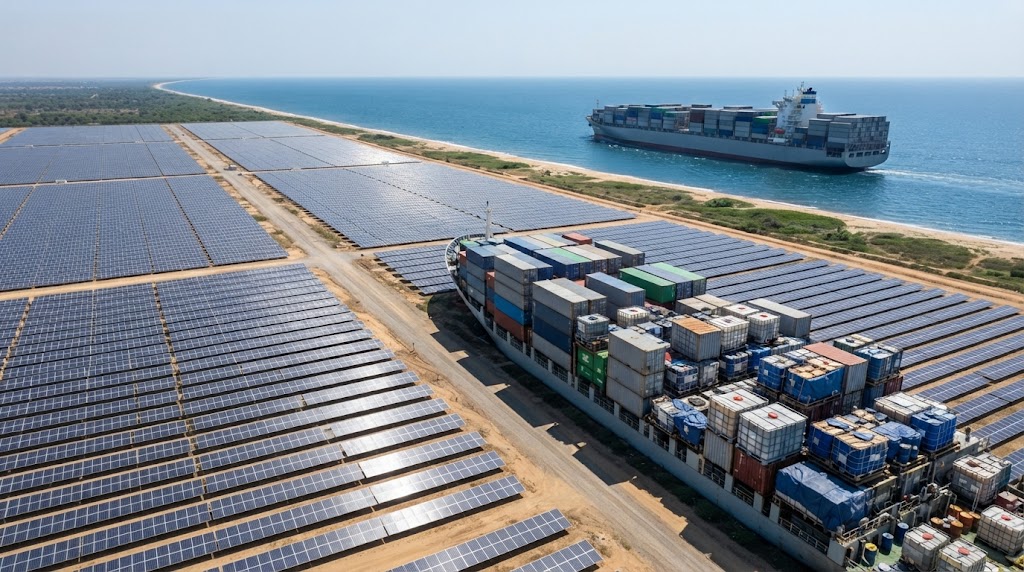
Japanese chemical makers spent decades building manufacturing and sales networks around China’s electronics and solar clusters. That center of gravity is shifting. Operating conditions in China have become harder, with growing regulatory friction, IP concerns and uneven market access. At the same time, India’s solar manufacturing ambitions have created a new demand hub for encapsulants, backsheet films and specialty materials.
As Japanese producers redirect trade and investment attention toward India, a new Japan–India solar materials corridor is taking shape. For chemical traders and procurement managers, this corridor opens fresh sourcing options but also introduces new risks around policy, infrastructure and local partners that did not exist when China dominated the picture.
Why Japanese Chemical Makers Are Rebalancing from China to India
Japanese producers still view China as a critical market, but their risk calculations have changed. Several structural issues drive the pivot.
Regulatory unpredictability in China has increased. Permit timelines, local environmental enforcement and data requirements now vary widely by province. Foreign firms report higher compliance burdens than local competitors.
IP and technology concerns have resurfaced. After years of joint ventures and tech transfer, Japanese firms see domestic Chinese competitors offering similar materials at lower prices. Legal recourse for trade secret leakage remains limited in practice.
Market access barriers such as opaque local content rules and procurement preferences can tilt large solar contracts toward domestic suppliers even when imported materials outperform.
By contrast, India offers a large, under-served PV materials market, clearer legal recourse under common law traditions and government incentives that actively court foreign investment in solar supply chains.
Inside India’s Expanding Solar Materials Demand
India has set ambitious targets for installed solar capacity to cut import dependence on fossil fuels and meet climate goals. That buildout is driving a parallel push to localize manufacturing of modules and upstream materials.
Several features of India’s demand profile attract Japanese chemical makers:
Rapid module capacity additions across Gujarat, Rajasthan and southern manufacturing hubs create sustained demand for encapsulants, backsheets and adhesives.
Production Linked Incentive (PLI) schemes reward higher domestic value addition in solar modules, pushing manufacturers to source more materials locally rather than importing complete bill of materials from China.
Diverse product mix including utility scale farms, rooftop systems and emerging BIPV applications calls for a range of material grades, not just one commodity encapsulant.
Indian producers that once imported most core polymers and films from China now ask for reliable, non Chinese alternatives that still meet aggressive cost and performance targets. Japanese suppliers see an opening.
What Japanese Chemical Makers Bring to India’s PV Chain
Japanese chemical companies built their reputations on high performance polymers, films and additives for demanding electronics and automotive applications. In solar, those strengths translate directly into key material categories.
Typical contributions include:
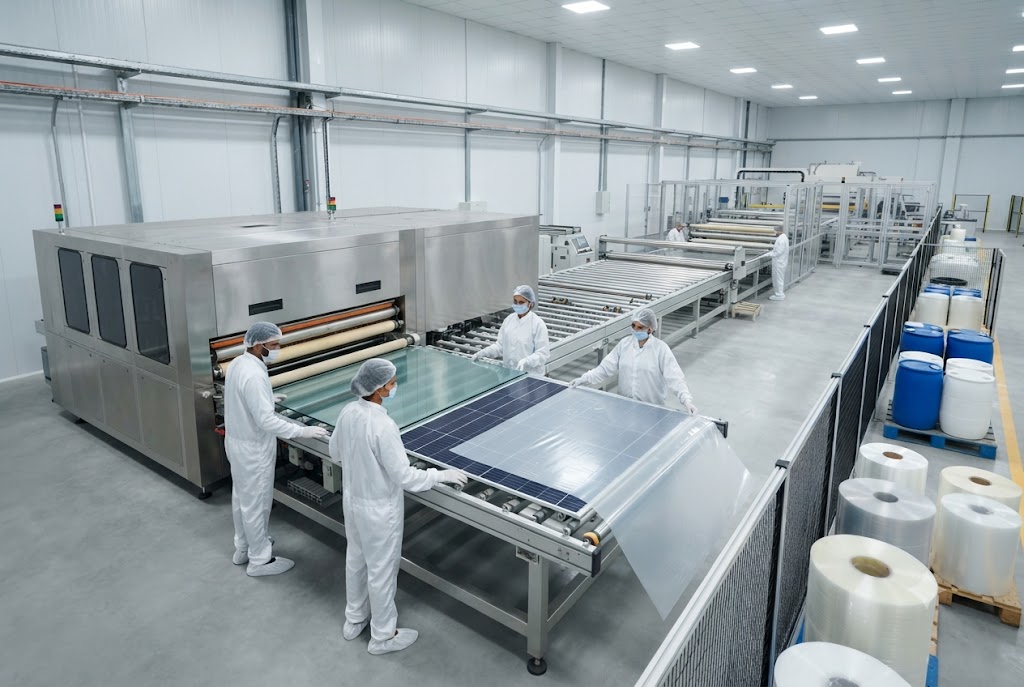
Encapsulant polymers such as advanced EVA and POE grades with better UV stability, faster crosslinking and lower shrinkage, critical for long module lifetimes in hot, humid Indian conditions.
Backsheet and frontsheet films using multi layer structures with PET, PVDF or other fluoropolymers that balance dielectric strength, hydrolysis resistance and cost.
Adhesives and sealants that maintain elasticity and adhesion in large daily temperature swings, a common stressor on Indian rooftops and ground mounts.
Specialty coatings for solar glass that improve anti reflection and anti soiling performance, important in dusty or polluted regions.
Japanese producers also bring process know how on mixing, lamination and curing that helps Indian module makers raise yields and reduce field failure rates. That technical service component differentiates them from some low cost competitors.
How the New Japan–India Trade Corridor Is Structuring Itself
The corridor is not just about shipping drums of EVA from Yokohama to Nhava Sheva. It is evolving into a mix of direct exports, tolling, local compounding and, in some cases, planned greenfield plants.
Several structural patterns are visible:
Direct polymer and film exports from Japan into Indian module hubs for immediate use, often under medium term contracts with large Tier 1 manufacturers.
Technical alliances where Japanese suppliers provide resin, formulation recipes and QC protocols, while Indian partners handle film extrusion or compounding near module lines.
Evaluation of Indian manufacturing for selected products. For high volume items like standard EVA grades, some Japanese players now study whether blending or even polymerization capacity in India can meet cost and PLI scorecard requirements.
Regional distribution nodes in western and southern India holding buffer stocks of high value materials like backsheet films and coatings to shorten lead times.
The corridor mirrors older Japan–China models in structure but operates under different rules. Supply contracts now pay more attention to local Indian policies, tariffs and PLI compliance rather than relying only on technology and price.
Key Solar Material Categories in Play
While the pivot affects many chemistries, several material families sit at the center of Japanese investments and trade flows.
1. Encapsulants (EVA and POE)
India’s module makers still use EVA heavily, but see POE as necessary for bifacial and high efficiency modules.
Japanese suppliers focus on tight gel control, fast cure kinetics and low shrinkage to help Indian lines run faster with fewer lamination defects.
Local formulators try to blend imported resins with regional additives to hit cost targets while retaining key performance.
2. Backsheets and films
Trilateral structures like PET core with fluoropolymer outer layers remain the standard, though some producers move toward all PET or non fluorinated systems to manage cost and PFAS concerns.
Japan’s film makers bring expertise in thickness control, corona treatment and adhesion promotion that directly affects module durability.
3. Silver pastes and metallization aids
As Indian cell capacity grows, Japanese suppliers of conductive pastes and fluxes see opportunities.
These products sit closer to electronics chemistry than bulk polymers, but ride on the same Japan–India corridor.
4. Adhesives, sealants and potting compounds
Silicone and polyurethane systems from Japan support junction box sealing, edge sealing and specialty mounting solutions.
Performance in high humidity and under UV exposure remains key buying criterion for Indian installers.
For traders, these categories define where near term volumes and margins will likely concentrate as the corridor matures.
Why India, Not Just “Diversify from China”
Some global buyers frame strategy as a simple “China plus one”. Japanese chemical makers do something more specific. They are choosing India because conditions align on several fronts.
Important pulls include:
Policy direction that openly favors domestic solar manufacturing with financial incentives and tariff walls against finished imports.
Legal environment that, while bureaucratic, offers clearer IP protection and contract enforcement than many investors feel in China right now.
Demographic and demand fundamentals where rising power demand and grid constraints support solar adoption well beyond headline government targets.
Geographic complementarity where west coast Indian ports link efficiently to Japanese shipping routes.
That does not mean India is easy. Power reliability, land acquisition and local permitting still challenge greenfield investments. But relative to China, many Japanese boards now view India risk as more manageable, particularly for export linked solar materials.
Risk Factors That Could Slow the Pivot
The Japan–India solar corridor is promising, not guaranteed. Several risks could slow or reshape it.
Policy volatility in India where import duties, PLI rules or local content requirements could change with budget cycles or elections, altering project economics.
Infrastructure bottlenecks at ports and industrial parks, including congestion, storage limits and last mile connectivity, especially during peak shipping seasons.
Currency swings between yen, rupee and dollar that complicate pricing and margins for both exporters and Indian buyers.
Competitive responses from China where Chinese chemical suppliers may cut prices or set up Indian joint ventures to defend share.
Technology shifts in PV, such as rapid adoption of TOPCon or perovskites, that change material requirements faster than Japanese suppliers can adapt.
Procurement managers should treat the corridor as a dynamic system, not a fixed new normal, and keep scanning for these risk signals.
Implications for Traders and Procurement Managers
For traders and corporate buying teams, Japan’s pivot opens both arbitrage and partnership opportunities.
You can expect:
New tender patterns where major Indian module makers explicitly invite Japanese suppliers alongside Chinese incumbents in RFQs for encapsulants and films.
More complex Incoterm mixes with some contracts shifting to CIF or DAP from Japan to reduce logistics friction for Indian buyers, while others revert to FOB to let traders orchestrate multi leg flows.
Greater technical involvement in sourcing decisions. Engineering teams will want to vet new Japanese materials in detail, so purchasing must align far earlier in the qualification process.
Pressure on existing Chinese supply contracts as buyers leverage Japan options during renegotiations, even if they do not switch immediately.
For Japanese suppliers, the corridor is not just about moving product. It is about locking in design wins at Indian module lines before those positions become as hard to dislodge as Chinese incumbents once were.
What Procurement Teams Should Do Now
Whether you sit in India, Japan, Europe or the Middle East, this corridor will influence your PV material options and price benchmarks. Several concrete steps help you get ahead of the curve.
Map your current exposure to Chinese solar materials. Identify where supply risk, IP concerns or geopolitical factors make diversification urgent.
Engage Japanese suppliers early for categories like EVA, POE and backsheet films. Even if volumes remain modest this year, starting qualification now creates leverage later.
Revisit specifications with engineering. Understand where you genuinely need top tier Japanese performance and where cost optimized regional materials still suffice.
Structure contracts for flexibility. Build in options to shift volumes between Chinese, Japanese and possibly emerging Indian suppliers as relative economics change.
Monitor Indian policy signals especially around PLI scheme updates, customs duties and any standards for solar materials that might favor particular chemistries.
The Japan–India pivot will not eliminate China from solar materials anytime soon. It does, however, give serious buyers more strategic choice than they have had in years.
Ready to source Low Density Polyethylene (LDPE) from verified global suppliers? Explore competitive offers on our platform today.