Ranking Epsilyte's Price Increases Against Broader 2026 Polystyrene Derivative Pricing Trends
Epsilyte's latest $0.05 per pound increase across its expandable polystyrene (EPS) grades provides a useful benchmark for evaluating pricing pressure across the broader polystyrene and styrenic-derivative market in 2026.
The company attributed the increase to continued increases in raw-material costs, making the announcement a useful indicator of how upstream feedstock economics are being passed through to downstream EPS customers. Epsilyte has announced several EPS price adjustments in recent years, illustrating how sensitive the product remains to changes in styrene and other input costs.
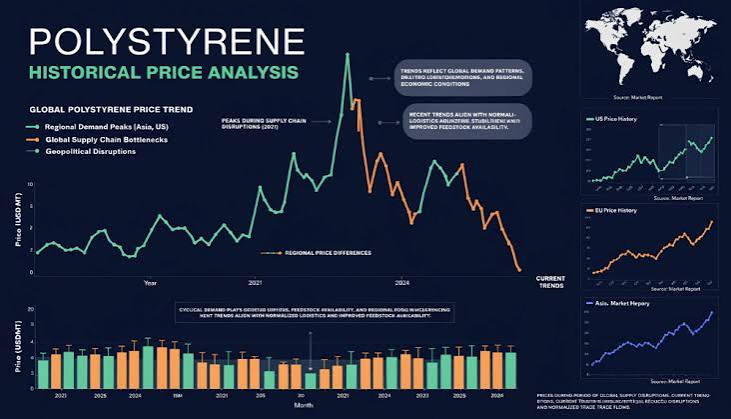
At the same time, broader EPS pricing has not moved uniformly across regions. North American EPS pricing has experienced periods of both upward pressure and subsequent declines during 2026, highlighting the difference between supplier price announcements and actual market pricing.
Why Epsilyte's Increase Matters
A $0.05/lb adjustment may appear relatively small in isolation, but price movements in commodity and semi-commodity polymers can have meaningful consequences for converters and downstream manufacturers.
The increase can influence:
EPS procurement costs
Insulation manufacturing expenses
Protective-packaging costs
Converter margins
Customer contract negotiations
Inventory purchasing decisions
Regional supplier competitiveness
For buyers, the important question is not simply whether a producer announces a price increase.
It is whether the broader market has enough support for that increase to stick.
The Feedstock Connection
EPS is closely connected to the economics of styrene, which is its primary petrochemical feedstock.
When styrene costs rise, EPS producers face immediate pressure on production economics.
That creates a relatively straightforward pricing chain:
Styrene costs ↑ → EPS production costs ↑ → producer margins pressured → price increase attempts ↑
Epsilyte's recent announcement fits this broader cost-pass-through model. The company specifically cited continued increases in raw-material costs when announcing the 2026 adjustment.
Epsilyte's Pricing Action in Context
Epsilyte has used similar pricing actions before.
In 2025, the company announced a $0.06/lb increase across all EPS grades, citing the availability and cost of delivered styrene following force-majeure announcements.
The company's history therefore demonstrates that EPS producers can respond relatively quickly when upstream feedstock economics deteriorate.
The 2026 announcement is consequently less an isolated event and more part of a recurring pattern of feedstock-driven price management.
Broader 2026 EPS Pricing Has Been Mixed
The broader market provides an important counterpoint.
North American EPS prices increased during parts of the first quarter as styrene costs and tighter inventories provided support. Chemanalyst reported a 4.67% quarter-over-quarter increase in the U.S. EPS price index during Q1 2026, with styrene costs identified as a key driver.
However, subsequent market conditions became less supportive.
Business AnalytIQ's July assessment showed North American EPS at approximately $1.79/kg, down 8.7% from the previous month. Europe was also down 13.3%, while several Asian markets experienced similar declines.
This divergence is important.
It suggests that Epsilyte's announced increase should be viewed as a producer cost response rather than proof of a broad, sustained EPS price rally.
Ranking the Pricing Signal
1. Feedstock Cost Pressure — High
The strongest justification for the increase is the relationship between EPS and styrene costs.
When raw-material costs rise, producers need to recover at least part of that increase through selling prices.
2. Producer Margin Protection — High
Price increases can protect margins when feedstock costs rise faster than selling prices.
For EPS producers, maintaining margin discipline is particularly important during periods of volatile petrochemical costs.
3. Market-Wide Pricing Momentum — Moderate
Broader 2026 EPS pricing has been inconsistent.
The market has experienced upward movements followed by declines, meaning producer announcements do not necessarily translate into sustained market-wide increases.
4. Downstream Demand — Moderate
Construction, insulation, packaging and cold-chain applications continue to support EPS consumption, but demand conditions remain uneven across regions.
5. Long-Term Pricing Power — Uncertain
Epsilyte's ability to maintain higher prices will ultimately depend on feedstock costs, competitor behavior, inventories and customer demand.
EPS Versus Other Styrenic Derivatives
EPS is only one part of the broader styrenics value chain.
Related products include:
General-purpose polystyrene
High-impact polystyrene
Expandable polystyrene
Styrene-butadiene products
ABS
SAN
Other styrene-based specialty materials
These products share exposure to upstream styrene economics, but their individual pricing dynamics can differ substantially.
Different end markets, production capacities, inventories and regional trade flows can therefore produce different price outcomes.
GPPS and HIPS Provide Important Comparisons
General-purpose polystyrene and high-impact polystyrene are particularly useful benchmarks.
GPPS is widely used in packaging and consumer applications, while HIPS is important in applications requiring greater impact resistance.
Both remain exposed to styrene costs, but their pricing can also be influenced by:
Consumer demand
Packaging orders
Appliance production
Electronics demand
Inventory levels
Import competition
Therefore, a move in EPS does not automatically mean that every polystyrene derivative will experience the same magnitude of increase.
Diammonium Phosphate (Technical 16-46) - Vietnam
Styrene Pricing Remains the Critical Variable
The styrene market itself has been volatile.
Business AnalytIQ's July 2026 assessment placed North American styrene at approximately $0.87/kg, down 13% from the previous month. Europe was around $1.09/kg, also down 10.7%, while Northeast Asia was around $1.07/kg.
That decline creates an interesting contrast with Epsilyte's price announcement.
If downstream EPS prices rise while styrene prices subsequently fall, producer margins can improve temporarily.
But if competitors resist increases and customers have adequate inventory, price realization can become difficult.
Announced Prices Versus Realized Prices
This distinction is essential for chemical-market intelligence.
A producer can announce a price increase.
That does not necessarily mean the full increase reaches customers.
The final market price depends on:
Negotiating power
Contract structures
Customer inventories
Competitive offers
Import availability
Regional supply
Feedstock costs
Consequently, Epsilyte's $0.05/lb announcement should be treated as a pricing intention and market signal, not necessarily as a $0.05/lb increase in every customer's realized cost.
Regional Differences Matter
The global EPS market is highly regional.
Transportation costs, local styrene availability, production capacity and trade flows can produce significant price differences.
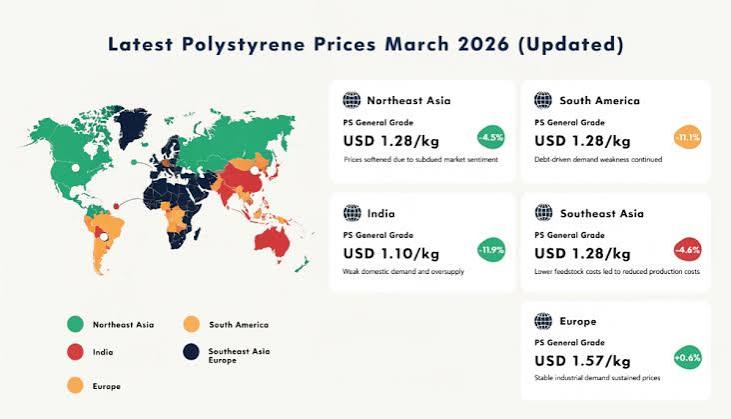
Current market assessments illustrate this clearly, with July 2026 EPS prices varying substantially between North America, Europe and Asian markets.
This means buyers should avoid applying a single global EPS price assumption to procurement planning.
A North American buyer may experience very different economics from a European or Asian customer.
Construction Remains an Important Demand Driver
EPS has a particularly important role in insulation and construction.
Its lightweight structure, thermal insulation properties and relatively low cost make it useful in:
Building insulation
Roofing systems
Foundation insulation
Geofoam
Infrastructure projects
Building-energy-efficiency requirements can therefore support longer-term EPS demand.
Market research indicates that construction and insulation remain important drivers of EPS consumption globally.
Packaging Provides Another Demand Base
EPS is also widely used for protective packaging and temperature-sensitive applications.
Important uses include:
Protective packaging
Foodservice packaging
Cold-chain transportation
Medical packaging
Consumer-product protection
Epsilyte itself markets EPS for insulation, protective packaging, cold chain, foodservice and molded applications.
This diversified end-market exposure can help support demand even when one downstream sector weakens.
Cold Chain Is Particularly Relevant
EPS plays an important role in maintaining temperature-controlled supply chains.
Food, pharmaceuticals and other temperature-sensitive products require insulation throughout transportation and storage.
As cold-chain networks expand, demand for lightweight insulating materials can provide structural support for EPS consumption.
However, this does not eliminate the influence of cyclical construction and industrial demand.
The Sustainability Challenge
EPS producers are also facing growing pressure to improve the environmental profile of their products.
Customers increasingly ask for:
Recycled content
Lower-carbon production
Improved recyclability
Reduced material usage
Circular-economy solutions
Epsilyte's current portfolio includes recycled-content EPS and other sustainability-oriented solutions, demonstrating how the industry is attempting to combine conventional EPS performance with evolving environmental requirements.
This could become an increasingly important competitive differentiator.
Pricing and Sustainability Are Becoming Connected
Sustainable materials can command different economics from conventional grades.
For buyers, the comparison is increasingly becoming:
price + performance + sustainability + supply security
rather than simply price per pound.
That creates additional complexity for EPS procurement teams.
A recycled-content or lower-impact material may cost more initially but provide value through customer requirements, regulatory compliance or sustainability targets.
What Epsilyte's Increase Says About the Market
The most important intelligence signal is that producers continue attempting to pass higher costs through the value chain.
But the broader pricing data suggest the market is not experiencing a simple one-directional increase.
Instead, 2026 has featured:
feedstock volatility + regional supply differences + mixed demand + changing inventories.
That combination makes price realization more difficult than during a straightforward cost-inflation cycle.
Procurement Implications
EPS buyers should therefore evaluate more than the announced increase.
Procurement teams should monitor:
Styrene pricing
Regional EPS assessments
Supplier inventories
Import availability
Freight costs
Construction demand
Packaging demand
Contract pricing mechanisms
A buyer with flexible sourcing can potentially negotiate better outcomes when producer announcements diverge from underlying market prices.
What Buyers Should Ask Suppliers
When an EPS supplier announces an increase, procurement teams can ask:
What portion of the increase is attributable to styrene?
Has the supplier's delivered feedstock cost actually increased?
Is the increase contractually fixed or negotiable?
Are competing suppliers making similar adjustments?
What are current regional market prices?
How much inventory is available?
Are imports competitive with domestic material?
These questions can help separate genuine cost pressure from attempts to rebuild margins.
What Investors Should Watch
For companies exposed to EPS and other styrenics, several indicators are particularly useful.
Feedstock
Styrene and benzene prices remain fundamental.
Margins
The ability to pass feedstock costs through to customers determines profitability.
Volumes
Strong pricing accompanied by falling volumes can indicate demand destruction.
Inventories
High inventories can limit producer pricing power.
Capacity
Plant outages and maintenance can rapidly alter regional supply balances.
End-Market Demand
Construction, packaging and consumer manufacturing remain critical demand indicators.
The Broader Styrenics Outlook
The global EPS market is expected to continue expanding, with market research pointing to continued demand from construction, packaging and insulation. Mordor Intelligence estimates global EPS consumption at approximately 13.23 million tonnes in 2026, with growth projected through 2031.
That provides a constructive long-term demand backdrop.
However, short-term pricing will remain much more dependent on feedstock economics and regional supply-demand balances.
Looking Ahead
Epsilyte's $0.05/lb EPS increase is a useful benchmark for understanding how North American producers are attempting to manage raw-material cost pressure in 2026.
The announcement is particularly interesting because broader EPS pricing has shown significant regional and monthly volatility. North American prices strengthened during parts of Q1, while later assessments showed substantial declines.
That suggests the current market should not be characterized as a straightforward polystyrene price rally.
Instead, the more accurate picture is one of volatile feedstock economics, uneven demand and selective producer attempts to defend margins.
For procurement teams, the key question is whether Epsilyte's increase becomes a broader market trend or remains a supplier-specific response to cost conditions.
For investors and industry analysts, the answer will depend heavily on styrene prices, inventories, capacity utilization and downstream demand during the remainder of 2026.
Key Takeaways
Epsilyte's $0.05/lb EPS price increase provides a useful 2026 pricing benchmark.
The company attributed the increase to continued raw-material cost pressure.
Styrene remains the most important upstream pricing variable for EPS.
U.S. EPS pricing strengthened during parts of Q1 2026 before becoming more volatile later in the year.
July EPS assessments showed significant regional price declines, highlighting the difference between announced increases and realized market pricing.
Construction, insulation, packaging and cold-chain applications provide important structural demand.
GPPS, HIPS and other styrenic derivatives provide useful comparisons but do not necessarily follow identical pricing patterns.
Buyers should monitor feedstock costs, inventories, imports and competing supplier offers before accepting announced increases.
Long-term EPS demand remains supported by construction and packaging applications, while short-term pricing remains highly sensitive to supply and feedstock conditions.
Found this useful?