Why Specialty Beats Base in Shareholder Returns — But Not by Much
Specialty chemicals have long carried a reputation as the more attractive part of the chemical industry for investors.
The logic is straightforward: specialty producers generally sell differentiated products, operate in less commoditized markets, maintain closer customer relationships and have greater control over pricing. Base-chemical producers, by comparison, are more exposed to feedstock costs, capacity cycles and global supply-demand swings.
But the shareholder-return data tells a more interesting story.
McKinsey's long-term analysis found no statistically significant difference between base and specialty chemical companies' total shareholder returns since 2003: base chemicals generated a compound annual TSR of approximately 10.1%, compared with 9.7% for specialty chemicals.
So specialty chemicals do tend to have an investment advantage—but the historical gap is surprisingly small.
The bigger difference is how those returns are generated and how volatile they are.
Why Investors Traditionally Prefer Specialty Chemicals
Specialty chemicals benefit from several structural characteristics.
Products are often differentiated through:
Formulation
Performance
Technical specifications
Intellectual property
Customer qualification
Application expertise
Regulatory approvals
This can give producers greater pricing power than manufacturers selling standardized commodities.
A customer may be reluctant to change a specialty supplier if doing so requires:
Requalification
Reformulation
New testing
Production trials
Regulatory approvals
Changes to manufacturing processes
Those switching costs can protect margins.
Base Chemicals Operate Under a Different Model
Base chemicals are generally much more exposed to market pricing.
A producer may have limited ability to increase prices when competitors have spare capacity.
Instead, profitability depends heavily on:
Feedstock costs
Energy prices
Plant utilization
Global capacity
Demand growth
Freight economics
Regional supply-demand balances
This makes earnings more cyclical.
McKinsey's research found that specialty chemical companies have significantly lower earnings volatility than base-chemical companies, even though their long-term shareholder returns have been remarkably similar.
The Numbers Challenge the Conventional Wisdom
The conventional argument is:
Specialty chemicals = high returns
Base chemicals = low returns
The historical data is more nuanced.
McKinsey's long-term analysis shows:
Segment | Long-term TSR CAGR since 2003 |
|---|---|
Base chemicals | 10.1% |
Specialty chemicals | 9.7% |
Diversified chemicals | 7.3% |
The difference between base and specialty is only around 0.4 percentage points annually.
That is hardly the dramatic divide investors might expect.
So Why Does Specialty Still Feel Better?
The answer is consistency.
Specialty companies typically generate shareholder returns through relatively steady revenue growth and more stable earnings.
Base-chemical companies can generate extraordinary returns during favorable cycles—but those returns can disappear quickly when supply expands or demand weakens.
McKinsey found that base chemicals' strongest performance was concentrated in several specific periods, including 2003–07, 2007–08, 2009–11, 2016–18 and 2020–22. Those periods were associated with major industry or macroeconomic tailwinds.
In other words:
Base can win big. Specialty tends to win steadily.
Commodity Cycles Can Create Huge Shareholder Returns
Base chemicals should not be dismissed.
When supply is tight and producers have a structural cost advantage, commodity businesses can generate enormous cash flows.
Examples include periods characterized by:
Cheap feedstocks
Limited new capacity
Strong industrial demand
Export advantages
Tight inventories
Rising chemical prices
In those circumstances, a base-chemical producer can outperform a specialty company by a wide margin.
Bain has similarly found that the highest-performing commodity chemical companies can outperform average specialty companies substantially over extended periods, reinforcing the idea that business execution matters more than simply being classified as "specialty."
Feedstock Advantage Can Beat Product Differentiation
One of the most important lessons from base chemicals is that cost position can be a competitive advantage just as powerful as product differentiation.
A producer with access to advantaged feedstocks can maintain attractive margins even when its product is highly standardized.
This has historically benefited producers with:
Low-cost natural gas
Ethane-based feedstocks
Integrated refining assets
Low-cost electricity
Strategic geographic locations
The product may be commoditized.
The cost position does not have to be.
Specialty's Advantage Is Pricing Power
Specialty producers have a different advantage.
Their products can sometimes be priced according to the value they create rather than simply the cost of production.
For example, a specialty additive that improves the performance of a customer's finished product may represent only a small portion of the customer's total cost.
That gives the supplier more room to capture value.
Base chemicals generally have less of this flexibility.
ROIC Matters More Than the Label
This is perhaps the most important investment lesson.
McKinsey's analysis of roughly 450 chemical companies found that ROIC and revenue growth were the major drivers of shareholder returns, while specialty-versus-commodity classification itself did not significantly determine shareholder value after accounting for those fundamentals.
That changes the investment question.
Instead of asking:
"Is this company a specialty chemical producer?"
Investors should ask:
"Can this company consistently earn attractive returns on the capital it deploys?"
Capital Intensity Can Change the Equation
A specialty business can have excellent margins and still produce disappointing shareholder returns if it requires too much capital.
This is where capital turnover becomes important.
McKinsey's research on specialty-chemical conglomerates found that median specialty conglomerates generated roughly six percentage points less ROIC than pure-play specialty companies, with the gap reaching about 11 percentage points among top-quartile players.
The lesson is simple:
High margins are not enough.
Companies also need to use capital efficiently.
Biotin
Growth Is the Other Half of the Equation
Investors reward companies that can combine:
High ROIC + Sustainable Growth
A specialty producer operating at a 20% return on invested capital but growing almost nothing may not create as much value as a company earning a slightly lower return while expanding rapidly in attractive markets.
That is why end-market selection matters.
Specialty businesses exposed to attractive growth areas can generate superior returns when they combine pricing power with capital discipline.
Not Every Specialty Chemical Is Truly Specialized
There is another problem.
Some products that were once considered specialty chemicals eventually become commodities.
This can happen when:
Competitors develop similar technology
Patents expire
Manufacturing processes spread
Chinese capacity expands
Customers become more price-sensitive
Product differentiation declines
McKinsey has previously warned that increasing commoditization can erode the advantages traditionally associated with specialty chemicals.
So investors should not automatically assign a premium valuation simply because a company uses the word "specialty."
China's Expansion Makes This More Important
China's chemical capacity expansion is accelerating commoditization across numerous value chains.
When large-scale new capacity enters a market, prices can increasingly become determined by:
Production cost + freight
rather than by the differentiated value of the product.
That can push previously attractive specialty businesses toward commodity economics.
This is one reason investors need to examine the durability of a company's competitive advantage rather than relying on sector labels.
Base Chemicals Face the Opposite Risk
Base chemicals have less product differentiation but can benefit enormously from temporary market scarcity.
The problem is that scarcity attracts investment.
High margins encourage:
New capacity → greater supply → lower prices → weaker margins
That cycle is the defining characteristic of commodity chemicals.
It explains why base-chemical earnings can swing dramatically from one year to another.
The Current Environment Is Particularly Difficult for Base Chemicals
The current global chemical market is dealing with substantial capacity additions.
Deloitte's 2026 chemical outlook highlights growing global overcapacity in basic chemicals, including additional ethylene and polyethylene capacity in the United States and Qatar and continued polypropylene expansion in China. Europe and parts of Asia face additional cost disadvantages and lower utilization.
This environment makes cost position especially important for base-chemical investors.
Specialty Companies Are Not Immune
Specialty producers face their own challenges.
They must continually defend differentiation.
That requires:
R&D
New products
Customer intimacy
Application development
Technical service
Regulatory expertise
If innovation slows, competitors can eventually narrow the gap.
A specialty company therefore has to earn its premium repeatedly.
Focused Companies Can Have an Advantage
Portfolio structure also matters.
Research from Charles River Associates found that focused chemical companies significantly outperformed diversified chemical companies over the 2007–15 period, with roughly a 350-basis-point annual TSR advantage.
This suggests that specialization itself can be valuable—but the benefit may come from focus and execution, not merely from selling specialty chemicals.
Diversification Is Not Automatically Bad
A diversified chemical company can still create excellent shareholder value.
The strongest diversified companies tend to:
Exit weak businesses
Invest in attractive markets
Improve ROIC
Allocate capital aggressively
Build scale where it matters
Reduce exposure to structurally declining businesses
The problem is not diversification itself.
The problem is owning too many mediocre businesses at once.
What Shareholders Actually Want
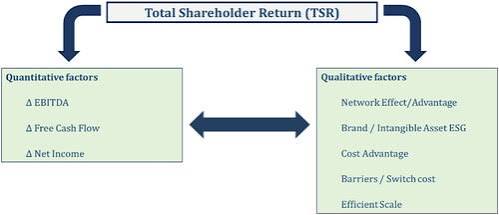
From an investor's perspective, the formula is increasingly clear.
Shareholders want companies that can deliver:
1. Attractive ROIC
Capital must generate good returns.
2. Sustainable Growth
Revenue and earnings need room to expand.
3. Cash Conversion
Accounting profits need to become actual cash.
4. Capital Discipline
Management must avoid destroying value through excessive investment.
5. Resilient Competitive Advantages
Margins need to survive competition.
Specialty chemicals can provide several of these characteristics.
But a well-run base-chemical company can provide them too.
Why the Difference Is "Not by Much"
The historical numbers make the central point difficult to ignore.
Base chemicals have actually produced slightly higher long-term TSR than specialties in McKinsey's dataset.
But the difference is small.
The real distinction is volatility.
Base chemicals can generate spectacular returns during favorable cycles.
Specialty companies tend to generate more consistent returns because their earnings are less directly tied to global supply-demand swings.
So the investment trade-off looks more like:
Base chemicals → higher cyclicality, potentially powerful upside
Specialty chemicals → greater consistency, generally lower earnings volatility
That is a much more useful framework than simply calling one segment "better."
What This Means for Chemical M&A
The difference also helps explain current portfolio strategies.
Chemical companies are increasingly evaluating whether capital should remain tied up in commodity assets or be redirected toward businesses with:
Higher margins
Stronger customer relationships
Better growth
Lower capital intensity
More predictable cash flows
Deloitte expects companies to continue rationalizing commodity assets and prioritizing higher-cash-flow specialty businesses in 2026.
This does not mean every commodity asset should be sold.
A low-cost commodity producer can be extremely valuable.
The key is whether the asset has a structural cost advantage.
The Best Base Chemicals Can Still Win
Investors should therefore be careful about writing off commodity chemicals.
A base-chemical company can outperform when it has:
Low-cost feedstocks
High plant utilization
Strong operational execution
Favorable geography
Integrated production
Conservative capital allocation
Disciplined capacity expansion
In those conditions, a supposedly "boring" commodity producer can create enormous shareholder value.
The Best Specialty Companies Can Win Even More Consistently
Specialty producers have a different playbook.
The strongest companies typically combine:
Differentiated products
Strong customer relationships
High switching costs
Pricing power
Attractive end markets
Recurring demand
High ROIC
Capital-light growth
That combination can make earnings less dependent on the chemical cycle.
The Investor's Real Question
The right question is therefore not:
"Specialty or base?"
It is:
"Where is the durable economic advantage?"
For a base producer, that advantage may be feedstock and scale.
For a specialty producer, it may be technology and customer qualification.
For another company, it may simply be superior capital allocation.
The sector label is secondary.
Looking Ahead
The specialty-versus-base debate is likely to become even more interesting as the chemical industry deals with global overcapacity, weak demand and regional cost differences.
Specialty chemicals retain important advantages because differentiated products can support pricing power and more stable earnings. But the historical shareholder-return data shows that the specialty premium is not nearly as large as conventional wisdom suggests.
McKinsey's latest long-term analysis puts the difference at roughly 10.1% TSR CAGR for base chemicals versus 9.7% for specialties since 2003.
The bigger advantage of specialties is their lower earnings volatility and greater potential for consistent value creation.
For base chemicals, the opportunity remains significant—but investors need to identify companies with genuinely advantaged cost positions rather than simply betting on a commodity cycle.
The ultimate lesson is:
Specialty chemicals may offer the better business model, but superior shareholder returns come from superior economics—not from the word "specialty" on the label.
Key Takeaways
Specialty chemicals have an important structural advantage in pricing power and earnings stability.
Long-term TSR data shows the gap with base chemicals is surprisingly small: 9.7% versus 10.1% CAGR since 2003 in McKinsey's analysis.
Base chemicals can outperform dramatically during favorable supply-demand cycles.
Specialty businesses generally experience lower earnings volatility.
ROIC and revenue growth matter more to shareholder value than simply being classified as specialty or commodity.
Capital efficiency is particularly important for specialty-chemical companies.
Specialty businesses can eventually become commoditized as technology spreads and new capacity enters the market.
Low-cost feedstocks, scale and operational excellence can make base chemicals highly attractive investments.
Focused portfolios can outperform diversified chemical companies when capital is allocated effectively.
The strongest chemical investments combine durable competitive advantages, attractive ROIC, sustainable growth and disciplined capital allocation.
Found this useful?