Carbon Capture Chemicals: Solvents and Materials Used in CO₂ Separation
Carbon Capture Chemicals: Solvents and Materials Used in CO₂ Separation
Carbon capture is becoming an important area of development for industries seeking to reduce carbon dioxide (CO₂) emissions from manufacturing and energy production. Power plants, cement facilities, steel mills, refineries and chemical processing units generate significant CO₂ emissions, making effective separation technologies an important part of industrial decarbonisation strategies.
The performance of carbon capture systems depends heavily on the chemicals and materials used to separate CO₂ from other gases. Solvents, solid sorbents, membranes and specialised adsorbents each offer different approaches to capturing carbon dioxide from industrial gas streams.
Among these technologies, amine-based solvents remain an established option for post-combustion carbon capture. However, research is expanding into advanced solvent blends, ionic liquids, metal-organic frameworks (MOFs), zeolites, solid amine materials and other alternatives designed to improve capture efficiency and reduce energy consumption.
For chemical manufacturers and industrial suppliers, this creates opportunities in solvent production, adsorbent development, speciality materials, process chemicals and carbon capture system components.
Understanding Carbon Capture Chemicals
Carbon capture chemicals are substances and materials used to selectively separate carbon dioxide from gas mixtures. They interact with CO₂ through chemical reactions, physical absorption, adsorption or selective transport.
The main categories include:
Chemical absorption solvents: Liquids such as amines and alkaline solutions that react with or absorb CO₂.
Physical solvents: Liquids that dissolve CO₂ under suitable pressure and temperature conditions.
Solid sorbents: Porous materials that capture CO₂ on their surfaces or within their structures.
Membrane materials: Selective materials that allow CO₂ to pass through more readily than other gases.
Catalytic and enzyme-based materials: Systems that accelerate chemical reactions involving CO₂, including its conversion into bicarbonate.
The choice of material depends on the CO₂ concentration, gas pressure, temperature, moisture content, contaminants and required capture rate.
Major Solvents Used in CO₂ Separation
1. Amine-Based Solvents
Amine-based solvents are among the most established chemical systems for post-combustion carbon capture. They contain nitrogen-based functional groups that react with CO₂ to form chemical species such as carbamates and bicarbonates.
Commonly used and researched amines include:
Monoethanolamine (MEA): A widely used reference solvent for post-combustion capture because of its fast reaction with CO₂.
Diethanolamine (DEA): Used in gas treatment and selected CO₂ removal processes.
Methyldiethanolamine (MDEA): A tertiary amine used in natural gas treatment and other gas-sweetening applications.
Piperazine (PZ): Used as a solvent or activator in blended amine systems to improve absorption performance.
2-Amino-2-methyl-1-propanol (AMP): A sterically hindered amine investigated in blended solvents for improved CO₂ loading and regeneration characteristics.
Industrial applications
Amine-based systems are used or considered for:
Flue gas treatment in power generation.
CO₂ removal from cement and steel plant emissions.
Natural gas sweetening.
Hydrogen production and gas processing.
Carbon capture at chemical manufacturing facilities.
Advantages and limitations
Amine solvents offer established operating experience and effective CO₂ absorption. However, conventional aqueous amines can require considerable energy for regeneration. They may also experience oxidative and thermal degradation, corrosion and solvent losses during long-term operation.
Manufacturers are therefore developing improved blends and formulations designed to increase CO₂ capacity, improve stability and reduce regeneration energy.
2. Blended Amine Solvents
Blended amine solvents combine different amines to balance absorption speed, CO₂ loading, solvent stability and regeneration requirements.
For example, piperazine can be combined with other amines to improve reaction kinetics, while tertiary amines can contribute favourable absorption and regeneration characteristics.
One researched formulation is CESAR1, which combines 2-amino-2-methyl-1-propanol (AMP) and piperazine. It has been evaluated in industrially relevant capture testing.
Blended systems are important because no single amine offers the ideal combination of absorption rate, capacity, viscosity, stability and energy demand under all operating conditions.
3. Inorganic Alkaline Solvents
Alkaline solutions capture CO₂ through reactions that produce bicarbonate or carbonate compounds.
Common chemicals include:
Sodium hydroxide (NaOH).
Potassium hydroxide (KOH).
Calcium hydroxide [Ca(OH)₂].
These chemicals are relevant to different carbon capture configurations, including certain direct air capture and industrial gas-treatment systems.
Applications
Alkaline solutions can be used in processes where CO₂ reacts with a basic liquid to form carbonate or bicarbonate salts. Calcium-based systems can also be integrated into calcium looping processes, in which calcium oxide captures CO₂ to form calcium carbonate.
Key considerations
Alkaline capture systems can offer strong chemical reactivity, but they require management of corrosive materials and appropriate regeneration processes. Calcium looping, for example, involves high-temperature calcination to release captured CO₂ and regenerate calcium oxide.
4. Physical Solvents
Physical solvents absorb CO₂ through dissolution rather than relying primarily on chemical reactions. Their performance is influenced by gas pressure, temperature and CO₂ partial pressure.
Examples include:
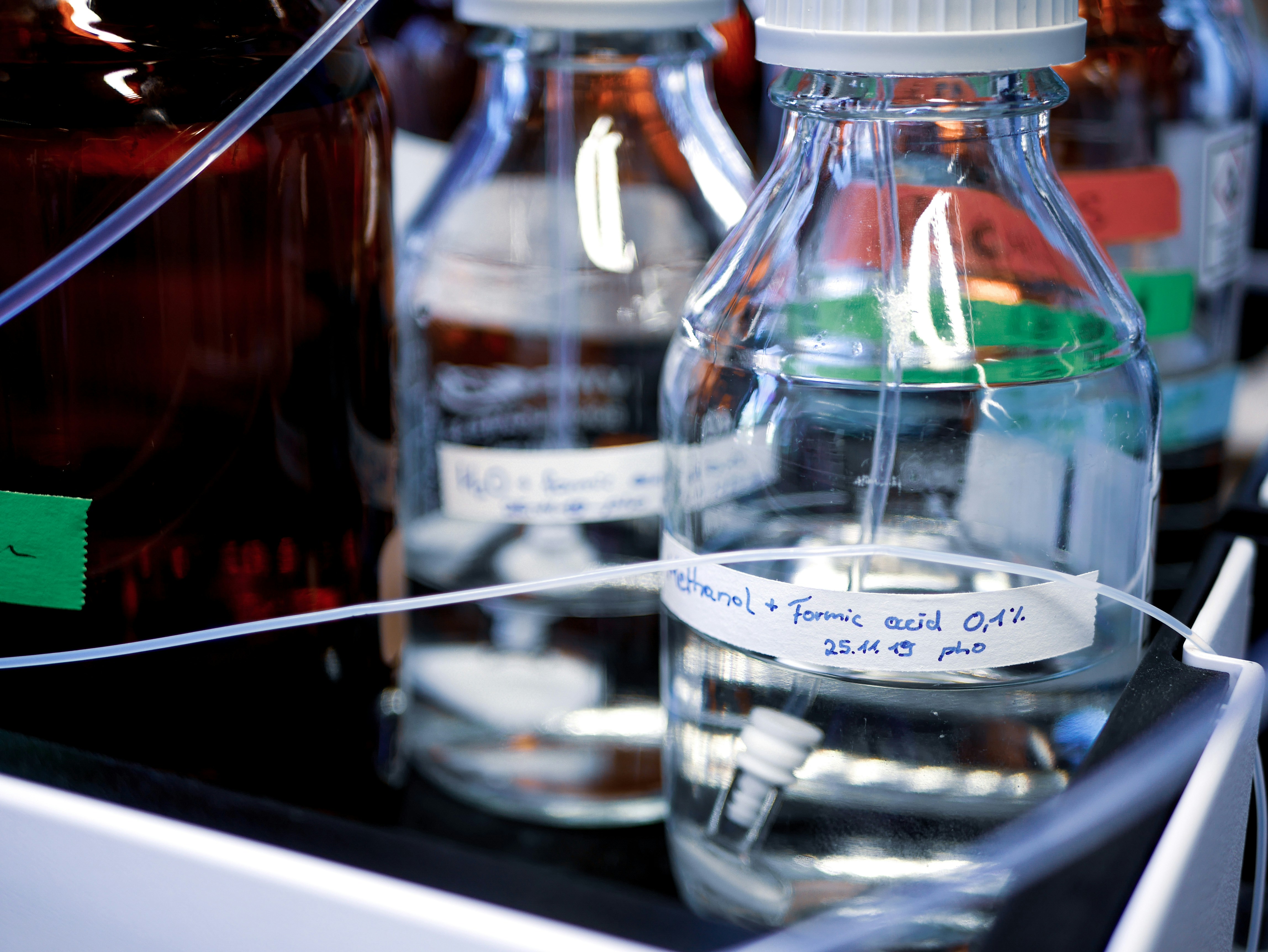
Methanol.
Dimethyl ethers of polyethylene glycol (DEPG).
Other specialised solvent formulations used in industrial gas treatment.
Commercial physical-solvent processes include Rectisol, which uses cold methanol, and Selexol, which uses a polyethylene glycol dimethyl ether-based solvent.
Industrial applications
Physical solvents are particularly relevant to high-pressure gas streams, including:
Hydrogen and synthesis gas production.
Natural gas processing.
Pre-combustion carbon capture.
Industrial gas purification.
Their effectiveness generally increases under conditions where CO₂ partial pressure is sufficiently high. This makes them less suitable for some low-pressure, dilute flue gas applications.
5. Ionic Liquids and Deep Eutectic Solvents
Ionic liquids are salts that remain liquid at relatively low temperatures. Their chemical structures can be modified to adjust properties such as CO₂ affinity, viscosity and thermal stability.
Both systems are being investigated as alternative CO₂ capture media.
Potential advantages include:
Low vapour pressure.
Tunable chemical properties.
Potential for selective CO₂ absorption.
Opportunities to integrate capture with chemical conversion.
However, viscosity, regeneration energy, material cost, stability and large-scale production remain important challenges.
Solid Materials Used for CO₂ Capture
In addition to liquid solvents, solid sorbents and porous materials are being developed for carbon capture. These materials capture CO₂ on their surfaces or within pores through physical adsorption or chemical interactions.
1. Zeolites
Zeolites are crystalline aluminosilicate materials with highly ordered porous structures. Their pore size and surface properties can be adjusted to support selective gas adsorption.
They are used in industrial separation processes and are being investigated for CO₂ capture applications.
Potential applications
CO₂ separation from gas mixtures.
Natural gas purification.
Biogas upgrading.
Gas drying and purification.
Selected post-combustion capture configurations.
Limitations
Water vapour can compete with CO₂ for adsorption sites in many zeolites, reducing their effectiveness in humid gas streams. Their suitability therefore depends on gas composition and operating conditions.
2. Activated Carbon
Activated carbon is a porous carbon-based material with a large internal surface area. It can be manufactured from different carbon-rich feedstocks and modified to improve its adsorption properties.
It is investigated for CO₂ separation from gas mixtures and can be tailored through physical or chemical activation.
Applications include gas purification, industrial adsorption systems and research into post-combustion carbon capture.
Its performance depends on pore structure, surface chemistry, temperature, pressure and the presence of moisture or other gases.
3. Metal-Organic Frameworks (MOFs)
Metal-organic frameworks are porous crystalline materials made from metal-containing nodes connected by organic linkers. Their structures can be engineered to create specific pore sizes and surface chemistries.
MOFs are attracting research interest because of their high surface areas and tunable adsorption properties.
Potential applications include:
Selective CO₂ adsorption.
Direct air capture research.
Gas separation.
Industrial flue gas treatment.
Hybrid membrane and adsorbent systems.
Despite their potential, MOFs can face challenges related to manufacturing cost, moisture stability, mechanical strength and large-scale shaping. Research is therefore exploring structured MOFs and coated adsorbents that are more suitable for industrial equipment.
4. Amine-Functionalised Solid Sorbents
These materials combine porous supports with amine-containing compounds. Common supports include silica, activated carbon and other porous materials.
The amine groups chemically interact with CO₂, while the solid support provides a surface for distributing the active material.
Potential advantages include:
High CO₂ affinity.
Reduced solvent handling requirements.
Opportunities for lower-volatility capture systems.
Application in post-combustion capture and direct air capture research.
However, amine loss, oxidative degradation, moisture effects and regeneration requirements must be managed.
5. Covalent Organic Frameworks (COFs) and Porous Organic Polymers
COFs are porous materials constructed from organic building blocks connected through covalent bonds. Porous organic polymers are another group of materials designed to provide internal surface area and adjustable chemical functionality.
They are being investigated for selective CO₂ adsorption and other gas-separation applications.
Their potential advantages include structural flexibility, adjustable pore chemistry and opportunities for functionalisation. However, cost, production scale, stability and practical operating performance remain important areas of development.
Membrane Materials for CO₂ Separation
Membrane separation uses selective materials to separate CO₂ from other gases based on differences in permeability and diffusion.
Unlike solvent absorption and solid adsorption, membrane systems do not generally require a separate liquid or solid material to capture and then release CO₂ through a conventional regeneration cycle.
Major membrane categories include:
Polymeric membranes: Made from polymer materials that selectively transport CO₂. They are used in certain gas separation applications and continue to be developed for industrial capture.
Inorganic membranes: Manufactured from materials such as ceramics and other inorganic compounds. They can offer thermal and chemical resistance in suitable applications.
Mixed-matrix membranes: Combine polymers with porous fillers such as MOFs or zeolites to improve separation properties.
Membrane systems can offer compact equipment and continuous operation. However, their performance depends on CO₂ selectivity, permeability, pressure differences, membrane durability and resistance to contaminants.
How Carbon Capture Chemicals Work in Industrial Processes
Carbon capture systems generally involve three major stages: absorption or adsorption, separation and regeneration.
1. CO₂ Absorption or Adsorption
Industrial gas containing CO₂ enters a capture unit. Depending on the technology, the gas contacts a liquid solvent, passes through a solid sorbent bed or moves across a selective membrane.
In amine-based systems, CO₂ reacts with the solvent and becomes chemically bound in the liquid phase.
In solid adsorption systems, CO₂ attaches to active sites on the material's surface or within its pores.
2. Separation of Captured CO₂
The CO₂-rich solvent or sorbent is separated from the remaining gas stream.
In a typical absorption process, treated gas leaves the absorber while the CO₂-rich solvent moves to a regeneration unit.
For solid sorbents, the material is separated from the gas and transferred to a regeneration stage, depending on the equipment configuration.
3. Regeneration and CO₂ Recovery
Captured CO₂ must be released so that the solvent or sorbent can be reused.
Amine systems commonly use heat to release CO₂ in a desorber or stripper. Solid sorbents may be regenerated through temperature or pressure changes, vacuum, or other process configurations.
The recovered CO₂ is then dried, compressed and transported for utilisation or geological storage, depending on the project.
Industrial Applications of Carbon Capture Chemicals
1. Cement Manufacturing
Cement production generates CO₂ from both fuel combustion and the chemical conversion of limestone into clinker. This makes carbon capture an important technology option for reducing emissions from cement plants.
Amine-based solvents and other post-combustion capture systems can separate CO₂ from kiln exhaust gases.
Potential supplier opportunities include amine formulations, corrosion inhibitors, solvent treatment chemicals, adsorbents and gas-cleaning materials.
2. Steel Production
Steel manufacturing generates CO₂ through different production routes, particularly processes that use carbon-based reducing agents.
Carbon capture technologies can be integrated into selected steelmaking and downstream gas-treatment systems.
Solvents, adsorbents and gas-separation materials may support the removal of CO₂ from industrial gas streams, depending on the plant configuration.
3. Power Generation
Coal- and gas-fired power plants release CO₂ through fuel combustion. Post-combustion capture systems can be installed to separate CO₂ from flue gases.
Amine-based solvents remain an important technology option for this application, while solid sorbents and membrane systems are also being developed.
The selection of capture chemicals depends on flue gas composition, CO₂ concentration, oxygen content, moisture and contaminants such as sulphur oxides and nitrogen oxides.
4. Hydrogen and Natural Gas Processing
Hydrogen production and natural gas processing can involve gas streams containing CO₂ that must be removed to meet product specifications or prepare the gas for further processing.
Physical solvents, chemical solvents and membrane systems are used or considered depending on pressure, gas composition and separation requirements.
Carbon capture chemicals therefore have established relevance in gas purification and hydrogen-related industrial processes.
5. Chemical and Petrochemical Manufacturing
Chemical and petrochemical plants can generate concentrated or dilute CO₂ streams from different production operations.
Capture systems may be integrated into hydrogen production, ammonia manufacturing, refinery operations and other industrial processes.
This creates opportunities for suppliers of solvents, adsorbents, process additives and specialised separation materials.
6. Direct Air Capture
Direct air capture (DAC) removes CO₂ directly from ambient air, where its concentration is much lower than in industrial exhaust gases.
DAC systems commonly investigate liquid alkaline solutions or solid amine-based sorbents.
Because atmospheric CO₂ is highly dilute, capture materials must have strong affinity and effective regeneration characteristics. Energy consumption, material durability, water requirements and operating costs remain major challenges.
Global Market Developments and Research Trends
The carbon capture materials market is developing as industries seek more efficient ways to separate CO₂ from industrial emissions and atmospheric air.
A 2026 review published in the Journal of Materials Chemistry A examined a broad range of reactive CO₂ capture systems, including conventional amines, redox-active liquids, inorganic bases, porous materials, amine-functionalised nanoparticles and enzyme-based systems. It highlighted the trade-offs between absorption capacity, reaction speed, viscosity, stability and regeneration energy.
A March 2026 review in Water Science & Technology examined solvent-based capture technologies and emerging systems such as ionic liquids, blended amines and phase-change solvents. It identified solvent degradation and energy requirements as important barriers to wider deployment.
In June 2026, research published in Green Chemistry reported the development of crosslinked solid amine materials for direct air capture. The research explored ways to address issues associated with volatile and supported amines, including leaching and oxidative degradation.
The UK government's May 2026 report on monolithic metal-organic frameworks also highlighted efforts to develop structured MOF materials for carbon capture. The project examined the potential of monolithic and MOF-coated adsorbents as alternatives to conventional powdered materials, which can face cost and structural-stability challenges.
Research published in July 2026 also investigated switchable serinol-based amine solvents designed to combine high CO₂ capacity with low viscosity. Such developments illustrate the continuing effort to improve solvent performance and reduce the energy required for regeneration.
These developments suggest that the future of carbon capture chemicals will involve both improvements to established amine systems and the development of alternative materials for specific industrial conditions.
Key Performance Requirements for Carbon Capture Chemicals
The suitability of a solvent or capture material depends on more than its ability to absorb CO₂. Industrial operators must consider performance across the complete capture and regeneration cycle.
Important requirements include:
CO₂ absorption or adsorption capacity: The amount of CO₂ that can be captured under specified operating conditions.
Selectivity: The ability to capture CO₂ in the presence of nitrogen, oxygen, water vapour and other gases.
Regeneration energy: The energy required to release captured CO₂ and restore the solvent or material.
Chemical stability: Resistance to degradation during repeated capture and regeneration cycles.
Corrosion behaviour: Compatibility with process equipment, piping and storage systems.
Viscosity and mass transfer: Important properties affecting solvent circulation, gas-liquid contact and pumping requirements.
Moisture tolerance: The ability to operate effectively in gas streams containing water vapour.
Contaminant resistance: Tolerance to impurities such as sulphur oxides, nitrogen oxides and particulates.
Material lifetime: The ability to maintain performance over extended industrial operation.
A material with high laboratory-scale CO₂ capacity may not necessarily be the most suitable industrial option if it requires excessive regeneration energy or loses performance after repeated cycles.
Challenges in Carbon Capture Chemical Manufacturing
1. High Regeneration Energy
Many carbon capture systems require energy to release the captured CO₂ and restore the solvent or sorbent.
For conventional aqueous amine systems, heating the CO₂-rich solvent can represent a significant energy requirement. Reducing this demand is a major objective of solvent research and process optimisation.
2. Solvent Degradation and Corrosion
Amine solvents can degrade through thermal and oxidative reactions, particularly when exposed to oxygen and impurities in industrial gas streams.
Degradation can reduce solvent performance and create additional operating and maintenance requirements. Corrosion inhibitors, solvent monitoring and appropriate gas pretreatment may be necessary.
3. Material Stability and Durability
Solid sorbents and advanced porous materials must maintain their structure and capture performance over repeated operating cycles.
Moisture, high temperatures, contaminants and mechanical stress can reduce performance. Manufacturers must therefore evaluate material lifetime under realistic industrial conditions.
4. Production Costs and Availability
Specialised solvents, MOFs, membranes and functionalised sorbents may require advanced manufacturing processes and expensive raw materials.
Commercial expansion will depend on developing scalable production methods and improving the cost of materials without compromising capture performance.
5. Industrial Process Integration
Carbon capture equipment must operate alongside existing production systems. Differences in gas composition, temperature, pressure and operating schedules can make integration challenging.
Material suppliers and technology developers must work closely with industrial operators to ensure that capture chemicals are compatible with the plant's operating conditions.
6. Environmental and Chemical Management
Capture chemicals must be managed throughout their operational life. This includes safe handling, storage, solvent replacement, degradation-product management and waste treatment.
A complete environmental assessment should consider the production of capture materials, energy consumption, solvent losses, emissions and disposal requirements.
Opportunities for Chemical Manufacturers and Industrial Suppliers
The growth of carbon capture projects creates opportunities across several chemical and materials supply chains.
Speciality solvent production: Manufacturers can develop amine blends, advanced solvents, corrosion inhibitors and solvent-treatment products for industrial capture systems.
Adsorbent manufacturing: Suppliers can produce activated carbon, zeolites, functionalised silica and other porous materials for CO₂ separation.
Advanced materials development: MOFs, COFs, mixed-matrix membranes and structured sorbents offer opportunities for companies with expertise in speciality materials and materials engineering.
Process chemicals: Carbon capture plants require chemicals for water treatment, corrosion control, gas cleaning and equipment maintenance.
Testing and technical services: Suppliers can support projects through solvent analysis, material characterisation, performance testing and quality documentation.
Recycling and solvent recovery: Recovery and reuse of capture chemicals can help reduce operating costs and support more efficient plant operation.
For manufacturers, success will depend on delivering reliable materials that meet the operating requirements of specific capture technologies rather than offering a single universal solution.
Sources:
https://pubs.rsc.org/en/content/articlehtml/2026/ta/d5ta10129h?
Activated Carbon (Powder) - China
Found this useful?