
Chemical Inventory Management: Reducing Costs and Preventing Stockouts
Chemical inventory management directly affects the operating costs, production schedules and supply reliability of chemical businesses. Holding excessive stock ties up working capital and increases warehousing expenses, while insufficient inventory can interrupt manufacturing and delay customer deliveries.
For chemical manufacturers, distributors, importers and industrial buyers, maintaining the right inventory balance requires accurate demand forecasting, supplier coordination and regular stock monitoring. Businesses must also consider chemical shelf life, storage compatibility and safety requirements when deciding how much material to purchase and retain.
An effective chemical inventory management system helps procurement teams identify available stock, schedule replenishment and prevent unnecessary purchasing. It also reduces the risk of expired products, unexpected shortages and avoidable storage costs.
Understanding Chemical Inventory Management
Chemical inventory management involves planning, recording, monitoring and controlling the chemicals a business purchases, stores and uses. It ensures that the right products remain available in suitable quantities without creating excessive inventory or unnecessary procurement expenses.
Unlike ordinary warehouse stock, chemicals require additional attention because their properties can influence storage conditions, handling procedures and usable shelf life. Some products require temperature-controlled storage, while others need segregation from incompatible materials.
A complete chemical inventory record should include:
Product name and identification: Record the chemical name, grade, product code and relevant identification details.
Available quantity: Maintain accurate records of stock received, consumed, dispatched and remaining.
Supplier information: Document manufacturer details, supplier contacts and purchasing references.
Product specifications: Record purity, concentration, grade and other important technical characteristics.
Storage location: Identify the warehouse, storage zone and specific location assigned to each product.
Expiry and batch details: Track manufacturing dates, batch numbers and expiry dates where applicable.
Safety documentation: Maintain accessible Safety Data Sheets (SDS) and relevant handling information.
These records help purchasing teams understand existing stock before placing new orders. They also support warehouse inspections, product traceability and regulatory reporting where applicable.
How Poor Inventory Management Increases Business Costs
Inventory problems often develop gradually. Businesses may purchase additional quantities to secure better prices, maintain large safety stocks or respond to uncertain supplier delivery schedules.
However, purchasing more chemicals does not always improve supply reliability. Excessive stock can create additional financial and operational burdens, particularly when products require specialised storage or have limited shelf lives.
Several factors contribute to unnecessary inventory costs.
1. Excessive purchasing
Buying more chemicals than production or customer demand requires increases the amount of working capital tied up in stock. Businesses also pay for additional storage, insurance, handling and inventory administration.
2. Expired and deteriorated products
Chemicals may lose suitability for their intended applications when they exceed their shelf life or experience unsuitable storage conditions. Expired or damaged inventory can create disposal costs and financial losses.
3. Warehouse space utilisation
Excessive stock occupies valuable warehouse capacity. This can limit space for faster-moving products and increase the need for additional storage facilities.
4. Repeated handling expenses
Moving, inspecting and rearranging unnecessary inventory increases warehouse workload. Additional handling can also increase the possibility of packaging damage or accidental spills.
5. Unnecessary emergency procurement
Poor inventory visibility can cause businesses to overlook available stock and place duplicate orders. When shortages eventually occur, procurement teams may need to arrange expensive urgent deliveries.
Effective inventory planning helps businesses control these costs while maintaining sufficient materials for operational requirements.
Demand Forecasting: Maintaining the Right Stock Levels
Demand forecasting helps chemical businesses estimate future purchasing requirements using historical consumption, production schedules and expected customer orders.
Without reliable forecasting, companies may purchase chemicals based on assumptions rather than actual requirements. This creates a risk of both overstocking and stockouts.
Procurement teams should consider several factors when forecasting chemical demand:
Historical consumption: Review previous purchasing and usage records to identify regular consumption patterns.
Production schedules: Coordinate inventory requirements with manufacturing plans and expected production volumes.
Customer demand: Consider confirmed orders, recurring contracts and changes in customer purchasing behaviour.
Seasonal requirements: Identify periods when certain industrial sectors typically increase their chemical consumption.
Supplier lead times: Account for the time required to manufacture, prepare and deliver replacement stock.
Market conditions: Monitor raw material availability, trade disruptions and other developments that could influence purchasing decisions.
Forecasts should also distinguish between regular demand and exceptional requirements. A temporary increase in purchasing should not automatically become the basis for permanent inventory expansion.
Businesses should review forecasts regularly and update procurement plans when customer orders or production requirements change.
Setting Minimum, Maximum and Reorder Stock Levels
Minimum and maximum stock levels help procurement teams maintain a controlled inventory position. These limits provide a practical framework for deciding when to purchase additional chemicals and how much stock to retain.
The minimum stock level represents the quantity below which inventory should not normally fall. The maximum stock level establishes an upper limit that helps prevent unnecessary purchasing and excessive storage.
A reorder point indicates when procurement should initiate a replenishment order. Businesses can calculate it using average demand during supplier lead time and an appropriate safety stock allowance.
A basic formula is:
Reorder Point = Average Daily Consumption × Supplier Lead Time + Safety Stock
For example, assume a manufacturer consumes 100 kg of a chemical daily. Its supplier requires 10 days to deliver replacement stock, and the business maintains 300 kg as safety stock.
The reorder point would be:
Daily consumption: 100 kg
Supplier lead time: 10 days
Safety stock: 300 kg
Reorder point: 1,300 kg
When available inventory approaches 1,300 kg, the procurement team should initiate replenishment.
Businesses should adjust these calculations according to actual consumption, delivery reliability and storage limitations. For chemicals with specialised handling requirements, safety considerations should also influence stock limits.
Inventory Classification: Prioritising Important Chemical Products
Not every chemical requires the same level of inventory monitoring. Some materials support continuous manufacturing operations, while others experience occasional demand or have multiple available suppliers.
Inventory classification helps businesses allocate management attention according to product value, consumption and operational importance.
One useful approach is ABC analysis, which groups inventory according to its annual consumption value.
Category A: High-value chemicals that require close purchasing controls, accurate stock records and frequent monitoring.
Category B: Medium-value products that require regular reviews and balanced replenishment planning.
Category C: Lower-value products that generally require simpler monitoring and economical purchasing arrangements.
However, purchasing value alone does not determine operational importance. A relatively inexpensive chemical can become a critical production input if no suitable substitute exists.
Businesses should therefore consider additional factors such as:
Production dependency and availability of alternatives.
Supplier concentration and replenishment lead times.
Product shelf life and storage requirements.
Safety risks and regulatory obligations.
Historical consumption and demand variability.
Combining ABC analysis with operational criticality allows procurement teams to identify which products deserve the closest attention.
Preventing Chemical Stockouts Through Better Replenishment Planning
Stockouts occur when a business cannot supply or use a required chemical because available inventory has fallen below operational demand. They can interrupt manufacturing, delay customer orders and increase procurement costs.
Preventing stockouts requires coordination between procurement, warehouse operations, production teams and suppliers.
Several practical measures can improve replenishment performance.
Maintain safety stock: Keep an appropriate reserve for chemicals with unpredictable demand or longer delivery times. Calculate reserve quantities according to actual business requirements rather than applying the same percentage to every product.
Monitor supplier lead times: Review how long suppliers actually take to deliver orders. If delivery periods become longer or less predictable, update reorder points accordingly.
Establish alternative suppliers: Identify additional qualified manufacturers or distributors for important chemicals. Multiple sourcing options can reduce dependence on a single supply channel.
Review open purchase orders: Track pending orders and expected delivery dates to identify possible delays before available inventory becomes insufficient.
Coordinate procurement with production: Share consumption forecasts and manufacturing schedules so purchasing teams can arrange replenishment before shortages develop.
Monitor fast-moving products: Give additional attention to chemicals with high consumption rates and frequent purchasing requirements.
A dependable replenishment system should also account for minimum order quantities, transportation schedules and supplier production capacity.
Digital Inventory Systems and Real-Time Stock Monitoring
Manual inventory records can become difficult to maintain when businesses manage hundreds of chemical products across multiple warehouses and distribution locations. Spreadsheet-based systems may also create inconsistencies when different departments update records independently.
Digital inventory management systems provide a more organised approach to tracking product movements and monitoring available stock.
These systems can support several important functions:
Barcode scanning: Employees can record incoming and outgoing products by scanning their identification codes.
Automatic stock updates: Inventory quantities change when authorised users record receipts, consumption or dispatches.
Reorder notifications: Systems can alert procurement teams when stock reaches predefined replenishment levels.
Batch tracking: Businesses can identify product batches and maintain records of their movement through the warehouse.
Expiry monitoring: Automated notifications help warehouse teams identify products approaching their expiry dates.
Inventory reporting: Management can review stock levels, consumption patterns and purchasing performance.
Enterprise Resource Planning (ERP) systems can also connect inventory records with procurement, sales, finance and production operations.
For distributors handling multiple chemical categories, centralised inventory visibility can improve communication between warehouses and purchasing departments.
However, digital systems only provide reliable results when employees enter accurate information and regularly reconcile recorded quantities with physical stock.
Chemical Storage, Stock Rotation and Product Quality
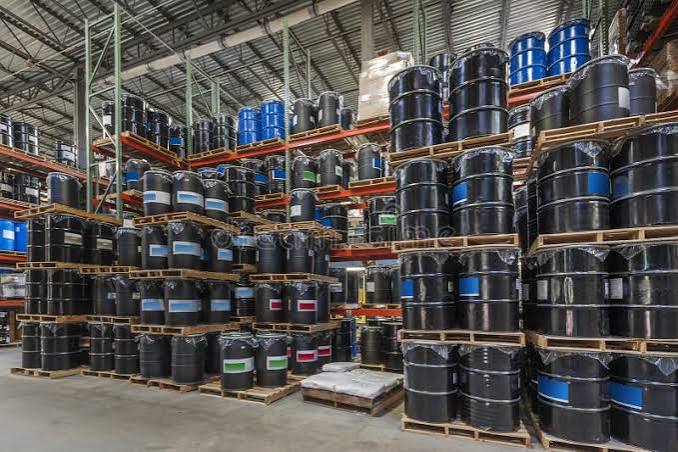
Inventory management must protect chemical quality throughout storage. A product may appear available in the warehouse records but still become unsuitable for use if its packaging deteriorates or storage conditions change.
Businesses should organise warehouse operations according to the characteristics of individual chemicals.
Important storage practices include:
Chemical compatibility: Separate incompatible substances according to their hazards and applicable storage requirements.
Temperature control: Maintain the storage temperatures specified by the product manufacturer and relevant safety documentation.
Packaging inspections: Check containers for leaks, corrosion, damaged closures and other signs of deterioration.
Clear identification: Ensure product names, batch numbers and hazard information remain readable.
Secondary containment: Use appropriate containment arrangements for chemicals that could leak or spill.
Regular inspections: Review storage conditions and identify products requiring corrective action.
Stock rotation also plays an important role in preventing losses. Businesses commonly use First-In, First-Out (FIFO), which prioritises older inventory for use or dispatch.
For chemicals with expiry dates, First-Expired, First-Out (FEFO) can provide better control because it prioritises the product with the earliest expiry date, regardless of its arrival date.
The Government of Canada recommends maintaining current chemical inventories, purchasing according to actual requirements and monitoring stored materials to reduce over-aged stock and waste.
Managing Inventory Across Suppliers and Multiple Warehouses
Chemical distributors and international traders often purchase products from different manufacturers and maintain stock across several storage locations. Without coordinated inventory records, businesses may struggle to identify where products are available and whether they can meet customer delivery requirements.
Centralised inventory management can improve coordination by providing purchasing and warehouse teams with a shared view of stock.
For example, if one distribution centre has excess inventory while another location faces a shortage, the business may be able to transfer suitable stock instead of placing another purchase order.
Effective multi-location inventory management should include:
Centralised product records: Use consistent product names, identification codes and specifications across all warehouses.
Location-based stock visibility: Record quantities separately for each storage facility.
Supplier performance reviews: Compare delivery reliability, product quality and commercial terms.
Stock transfer planning: Evaluate internal transfers before purchasing additional quantities.
Purchase order tracking: Monitor outstanding orders and expected delivery dates.
Inventory reconciliation: Compare physical quantities with system records at regular intervals.
These practices can reduce duplicate purchasing and improve the use of existing warehouse capacity.
Regulatory Compliance and Chemical Inventory Records
Chemical inventory management also supports workplace safety and regulatory compliance. Businesses must understand the requirements that apply to the chemicals they manufacture, import, store, distribute or use.
Accurate inventory records help organisations identify hazardous substances, maintain product documentation and provide relevant information during inspections or emergency situations.
The US Environmental Protection Agency (EPA), under the Emergency Planning and Community Right-to-Know Act (EPCRA), requires covered facilities to maintain relevant hazardous chemical information and submit inventory reports when applicable reporting thresholds are met.
Chemical businesses should focus on the following practices:
Maintain updated chemical inventories with product names, quantities and storage locations.
Keep applicable Safety Data Sheets accessible to employees.
Record chemical classifications and relevant hazard information.
Monitor storage quantities against applicable regulatory limits.
Maintain purchasing, receiving and dispatch documentation.
Review chemical storage arrangements and update records when products move between locations.
Requirements differ between countries and product categories. Importers, exporters and distributors should therefore review the applicable regulations in their operating markets.
Key Performance Indicators for Better Inventory Control
Businesses need measurable indicators to understand whether their inventory strategies are delivering results. Regular performance reviews can identify unnecessary stock accumulation, purchasing inefficiencies and potential supply shortages.
Important inventory performance indicators include:
Inventory turnover: Measures how frequently a business sells or uses its average inventory during a given period. Higher turnover can indicate efficient stock utilisation, although excessively high turnover may increase stockout risks.
Stockout frequency: Measures how often required products become unavailable. Frequent stockouts may indicate inaccurate forecasting or inadequate replenishment planning.
Inventory carrying costs: Measures expenses associated with holding stock, including warehousing, insurance, handling and capital costs.
Order fulfilment rate: Evaluates how effectively a business fulfils customer orders using available inventory.
Inventory accuracy: Compares recorded quantities with actual physical stock to identify discrepancies.
Supplier lead time: Measures the time between placing a purchase order and receiving the products.
Procurement teams should review these indicators regularly and use the findings to adjust purchasing strategies.
What Procurement Teams Should Do to Improve Chemical Inventory Management
Reducing inventory costs while preventing stockouts requires a coordinated approach rather than simply purchasing fewer chemicals. Businesses must understand product consumption, supplier reliability, storage limitations and changing customer requirements.
Procurement managers should begin by reviewing existing inventory records and identifying products that remain unused, experience frequent shortages or create excessive storage expenses.
A practical improvement strategy should include:
Review historical consumption and establish realistic demand forecasts.
Set suitable minimum, maximum and reorder stock levels.
Classify chemicals according to purchasing value and operational importance.
Establish supplier alternatives for critical materials.
Introduce digital stock tracking and automated replenishment alerts.
Apply appropriate FIFO or FEFO stock rotation procedures.
Conduct regular physical inventory checks and warehouse inspections.
Monitor inventory performance and adjust purchasing plans.
Chemical inventory management is an ongoing business process. Companies that combine accurate records, disciplined procurement and reliable supplier relationships can reduce unnecessary expenditure while maintaining product availability.
For chemical traders and industrial buyers, the objective is to maintain enough inventory to support business operations without tying up excessive capital in stored materials. Better inventory visibility and proactive replenishment planning can strengthen supply chain reliability and improve long-term procurement performance.

Sodium Tripolyphosphate
Found this useful?