Ph.Eur 11 Updates and Supplier Qualification Urgency | ChemicalsBlog.com
Price Trends
schedule3 Min Read
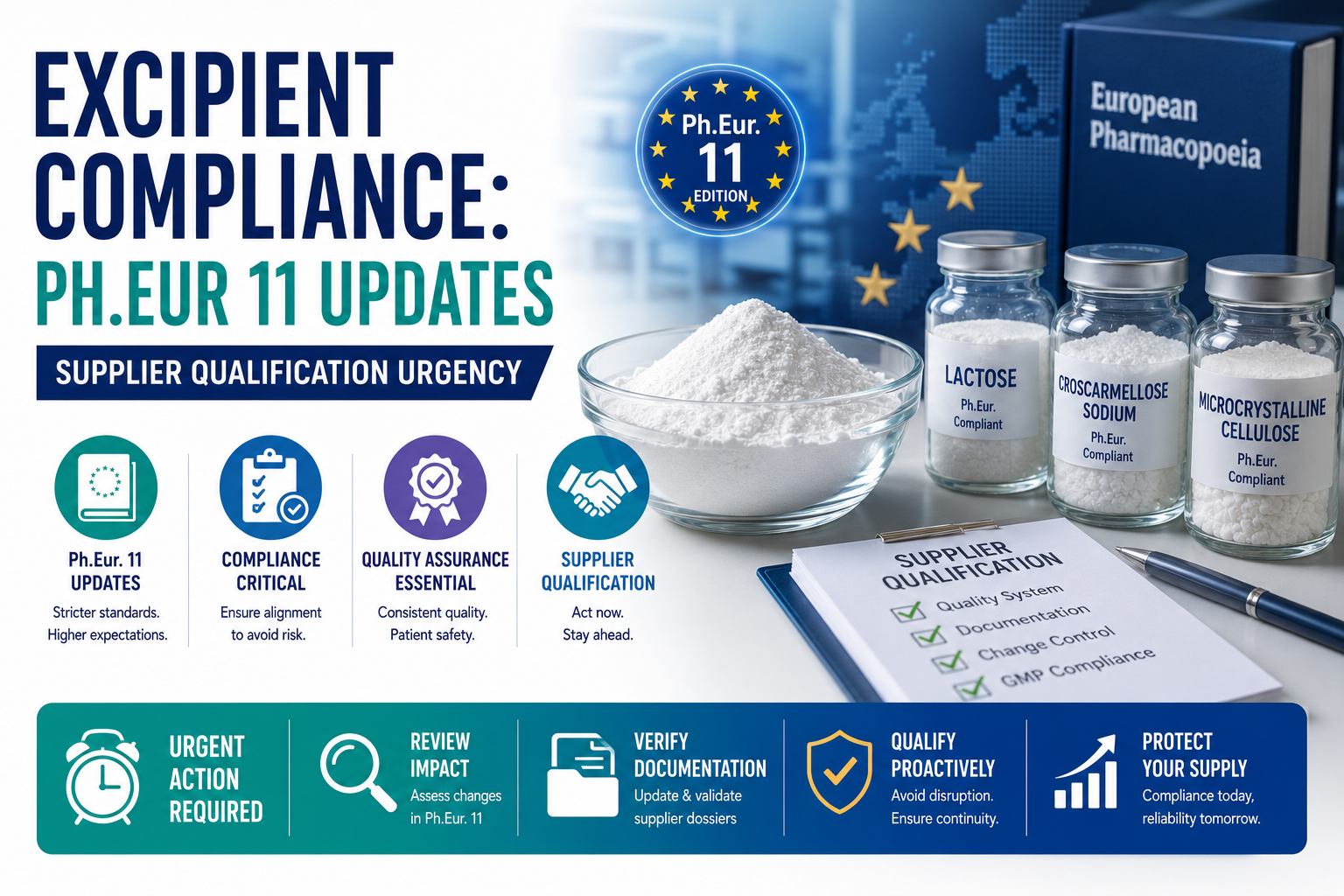
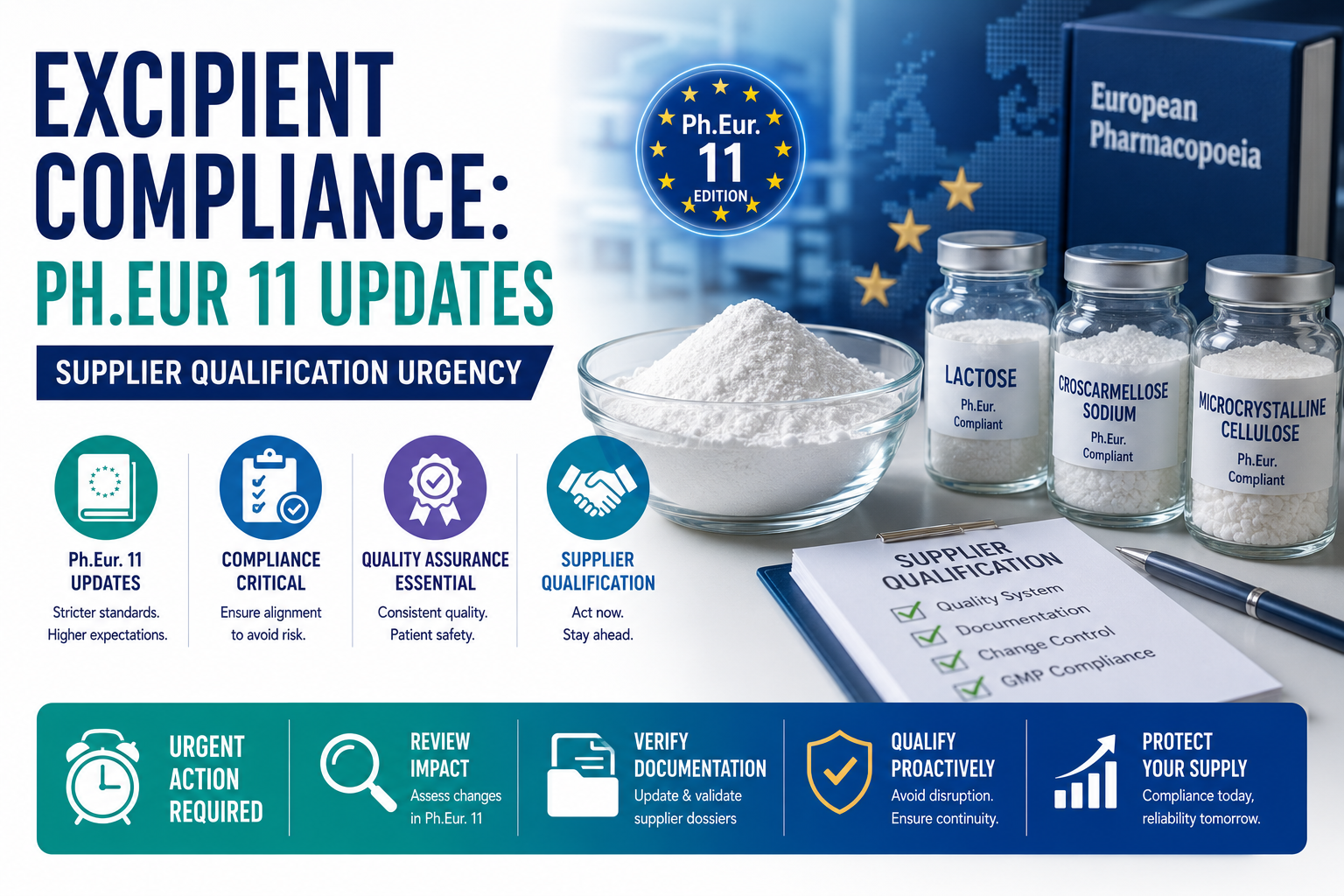
Excipient Compliance: Ph.Eur 11 Updates and Supplier Qualification Urgency
terminal
prodchem
Jun 24, 2026
Excipient Compliance: Ph.Eur 11 Updates and Supplier Qualification Urgency
Regulatory changes rarely disrupt pharmaceutical supply chains overnight — but ignoring them can create serious compliance problems long before companies realize the risk.
In 2026, pharmaceutical manufacturers supplying European markets are facing an important compliance transition with the implementation of the European Pharmacopoeia (Ph.Eur) 11th Edition. The updated framework introduces revised specifications across several pharmaceutical excipients, including stricter standards for heavy metal limits, impurity profiles, and updated identity testing requirements.
For procurement teams, the issue is not simply understanding the regulation itself. The immediate challenge is determining whether existing excipient suppliers are actually prepared for the new compliance standard.
Why Procurement Teams Must Requalify Excipient Suppliers Immediately
The most important change introduced under Ph.Eur 11 is the requirement for suppliers to demonstrate updated compliance through revised analytical documentation and updated Certificates of Analysis (CoA) aligned with the new specification framework.
For pharmaceutical manufacturers exporting into European markets, relying on suppliers who have not updated testing procedures creates direct regulatory risk.
Several widely used excipients are affected by the specification changes, including:
Mannitol
HPMC (Hydroxypropyl Methylcellulose)
Microcrystalline Cellulose (MCC)
Sodium Stearate
Certain pharmaceutical preservatives and formulation stabilizers
The challenge is that not every supplier moves at the same speed when regulatory standards change.
Some excipient manufacturers have already updated internal analytical procedures, revised impurity testing protocols, and adjusted documentation systems to reflect Ph.Eur 11 requirements.
Others may still be operating under legacy testing frameworks or issuing Certificates of Analysis formatted around previous standards.
For pharmaceutical manufacturers, this creates a hidden compliance vulnerability.
A supplier delivering technically acceptable material may still create regulatory exposure if supporting documentation no longer matches updated European Pharmacopoeia requirements.
This makes supplier verification an immediate procurement priority.
Procurement and quality teams should begin issuing supplier compliance surveys this week, specifically requesting formal confirmation of Ph.Eur 11 alignment and updated documentation capability.
Key verification points should include:
Updated Certificates of Analysis reflecting Ph.Eur 11 specifications
Revised heavy metal testing limits where applicable
Updated impurity profile testing procedures
New identity test compliance for affected excipients
Laboratory method validation confirming analytical procedure updates
Regulatory documentation readiness for EU market submissions
Suppliers unable to provide updated compliance confirmation should immediately be flagged for risk review.
This does not automatically mean the supplier relationship ends.
But it does mean urgent qualification of alternative suppliers should begin before compliance issues affect production schedules, regulatory submissions, or product release timelines.
The biggest risk is assuming suppliers have already updated compliance systems simply because product quality has historically been consistent.
Regulatory compliance is not static.
And in pharmaceutical manufacturing, documentation gaps can become operational disruptions just as quickly as raw material shortages.
For procurement teams, Ph.Eur 11 is not a future compliance project.
It is an immediate supplier qualification issue.
The manufacturers acting early will reduce regulatory risk, while those waiting for formal compliance problems may find supplier transitions far more expensive later.
In pharmaceutical supply chains, regulatory preparation is often the difference between uninterrupted production and preventable disruption.
Looking for pharmaceutical excipient sourcing intelligence or supplier qualification support? Ph.Eur 11 compliance verification should now be a top procurement priority for manufacturers supplying EU-regulated markets.