Top 5 Chemical Intelligence Tools That Proved Their Value During the Hormuz Crisis | ChemicalsBlog.com
Price Trends
schedulenull Min Read
Top 5 Chemical Intelligence Tools That Proved Their Value During the Hormuz Crisis
terminal
prodchem
Jul 1, 2026
Top 5 Chemical Intelligence Tools That Proved Their Value During the Hormuz Crisis
The 2026 Hormuz crisis exposed a weakness that many chemical procurement teams had quietly ignored for years. Traditional procurement systems were built for stable markets, predictable shipping routes, and normal supplier communication cycles. When the Strait of Hormuz entered prolonged disruption and one of the world’s most critical chemical trade corridors became commercially unstable, conventional procurement workflows failed almost immediately. Supplier emails stopped reflecting physical reality, shipping timelines became unreliable, freight quotations changed faster than contract teams could react, and public headlines often contradicted what vessels were actually doing on the water. The companies that navigated the crisis most effectively were not necessarily the companies with the strongest supplier relationships. They were the companies with access to better market intelligence tools capable of separating operational truth from market noise.
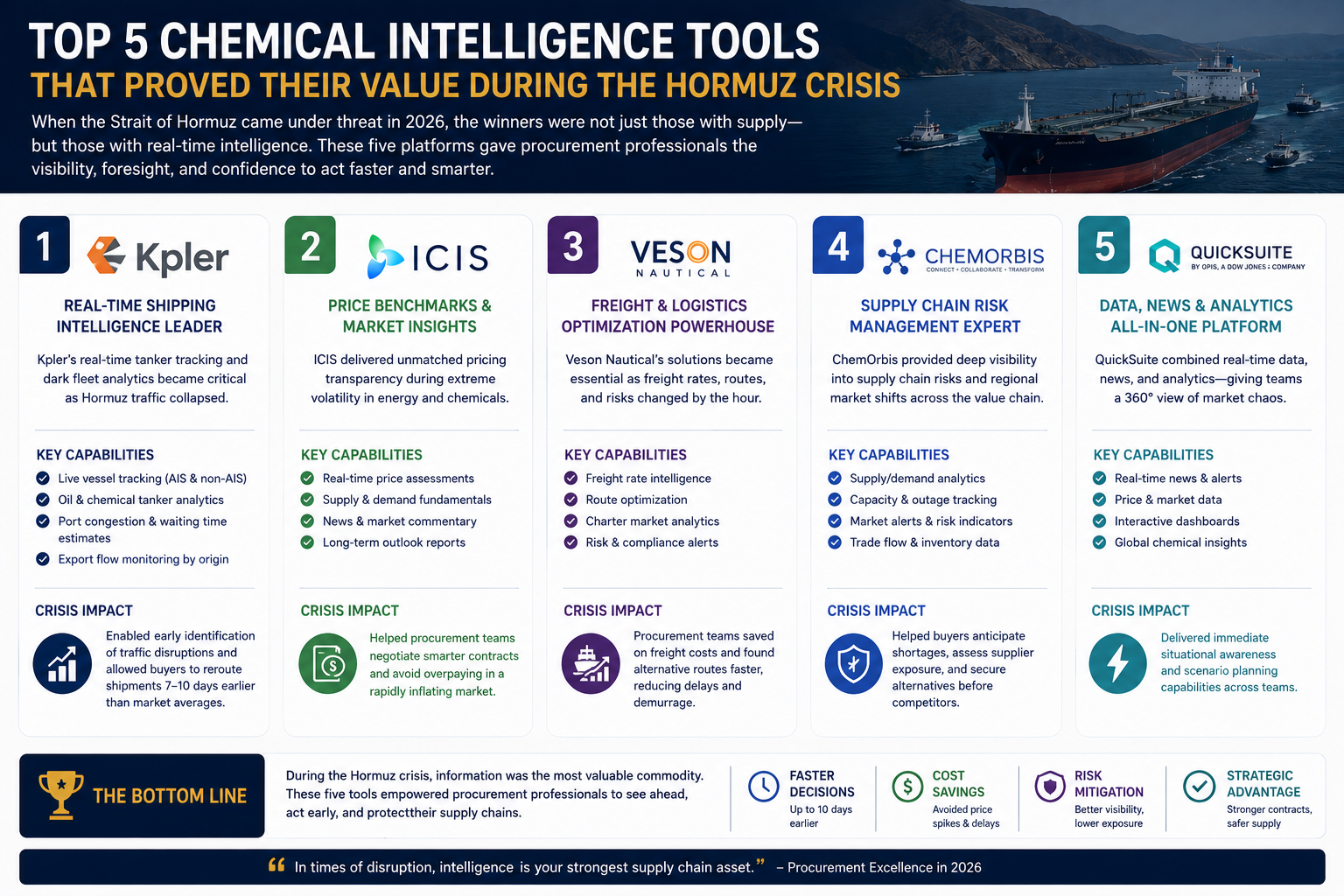
Over four months of disruption, five intelligence platforms consistently proved their value because they delivered real-time visibility when conventional procurement information channels became unreliable. **Straits.live emerged as one of the most important operational tools because its live AIS tracking data updated every five minutes, allowing procurement teams to distinguish between media claims that Hormuz was “closed” and actual vessel movement data showing whether ships were physically crossing. **ICIS remained the most trusted commodity pricing service during the crisis because it continued publishing price assessments across chemical categories while openly acknowledging when pricing reflected abnormal crisis conditions rather than standard market fundamentals. **Xeneta became the most reliable freight intelligence platform because it consistently identified early carrier bunker adjustment factor movements and lane-specific freight changes before suppliers formally updated contract pricing. These three tools alone allowed procurement teams to make faster pricing and logistics decisions than competitors relying on delayed supplier communication.
Why Procurement Teams Need Intelligence Systems Instead of Traditional Supplier Monitoring
As the crisis evolved, deeper cargo visibility became equally important. **Kpler proved exceptionally valuable because it allowed procurement professionals to monitor named cargo vessels directly, showing exactly which chemical tankers carrying DAP, MAP, methanol, or petrochemical cargo were moving normally and which vessels remained stranded due to Gulf disruption. This shifted procurement conversations away from supplier estimates and toward independently verified shipment intelligence. Equally important was **IMF PortWatch, a port-level shipping intelligence platform developed with international economic institutions that provided country-specific disruption visibility by tracking congestion, vessel activity, and import slowdowns at individual ports around the world. Together these tools created something procurement teams previously lacked: independent operational intelligence capable of validating supplier claims during periods of extreme market uncertainty.
The biggest lesson from the Hormuz crisis is that procurement itself has fundamentally changed. Chemical buyers can no longer rely exclusively on supplier communication, quarterly pricing reports, or internal ERP systems when global supply chains enter unstable conditions. Modern procurement increasingly requires continuous intelligence monitoring across commodity pricing, vessel movement, freight rate analytics, port congestion, and geopolitical disruption indicators simultaneously. What made these five tools so valuable in 2026 was not simply better data quality but speed. They allowed procurement professionals to identify market shifts before competitors, challenge inaccurate supplier assumptions with independently verified intelligence, and make sourcing decisions grounded in physical market reality rather than optimistic commercial messaging. The Hormuz crisis proved that in volatile global chemical markets, the strongest procurement teams are no longer the best negotiators alone. They are the teams operating with better intelligence systems than everyone else.
Looking for chemical procurement intelligence or supply chain strategy insights? The biggest lesson of 2026 may be simple: in crisis-driven chemical markets, data visibility has become just as valuable as supplier access itself.