Urea Price Direction: Does Brent Below $80 and Hormuz Record Transit Signal Further Correction?
terminal
prodchem
Jun 29, 2026
Urea Price Direction: Does Brent Below $80 and Hormuz Record Transit Signal Further Correction?
The fertilizer market rarely gives buyers a second chance after a major price correction — and urea may be approaching that moment right now.
After months of extreme volatility, urea prices have fallen sharply from the April 2026 peak of nearly $700 per tonne to around $453 per tonne in New Orleans by mid-June, marking one of the fastest corrections seen this year. The earlier price spike was driven largely by the Hormuz crisis, which trapped Gulf fertilizer exports and triggered widespread supply panic across global agricultural markets.
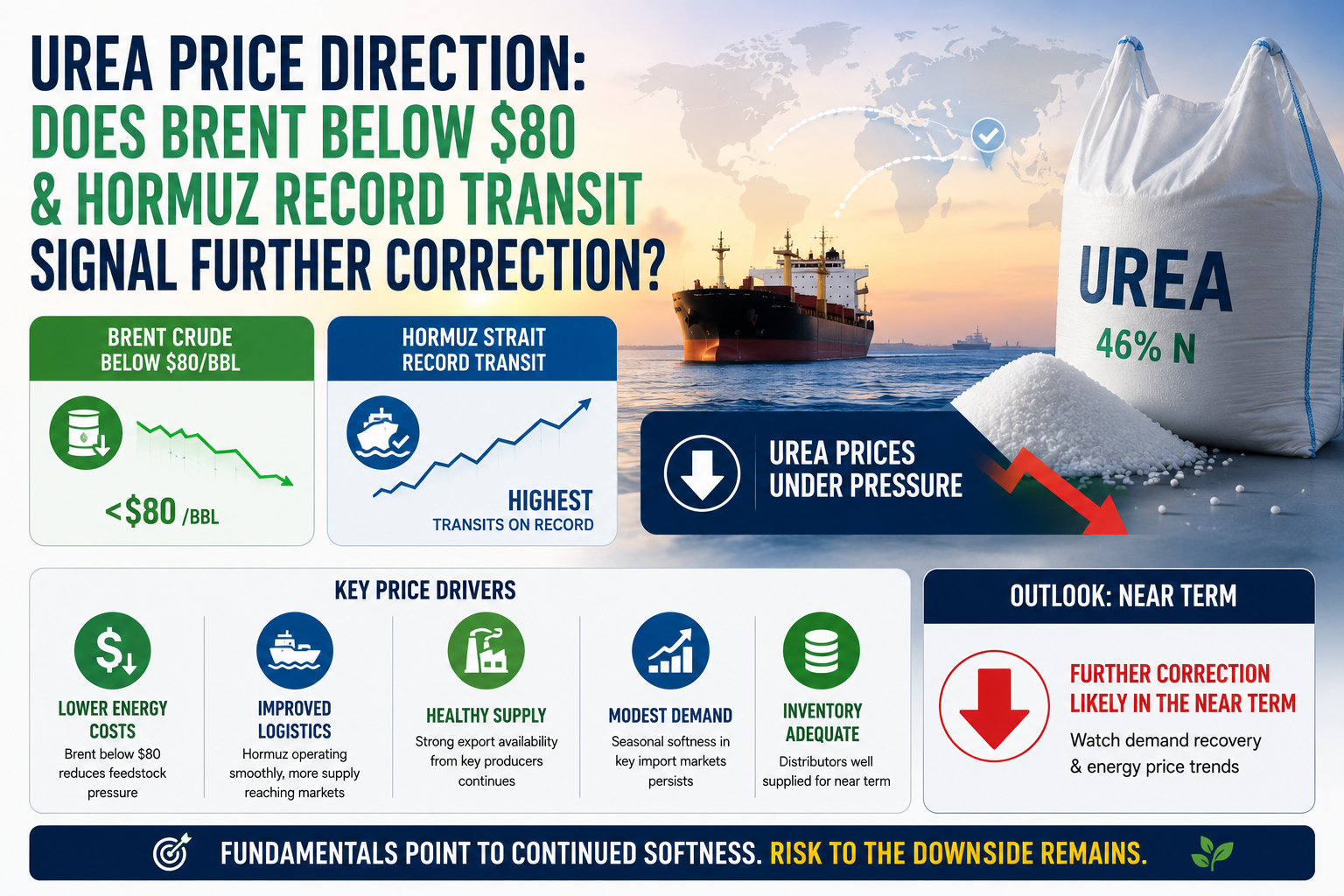
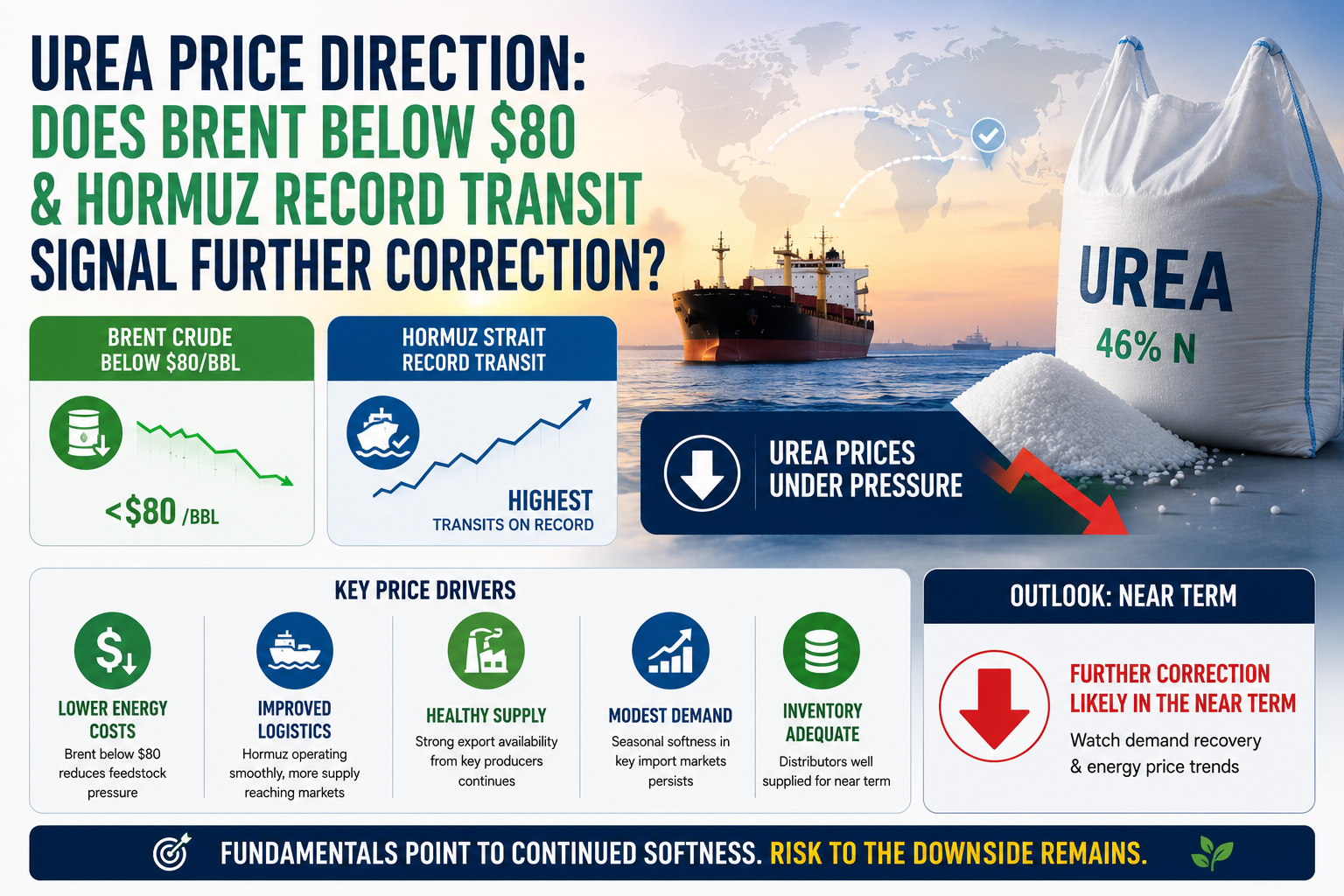
Now the market is entering a new phase. With Brent crude trading below $80 per barrel and record vessel transit through Hormuz on June 21 signaling improving supply recovery, buyers are beginning to ask whether prices still have room to fall further in Q3 — or whether most of the correction has already happened.
Why Today’s Urea Market May Offer the Best Buying Window Before Q3 Stabilisation
Two major forces are currently pushing the market toward further downside.
The first is energy pricing.
Lower Brent crude directly improves production economics for Gulf and US urea producers, particularly because urea production remains closely tied to natural gas and energy-linked feedstock costs. As energy prices fall, production costs ease, allowing producers to operate under lower cost pressure and reducing the upward pricing pressure seen earlier in the year.
The second factor is improving logistics confidence.
The record June 21 vessel transit through Hormuz is one of the clearest signs yet that shipping confidence is gradually returning after months of disruption. As Gulf fertilizer exports slowly begin normalizing, more supply should re-enter global markets, helping relieve some of the supply tightness that triggered the earlier price spike.
On paper, this suggests further correction remains possible.
But futures markets are telling buyers not to become overly optimistic.
Current CBOT urea futures for July 2026 are trading around $555 per tonne, while September contracts remain near $550 per tonne — both substantially above the $359 spot low recorded on June 18.
This gap matters.
If futures markets believed urea prices were heading significantly lower, forward contracts would be much closer to current spot levels. Instead, futures pricing suggests traders expect some supply recovery following the Bürgenstock diplomatic outcome, but not enough to push prices into prolonged weakness.
In other words, the market expects stabilization more than collapse.
Several indicators now deserve close monitoring:
Brent crude below $80 reducing production cost pressure
Hormuz shipping recovery improving Gulf fertilizer export confidence
Urea prices correcting from $700 per tonne to $453 per tonne
CBOT July futures holding near $555 despite recent spot weakness
September futures remaining elevated near $550
Market pricing partial supply recovery rather than full normalization
For agricultural procurement teams, this creates a difficult timing decision.
Urea ExportsUrea MarketUrea Prices 2026Urea Market Outlook
Found this useful?
Share With Friends
A 36% price correction has already occurred, meaning buyers have already captured much of the downside move from April’s crisis-driven pricing.
Yes, further modest correction remains possible as Gulf supply conditions continue improving.
But waiting for significantly cheaper prices may carry more risk than reward.
If supply normalizes faster than expected or buyers begin rebuilding fertilizer inventories ahead of upcoming planting cycles, current pricing could prove to be one of the strongest procurement windows of the quarter.
This is why the current $453 per tonne spot market stands out.
The market may soften slightly further.
But the biggest correction phase has likely already passed.
For fertilizer buyers, the challenge now is avoiding the common mistake markets punish most severely: waiting too long for the perfect price while the opportunity quietly disappears.
Sometimes the best buying window is not the absolute bottom.
It is the moment before the market realizes recovery has already begun.
Looking for fertilizer procurement intelligence or urea market pricing strategy? Q3 buying decisions will depend heavily on whether current supply recovery turns today’s correction into the market rebound buyers least expect.